
November 2001
Vigorous dialogue on faith and psychology
BC Christian News, · Counselling Supplement
• Eric L. Johnson & Stanton L. Jones, eds.: Psychology and Christianity: Four Views, IVP, 2000.
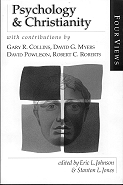
HOW PAINFUL it is to face the reality that truth is much bigger than my limited and out-of-focus picture of it!
Addressing the controversial issue of how psychology and Christian faith relate to one another, Johnson and Jones draw us into a vigorous dialogue -- one that is wisely embedded in historical context. Their book will help to expand and sharpen our respective pictures of this aspect of truth.
The core of the book comprises a conversation among four competent Christian educators with unique views on how Christian faith and psychology are related.
All are committed to the authority of scripture; however, they differ considerably in the value they place on the findings of mainstream psychology. As the book unfolds, each contributor presents his unique perspective, and the other three offer reactions and comments. Because each person 'speaks' a total of four times, the book has the satisfying feel of a lively interaction. This format effectively illuminates the strengths and weaknesses of all four positions.
Preceding and following their conversations are two chapters by the editors. In the first, historical background to the conflicts between psychology and Christian faith is examined. Johnson and Jones make two very significant points. First, they remind us that Christian thinkers such as Augustine and Thomas Aquinas freely incorporated extra-biblical insights into their Christian understanding of life and people. Secondly, they suggest that in no sense is the care of souls (psychology literally means "soul-ology") a new venture for Christians; it has been part of the church's work for centuries.
Why, then, has a warfare model often dominated the relationship between psychology and Christian faith? The answer seems to lie in modern psychology's relatively recent appearance. By the time it was emerging just over a century ago as an independent discipline, the secularization of North American society and the privatization of Christian faith were well underway. The messages in God's two 'scrolls' -- scripture and nature -- were therefore regarded as separate, and potentially conflicting. We now need to pursue ways in which the domains of psychology and Christian thinking can once again inform one another constructively.
Johnson and Jones conclude with an appeal to recognize value in each of the four perspectives offered, and to see Christ as Lord of all. While the reader is left to ponder the question of which view is most appropriate, the implication is that completely rejecting any of the views would be a mistake. "No human perspective can capture all the truth," they conclude. "The truth is too big and our minds are too small."
This book will not satisfy everyone. It gives no clear answer as to what the correct view is, and leaves us with little hope that such an answer even exists. No, this book is not about giving answers. It is about pondering long and carefully on challenging but important questions, and recognizing that Christians exploring the intersection of faith and psychology end up seeing this junction in quite different ways.
But if this book brings us even a grain of truth, and truth has its origin in an infinite God, should we be surprised that it can't be neatly packaged?
Harold W. Faw is professor of psychology at Trinity Western University.