
December 2001
Anti-Christian violence averted at Dalit rally
BC Christian News, · International
In India, the Hindu-based caste system --although technically illegal -- is still very much in evidence. One people group, the Dalits, have traditionally been regarded as the lowest of the low. In recent years, a movement has developed among them, advocating the repudiation of the caste system through conversion from Hinduism. Considerable excitement was recently generated when a rally was scheduled for November 4 in New Delhi, where thousands of India's 300 million Dalits would be invited to become either Buddhists or Christians. Various evangelicals became involved, hoping to baptize large numbers of Dalits; some Christians predicted the event would start a movement eventually resulting in millions of Dalits accepting Christ. Stuart Spani, a freelance video producer from North Vancouver, attended the rally, and wrote this account.
DALIT LEADER Ram Raj is a well educated senior civil servant; however, every day he faces injustices, like all of his caste. He is determined to break the system. Did he get carried away in predicting that large numbers of people would reject Hinduism? Probably. And did Christian groups get carried away with these same numbers? Probably.
But consider what they were hoping to witness. If indeed one million Dalits rejected Hinduism in one day, and 20,000 were baptized as predicted, it would have been the greatest one-day conversion to Christianity of all time -- perhaps the greatest spiritual event since the resurrection of Jesus. The so-called 'hype' around the November 4 event caused me to drop everything and to head for India, to become part of a video team recording this event.
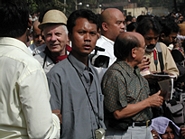
But just before the rally, things began to unravel. A fundamentalist Hindu group declared that they had 20,000 well-armed volunteers in place, to disrupt the event.
Everyone reacted differently to the threat. Ram Raj -- determined to have the rally in order to focus world attention onto the injustices of the caste system -- denied ever suggesting conversions to Christianity and withdrew the invitation to distribute Christian literature. Rightly or wrongly, the Christian groups still agreed to participate.
The Hindu group, sensing weakness and disunity in the Christians, pushed harder and demanded the rally be stopped completely. The government responded by withdrawing the permit to meet, and putting many heavily armed guards at the gates of the grounds where the rally was originally to take place.
The militant Hindus had claimed this was a Western Christian conspiracy, and swore they would stop it at all costs. If the baptisms had gone ahead, there would have been bloodshed -- quite likely on a massive scale. Would it have been right to baptize people, mainly for political reasons? They would not have been discipled at this point, and would be under the threat of being killed.
Rather than inflame an already tense situation, the church backed off on public conversions, baptisms and the distribution of Christian literature, and only offered support to anyone seeking freedom from the caste system. Without these compromises, we might well have been responsible for some physical deaths of new converts.
Soon after the rally ended, about 5,000 Dalits came out of the walled grounds and onto a parking lot -- and then the army moved in. They sealed the gates of the compound and erected barricades around the parking lot. Thus began a two and a half hour standoff; the tension was at a breaking point.
About 15 minutes into the standoff, one of the Dalits tried to hit a soldier with a stout staff. Someone behind him grabbed the end of his weapon and prevented the blow.
Ram Raj finally got on the top of his rally bus with a megaphone, and exhorted his people to non-violence -- and then negotiated with the army to let everyone out, a few hundred at a time, with the promise not to reassemble. Violence was very narrowly averted.
My most emotional experience occurred just as the rally ended. As our group was working our way to the exit, a man stood up right in my face.
He said, "I am an untouchable -- in fact, I am an outcaste, the lowest of the untouchables." It was a distinct challenge to see how I would react.
I first reached out and took his hand in both of mine, then gave him a hug. What it started was amazing: literally hundreds crushed around me, to touch and to be touched. Some even threw themselves at my feet and kissed them. I wept; it is hard to fathom the emptiness of never having been touched by someone who is outside of your caste.
If I learned anything from my experiences, it is that what makes us equal in God's sight is not our station in life, not our gifts, not our achievements, not our wealth, not our influence or power, not anything we feel makes us important. What makes us all equal is that each one of us, high and low, saint and murderer, is that we are all sinners -- we are all desperately in need of a saviour.
We have to realize that the battle in India is not between people, but is being waged in the heavenlies, between the forces of good and evil, between Jesus and Satan, as they wrestle for precious souls. India will be brought to Christ through the demonstration of Christian love and concern, and the preaching of the gospel.