
December 2001
Creative voices renew the church
BC Christian News, · Arts
• Murray Pura, The Poets of Windhover Marsh, Regent College, 2001.
• Karl Petersen, Bellowing in the Common, Regent College, 1999.

"THEY GATHERED every summer in the cottage in the marsh because they knew the only hope for the church was poetry and plenty of it." So begins the title story in Murray Pura's anthology The Poets of Windhover Marsh, and it's not a bad window into the entire collection.
The story itself is a treat, a whimsical invention that springs from a premise along these lines: what if there existed a little stone house in the south of Scotland where every major British poet of faith had ended up at one time or another, inspired to write about God? There is stout furniture to accommodate Chesterton on his visits, and a privy built by C.S. Lewis and J.R.R. Tolkien on a visit in 1954. The Brownings, George MacDonald and Gerard Manley Hopkins are among the illustrious literary visitors who find inspiration in this place.
The tradition continues into the twenty-first century, when a new generation of poets begins to gather, intent on bringing change to a moribund, mediocre church.
"Let Industrial Christianity come to an end . . . Let us have women of substance now, whose words are winged, let us have the men, lit with flame, whose God is Truth, and whose sentences hurl sparks upon all the dead forests and brittle grasses of Christendom."
In another story, 'Pangur Ban,' a small group of Christian artists start a small church built around the making of Christ-dedicated art -- plays, dance, music, painting -- and a movement is born which brings revival to some, but is rejected by others who prefer churches of safety and reassurance. "Like the old opium dens, you go there not only to get away from it all but to get drugged by it all and dwell, for as long as possible, in a pleasant artificial reality. But you become addicted. It kills you. It kills your soul. True Christianity ceases to exist in you. So the Christian faith has become a faith of addicts. And the faith itself is dead."
Murray Pura has a burning desire to see the church fully alive: serious about spiritual things, in the business of Truth and Beauty, struggle and authenticity. More often, it seems, he finds churches to be places of compromise, judgment, manipulation and mediocrity. His book is full of stories of conflicted pastors, compromised congregations, failure and pain and, in the middle of all that, a God of terrible mercy.
Perhaps the key to this essential dichotomy is to be found in 'The Book of Wonders,' in which a pastor keeps two journals, The Book of Wounds and the Book of Wonders.
"Maybe it was not such a good idea to keep the Book of Wounds but he could not help himself. Every time a Christian in one of his congregations slapped him on the back with one hand and slipped the long knife into his back with the other he had to go somewhere with his pain and grief. . . . He had to write."
It occurs to me that much in this anthology consists of excerpts from pastor Murray Pura's own Book of Wounds, and, like the character in his story, at times it seems "he could only walk the stony road of Christian ministry as a via dolorosa, never as a via dolce."
But there is, if not a balance, at least a dialectic within this volume. Because there are those stories from his Book Of Wonders: 'Daughter,' a meditation on the eve of his girl's sixth birthday; 'Daybreak,' a compelling vision of the eschaton; and 'Snow Angels,' a beautifully written piece which marks the progress through the lives of a brother and sister through the angels they form in the snow each winter.
If you know a Christian literature enthusiast, or an Inklings fan, pick up this book as a sure-fire Christmas gift. If you know a weary pastor who needs to hear from someone who's been there, this might be the volume for them. If you think of a Christian artist who doesn't see how their art might be part of a holy calling, this might be the most important present you could buy for them. And if you want to challenge your own complacent view of the church or our faith, this might be just the book to set something on fire within you.
And while you're at the Regent College Bookstore you can pick up one of their handsome poetry publications, Bellowing in the Common by Karl Petersen, a Vancouver man who is living out part of Pura's vision for what Christendom might be.
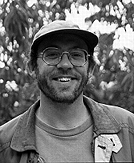
Petersen is a fine poet who has done the hard work of sharpening his creative gifts in the discipline of the highly regarded UBC Creative Writing department, where he earned an MFA.
These are extremely accessible poems; many of them read like scenes in a movie, excerpts from a diary, bits from a stand-up routine, snippets of magazine articles. A man stands naked by the tub, answering a phone call from a girl he met at a party the night before. A man and a woman eat Father's Day brunch together, remembering fathers who have died. A guy at the beach looks "like Moses in blue jeans / except that the waters do not part / and no one is following / he not having found / his power or his people."
And that's exactly the way faith keeps breaking into the oh-so-recognizable Vancouver world where Petersen's poems are set. In the closely observed moments, interactions, experiences of everyday life in this city, and in the wilderness beyond it, the poet keeps stumbling across traces of things transcendent. His faith is real and pervasive in these poems, but never trite, never glib. I get the sense of a life lived, fully engaged with the world around, not filtered through religion -- as I find in too much 'Christian poetry.'
For Karl Petersen, faith is not a filter but a compass. God dwells inside the writer, and keeps pointing to himself in the world around. Petersen's mind and heart are permeated with the realities of scripture, decades lived in the awareness of God, so it is no effort to see God everywhere.
I'll leave you with a fresh poem from Karl Petersen, too new to be included in his anthology. Karl grew up in Lynden and Bellingham. As an American, the events of September 11 and their aftermath affected him deeply; as a poet, he found a way to crystallize those feelings into the shape of a poem.
Since September 11
Since September 11
I always face the door
and eat more and
don't stay in the basement long.
I believe more in play
and work, how I
mark an essay -- a comma,
like a sigh,
bears the weight of a world's waiting.
I care now
how I walk the golf course and with whom,
care less about who wins the world series
(though the Yankees seem a fitting end)
care more about the game.
Also think of old friends often and
high school, and even go back down
through the two hour border check
to see if it's all still there -- the school,
the football bleachers, the guys -- they are,
and glad to see the old dog again, I even
get a hug. But the small town cheer is gone,
the intoxicating buzz of homecoming, too,
the colour washed
from the town's pallid eyes
and I do not know
whose eyes have changed,
theirs or mine.
Today at the mall I notice
water trickling from a fountain
brittle as baby's breath
while a flute plays
'All things bright and beautiful'
and hear trembling instead of tremolo.
And as I turn in a shop
I stop at a door,
one like my mom's linen closet
back at the old house in Platte,
and just stare
until a clerk taps my shoulder.
In the change room area a door
creaks and groans
like the iron gate back home,
so I open it again,
and again,
just to let old times in
(Dad's suspender pants perhaps
and wing-tipped shoes)
just to stop the changing inside.
In an underground garage my eyes
lock with a complete stranger's,
and we talk across the hollow
about nothing
to fill the void with voice
and empty words and our
out of place commiseration,
as if this, this could last
until we neither fear nor want,
nor want to go our separate ways.