
April 2002
Floundering economy keeps Harvest Project busy
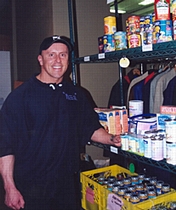
IF THERE is one thing John Day has learned in his four years as a counsellor with the Harvest Project, it is that there is more to every person than meets the eye.
Day sees dozens of faces in his work with the Harvest, an organization that lends physical, emotional and spiritual help to people who are in transition and working towards self-sufficiency. And he is no longer caught off-guard when he looks into the desperate eyes of an experienced businessperson or skilled tradesman seeking help.
With government cutbacks, rising taxes and a fledgling economy, these are the new faces of poverty.
"We're starting to see more clients, but we're also starting to see a different type of client come in -- a more professional client," says David Foster, who founded the Harvest Project eight years ago. "The people who are our donors one year could be our recipients the next. We've had bankers, lawyers, stockbrokers -- people from all walks of life -- come through our doors."
Situated on Bewicke Avenue in North Vancouver, the Harvest Project offers a glimmer of hope for those weathering B.C.'s recent economic storms. With everything from a clothing boutique serving those who need professional outfits for job interviews, to an emergency food hamper service and a job resource centre, all services offered by the Harvest Project, which relies solely on private funding, are free.
"Our mandate is to give a hand up, not a handout," says Day -- who, in addition to serving as a counsellor, is also the organization's client care manager.
In the past few months, the Harvest has taken new initiatives to meet the growing needs in B.C.'s neighbourhoods and com-munities, turning the province's hardships into God-given opportunities.
"Though it's challenging, I think it's a good thing that we're going back to reliance on community rather than reliance on government -- which brings more of an open door for the church and for Christians or God's people to get involved in meeting these needs," says Foster.
One of the Harvest's recent initiatives is its new approach to client care. "What we want to do is to get to know the name behind the face of those who come through our doors, get to know the situation, and become a partner in change," says Foster.
"Most people coming in here are so fixated on the need at hand that they cannot even begin to focus on a new direction. So here we get to focus on that new direction and help our clients in that way."
While the Harvest used to provide a broad-based form of client care, in which a client often met with a different worker on each visit, the organization recently streamlined its services so that a client sees the same worker each time.
"This allows us to build those longer relationships, and really get a better understanding of how we can help that client through their transition and ultimately to a life of self-sufficiency," says Foster.
The Harvest's resource centre is another new initiative that enables clients to meet with a volunteer who can link them with other services available in the community.
"The volunteers will phone and make appointments and advocate on the client's behalf in the community -- rather than saying, 'Here's a brochure, you might want to check this out,'" says Foster.
With more than 1,300 client care appointments made annually, and approximately $96,000 worth of clothing and more than half a million dollars worth of food given per year, the community relies heavily on the Harvest to provide hope for many in B.C. during tough economic times.
The Harvest, in turn, relies on the community to help supply this hope. Only eight of those working at the Harvest are on staff. The other 120 are volunteers.
"Everything you see here is gathered from the goodness of the community," says Foster. "This is a God-sized initiative."
Over the next few months the Harvest will also set into motion a monthly pancake breakfast -- providing an opportunity for people to share their testimonies and other inspirational stories with the Harvest's clients.
Foster predicts that the demands for services at the Harvest will continue to grow. With churches from a dozen denominations already involved in the Harvest, the need for partnerships is rising.
"We knew at the beginning that this is where things were heading, and that this is why God put this together -- because of the wave that's coming," says Foster.
"And the need will go ultimately back to the community, and back to the church. We want to offer the Harvest as an extension of the local church, so that we can work together to meet the needs of individuals -- and so churches who send clients to us here can also build a relationship with the client, and bring them into an extended family in their church in that way.
"That's how we'll win the war on poverty in this world," he adds. "One community at a time."
Contact: www.harvestproject.org