
April 2002
Irony -- or insult?
LAST MONTH when a piece of artwork -- merging Christian imagery and lingo with a sales pitch for Estée Lauder cosmetics -- raised the ire of some Christians living in Richmond, people quickly lined up on both sides of the debate. After seeing the rhetoric escalate, one local pastor seized the chance to, as he puts it "build bridges, not burn them."
Ken Kutney, pastor of Steveston Christian Church, says he just "stumbled" into the issue, but ended up mediating discussions between concerned Christians, the mayor of Richmond and staff at the Richmond Art Gallery.
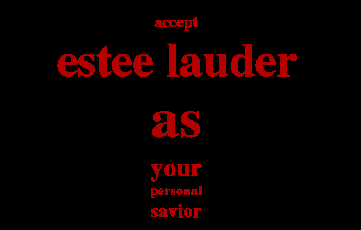
The pastor waded into the conflict after a loosely organized group calling itself 'Concerned Christians in Richmond' faxed a letter to his church's office. The letter called on Christians in the area to sign a petition against a small piece of art in the city's gallery. The artwork in question was part of 'redTEXTblack,' an exhibit of 81 text-based images projected for 21 seconds each -- in a continuous loop -- in a darkened room at the gallery.
The controversial image (shown here) by artist Ricarda McDonald consists of red lettering in the shape of a cross with the words: "accept estee lauder as your personal saviour."
Corrine Corry, curator at the gallery, says there were positive and negative responses from the Christian community. And she credits Kutney with turning a clash of values -- which had become a public battle on the letters page of the local papers -- into a fruitful exchange of ideas.
"We really have seen both sides of the debate here . . . [Ken Kutney] brought a voice of reason to the discussion," she says. "He taught me a lot about how to speak to those people who felt strongly about the exhibit."
While a threatened protest didn't happen, some Christians ventured out to the gallery to see the exhibit, several expressing their disapproval with comments in the gallery's guestbook.
"This was the perfect opportunity, a case study for how we, as Christians, can engage the culture," says Kutney. The pastor says he became concerned about the direction the debate was taking when "the tone of the letters started to become the message."
After corresponding via email with some of the more vocal Christians opposing the piece of art, Kutney was invited by the group to meet with Richmond mayor Malcolm Brodie as they presented him with a 120 name petition which called on the city to halt the exhibit.
Kutney says the meeting went better than expected. "It was more than just a token handing over of a petition. [The mayor] sat with us for 20 minutes, listened to what we had to say and also told us what he thought."
Both Corry and Kutney see the crux of the debate in the way individuals view satire, wit and cultural statements as they apply to religious symbols. "Some people didn't understand the irony in the work. It's asking for the viewer to examine themselves, our society," says Corry.
Kutney concurs, but adds that Christians can become understandably frustrated with a culture that continually blurs the line between the sacred and profane.
The pastor feels that, in the end, the controversy did produce some positive results. Because of his discussions with Corry and others involved with the exhibit, he has been invited to attend the next planning meeting at the gallery.
He says it's just one small example of how Christians can stick to their values and still get their message across. "At some point Christians have switched from proclaiming the gospel to protecting it," says Kutney.
"The message of Christ can be hard enough. We shouldn't be making people stumble over the messenger. If they stumble over the message, well, that's different."