
May 2002
Chronic illness and pain: one family's journey
BC Christian News, · Top Stories
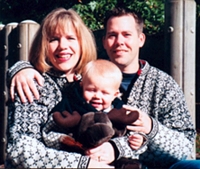
ANITA and I were married in the summer of 1997. We were happy and in love, and simply couldn't believe that God had so richly blessed us with each other.
I'd been working hard to develop my business, and Anita worked equally hard at the job she had had since before we were married. We had all the hopes and dreams a young married couple could have, and looked to the future.
I knew that Anita had health problems before we married; but I overlooked any potential hardship -- I knew that God had brought our lives together. Years before we were married, Anita had been diagnosed with the horrible disease Lupus. She'd been traveling as the tour coordinator with the African Children's Choir for three years, when her health began to deteriorate. It was devastating for her and her family, and she was unsure about her future.
After living under a cloud for over a year, Anita refused to accept her diagnosis and began to seek other medical opinions. She eventually found a doctor who said she didn't actually have Lupus -- but rather a rare auto-immune disorder called MCTD (Mixed Connective Tissue Disorder). It was a relief that she didn't have Lupus, but now there were even more unanswered questions. Her symptoms were already quite debilitating and painful: very arthritic and swollen joints, constant headaches, muscle pain and burning patches on her skin that were too painful to touch. None of the specialists offered any hope -- they simply prescribed toxic, potent drugs with extreme side effects, to battle her condition.
After we were married, her condition gradually worsened to the point where she had to leave her job. She was designated as having a permanent disability, and would be unable to work again. My business was still growing, and our lives changed quite drastically; we had to scrape by on her disability insurance and what little the business brought in. Working from home, it was very difficult to watch my new wife crying in pain almost every day, with no relief in sight.
We knew that we wanted to have children, and were informed by our many doctors and specialists that childbirth wouldn't be a problem -- that Anita's disease would not be passed on to our children.
We were ecstatic when we finally found out we were pregnant and we started to prepare for our new addition. However, two months later, we knew something was very wrong and went to see our doctor.
Anita had a very traumatic miscarriage, ending up in the hospital. We were devastated, but we both knew that God's hand was on us, and that he obviously had other plans for us.
As we tried the best we could to cope with the loss, Anita's condition began to worsen. She would have horrible stretches of time where she couldn't move, and had such a bad fever that I had to hold her up in a freezing cold shower. Her joints would seize up. Her hands would swell. She would have horrible headaches 24 hours a day. Her skin was so painful to touch that she was unable to wear any outer clothes. This was not the life we expected to have together.
I was fortunate to be able to run my business from a home office, so that I could be there for Anita when she needed me. I did all the cooking, cleaning and running of the household, as my wife was simply unable to do it. This is the way things were for the first two years of our marriage.
Many aspects of one's life are affected when dealing with chronic conditions: physically, mentally, spiritually, psychologically and practically. But we knew that God was with us, and we counted on him to keep us strong.
A major part of our life plan was based on having a family. In early 1999, we found out that we were pregnant again. This time, because of previous complications, Anita's health was monitored very closely for any signs of change. The pregnancy was a difficult one. Anita's health began to deteriorate even further than before, and she needed almost constant care and assistance.
One month before her due date, Anita's heart began to race out of control, at 240 bpm. We rushed into the hospital where she was quickly admitted. The doctors and nurses were unsure what to do because they hadn't seen this type of condition in a woman eight months pregnant. After many hours of consultation with major health and trauma centres, they successfully treated and released her . A week later the same things happened again, and our doctor decided it was time to deliver the baby prematurely.
Anita was categorized as a "high risk patient."After many hours of agony, our son Riley came into the world. The delivery was done with painkillers, but nothing was effective. Anita came through the delivery extremely exhausted, and was unable to move for the next month. Because of her pre-existing condition, her body shut down from the shock of the delivery. She couldn't even lift her arms to feed Riley, so I got a crash course in feeding and diaper-changing.
Four months after the birth of our son, we realized that something was seriously wrong with Anita's back. My wife was unable to sit, unable to lay down and unable to stand for any more than five minutes at a time. We asked our doctor about it. He said to wait awhile, as this was a common problem after childbirth and it would soon disappear.
I spent many days researching Anita's symptoms, and found that she had coccydynia. Her tailbone, specifically the tip called the coccyx, had been destroyed during labour.
When the pain didn't subside, we searched for a specialist who could treat her condition. After many doctors and specialists -- most of whom didn't believe what we said, or simply refused to see us -- we finally found one who believed what my wife was experiencing. He said surgery was the only solution.
Almost three years from the birth of our son, we are still waiting for that surgery. We've been dealing with an under-funded medical system, and have been put on never-ending waitlists. My wife's condition is gradually getting worse. I've almost lost my business, because I need to spend much of my time at home caring for my wife and son.
Anita is unable to enjoy the simple pleasures in life that most of us take for granted. She can't sit for longer than five minutes, can't get down on the floor to play with our son, and can't stand in the kitchen to cook a meal.
She's been on painkillers for almost three years. Nevertheless, even through all the hardships we face, we know that we have a God who is watching over us. We have no money -- I've almost lost my business, and we try to get by on the meagre assistance we receive from the government.
I keep telling people that the toughest part of dealing with what we're going through is simply being a Christian. Our faith has been challenged greatly, resulting in our lives being equally changed. But we can take comfort, because we know that God, somehow through all of our pain and chaos, has been in control all along. We've realized that we need God more than ever. Not every day is perfect, but we know that he will provide.
I once debated on a radio program with a philosophy student. He claimed that God was simply a crutch, and wondered how I could be surviving all of this. I told him that, when someone breaks their leg, they need a crutch to help it heal correctly, so that it will be stronger than ever. No one ever ridicules the person with the broken leg just because he's using a crutch to heal. In this same way, we can use God to lean on when we walk through any trials we may face. It's one of the neat benefits of being a Christian -- and God does this willingly!
One excellent resource, which has been a source of encouragement and hope for Anita, is Yet I Will Praise Him: Devotions of Praise Through Chronic Pain, by Cindy R. Nelson.
It can be found at our website:
www.curemywife.com