
November 2002
Mayor shed 'fat cat' image, showed compassion and faith
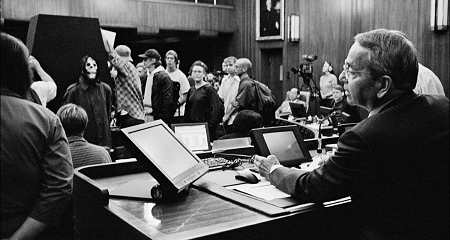
HE REGULARLY walks the streets of Vancouver's downtown eastside, and has been known to bend down, in tailored business attire, to gather trash into a neat pile on his way home from civic functions. He has impulsively hugged downtown eastside residents who have managed to get off drugs -- a civic leader whom The Vancouver Sun describes as a decent and caring man.
As Philip Owen leaves the Vancouver mayor's office next month, he leaves the legacy of a leader who, although not known to speak much of his personal faith, was compelled by that faith to take a difficult stand against strong opposition from his own community and political party to protect those he did not see as disposable -- the city's destitute and chemically addicted.
An unusual mix of Vancouver's powerful elite and marginalized came together October 16 to pay tribute to the man in his farewell gala, which, in keeping with Owen's self-effacing style was not the usual lavish dinner in his honour, but rather a screening of the film Fix: The Story of an Addicted City.
The film depicts the mayor's battle to see the Four Pillar Plan, with its controversial harm reduction component, become the Vancouver Agreement, a five-year agreement signed by three levels of government that has the power to change the way chemical addiction is handled on a national scale.
Proceeds from the gala are being used to promote showing the film in cities across the nation, beginning in Ottawa. For the unstoppable Owen, it is just one more step an a campaign that is far bigger than any local politics.
"It's beyond politics," Owen told BCCN in late October. "I said at the beginning, here's a need, there's sick people hurting -- it needs political will. I'll rise or fall, but I don't care about the next election. This is something for the country for the next 50 to 100 years."
Listening with respect
Owen, who attends St. John's Shaughnessy Anglican Church, credits his ability to listen to those at the low end of the economic scale to growing up in a family focused on community. Owen's grandfather, Walter Owen, was warden at this province's Oakalla prison farm for 18 years, and Owen and his brother used to visit him on weekends, walking the prison grounds with their grandfather, chatting with prisoners as they picked fruit and looked after animals on the institution's farm. Owen never felt afraid around the prisoners, and learned from his grandfather's example to treat all people with respect and dignity.
Apparently, it runs in the Owen blood to pioneer experimental, compassion-based projects. A Sun article last year revealed that because of Warden Owen's support, B.C. developed the New Haven program for criminal rehabilitation, a treatment-based experiment that differed from the punitive approach of the time.
In the mid-'90s Owen began to believe that a similar compassionate approach was the solution to Vancouver's open drug scene, which had changed dramatically with the introduction of crack cocaine.
Convinced that the U.S.-- style 'war on drugs' wasn't working, Owen began to research options through Stanford University's Hoover Institute think tank.
At an early Vancouver seminar exploring European-style harm reduction approaches, a drug-user advocate interrupted the proceedings to point out that city needed to hear the user's voice.
At this point, Owen says he began to realize the importance of including recovering and current drug users in the discussion. He expressed this idea at the next Stanford meetings, and initiated communication with the Vancouver Area Network of Drug Users (VANDU), visiting them in their area.
"They were saying 'We're marginalized, we're condemned by society, we're in the lanes shooting up,'" Owen relates. "[They said] 'We're cold and hungry and sick, and we have no facilities -- we're not cared for by health care and we don't have money for private clinics. We want to be part of society.'" Owen says it came clear to him then that "the user is sick and the drug dealer is evil," a phrase which he often repeats.
The right thing
Such phrases have brought Owen criticism for being overly simplistic in his approach to harm reduction, which he has sometimes defended as the "right thing to do."
Although some Christians do not agree with Owen's conclusion on the issue, his stand on harm reduction is clearly a moral stance, based on doing what he believes is the 'right thing.'
"Are we saying that we're not going to help these people that are ruining their health and meeting an untimely and awful death?" he asks. "They're disposable, I guess. Doing drugs is bad, it's their own fault, so we're going to write them off? I don't think that's what Christ said. Christ says everybody is to be reached -- the sick, the poor, the lame, the hungry and the filthy -- they're people and have to be cared for," he maintains.
He is equally passionate in his dislike for drug dealers, who he says are "vacuuming all this money out of our economy, not paying any tax, ruining the quality of life in our neighbourhoods and destroying lives."
Dealers have to be dealt with harshly, he says. "Satan controls them. I'm going to drive them out, unless they want to repent and mend their ways."
Owen's personal connection with families of addicts has been a large part of his commitment to find a solution for the drug problem. He knows many members of the 'Grief to Action' group based out of St. Mary's Church in Kerrisdale, one of Vancouver's most affluent neighbourhoods. He was invited to the parish-based group's first meeting, where organizers were overwhelmed when 250 parents showed up.
"Suddenly you realize it is everywhere," he says. "We have a needle exchange at the Kerrisdale Health Centre. People don't realize we have needle exchanges in all the health units now."
Owen admits that growing up in the heart of affluent Vancouver made him a suspicious partner to some in the battle for harm reduction. Ann Livingston, outspoken advocate for safe injection sites and users' rights, twice ran against Owen for city councilor, once on a Labour Welfare Party ticket, and once on a COPE-Green slate, when Owen was running for mayor. Owen is on record as having once called Livingston, who is Catholic, a "public nuisance." Yet, he says, the two gradually came to realize they were on the same side of the harm reduction battle.
"She was on my case in the mid- and late-90's," Owen says. "She thought I was some fat cat from a rich neighbourhood who didn't understand the downtown eastside. There was a spiritual thing that happened between us, we came together through a whole series of events and realized we had compassion and understanding for the sick and the poor."
Owen says that although their faith never came up, it was something each could sense in the other. That two Christians were at the forefront of the harm reduction issue, one fighting from the user's side and one from the political side, is significant, he says.
"It was meant to happen. I never had a deep discussion about faith with Ann at all," he explains. "We didn't get into any of that, we were focused on the need out there, and I think we're bringing a spiritual perspective that has an awful lot of impact."
Both Owen and Livingston have faced a significant amount of personal cost over the issue. Owen has been denied another nomination for mayor by his own party, amidst rumours of backstabbing and betrayal from colleagues. Livingston has spent her own money and time to fight tirelessly to see the issue brought to public attention. But the result, as Owen indicates, has been to bring the issue to the attention of the nation.
As health minister, Allan Rock was very supportive of Owen's work, and com-mended his "courage and dedication" to improving national health, adding that the Vancouver Agreement holds "national significance."
"The goal is to get a national drug strategy," Owen says. "I'm being pushed to do this by a Being higher than myself."