
January 2003
Healing ministries: pure faith or blind faith?
BC Christian News, · Top Stories
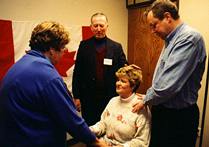
A RESURGENCE of interest in faith healing has some Christians asking the question: "Does God still heal people today?"
In a 1996 poll of 1,000 adults, 79 percent declared that they believed spiritual faith can help people recover from disease. Medical science shows that spirituality -- that nebulous term -- has positive health benefits for practitioners. But since the time of Christ, the practice of healing has changed. Some evangelists, who make as many skeptics as converts, promise God's healing, while raking in enough money each month in merchandise sales to make the film industry sit up and listen. Scientifically controlled double-blind studies to prove or disprove the effectiveness of prayer are fraught with subjective, human judgments. Medical documentation of divine healing is difficult if not impossible to obtain.
Yet there are those who believe beyond a shadow of a doubt that they have witnessed or experienced healing at the hand of God.
The face of healing today
Bible-believing Christians trust that God's power over illness is as strong as it ever was. Some believe that God works through science and technology, redefining the word "healing" in light of modern medicine. A greater understanding of physiological functions of the body allows medical facilities to provide on a daily basis what would have surely been hailed as "miraculous cures" 2,000 or even 200 years ago.
Others downplay the role of physicians and surgeons, some to the point of rejecting medical advice, in order to allow God alone to heal them. Then there are those who see all healing as a mysterious process governed by powers that we know incompletely, a grey area of overlap between physical and metaphysical.
The face of healing has altered over the centuries. But, as far as Steve and Christina Stewart, directors of the Vancouver Healing Room, are concerned, God still desires to heal people.
"There's a lot of different streams and approaches to healing today," says Steve. The 'healing room' concept is new -- and is definitely meeting a need.
Until recently, Vancouver was the only Canadian city with a healing room. In the past three months, more than half a dozen cities across the country have opened similar facilities -- or are in the process of doing so.
The Vancouver Healing Room, located on McPherson Avenue in Burnaby, is steeped in the mending of human ills: it was once a doctor's office. People arrive, sign in indicating their need, and await their turn. When they are called in, they are prayed over, some for 20 - 30 minutes. Men pray with men, women with women, couples with couples. The Healing Room is no-fee, nondenominational and non-exclusive and many people -- including Sikhs, Muslims and Hindus - return time and time again, often finding salvation along the way. "It connects the community with the Lord," says Stewart. "They're not coming for evangelism, they're coming for prayer but so often people come to Christ."
Healing Room teams have prayed over a wide variety of health problems, from arthritis and chronic fatigue syndrome to injuries and cancer. Prayers lightly touch the affected area of the body, placing their hands over the person's hands when a personal area is involved.
Jan D'Eon of North Vancouver had asthma all her life -- until she visited the Healing Room. "I was still using an inhaler when I started going to the 'rooms,'" she recalls.
"After several months I began to notice I wasn't using it much. After six months I carried it and didn't need to use it." D'Eon says that it's been two years now since she's had an attack or needed her inhaler. "I consider myself healed from asthma by the grace of God."
Manipulating the divine
Jodie Oades is a registered nurse who works in palliative care. "I had an experience myself about 30 years ago," she says, "so I do believe God can heal." She describes a severe back injury that left her with a limp and constant pain that required frequent medical and chiropractic visits. Then she was invited to a dinner at which an evangelist/healer was speaking.
When those suffering back injuries were called to the front, she refused to go up. "I didn't want to make a fool of myself and I didn't want to be disappointed in God," she says. But about an hour later, she got up to leave and realized she wasn't in pain. Her limp was gone and she hasn't needed any further therapy.
But Oades also knows the other side. "I've had other injuries that have been prayed for that have not been healed,"she adds. "I was told my faith wasn't good enough. I was chastised for seeking medical help. I spent a fair amount of time being angry with God but I finally came to terms with it being God's will, not people's will."
Cam Stuart is an Abbotsford pastor who agrees that the focus needs to be on discerning God's activity in the lives of those who suffer. "God's not a genie that needs to be stroked a certain way to get what you want," he says. "This is ultimately about God, his desires, his will. We've got to be careful we don't use God for our own ends."
Afraid of miracles
With all the wonderful things God is doing, why do alarm bells start tinkling for some when talk turns to healing ministries? Stuart suggests perhaps it is a control issue combined with a fear of disappointment. "We like control," he says. "This is the other end of the genie aspect. They want to know they can manage God so they won't fully trust God because it's out of their control."
Unfortunately, it's a fact that not all who claim the gift of healing are legitimate. "We need to give room for discernment," cautions Stuart, "and be aware of the potential for deception."
He suggests two ways of discerning an authentic ministry: accountability and long-term effects. "Are the ministers accountable to a local church and board somewhere?" Stuart asks. "People ultimately need a grounding to be authenticated in their ministry. Second, what is the long-term fruit in the life of the person being touched? While physical healings are wonderful, fundamentally for me the deepest work and most important supernatural work is when the heart is touched and moved closer to God."
Discernment is vital, but sometimes those asking the questions are frowned upon for their lack of faith. "It's not trying to make things look bad, not trying to look for problems," says Stuart, "but the reality is we're living in a day when there's a lot of stuff being communicated as truth and goodness that I don't see evidence for in scripture."
Dying well
In some cases, the answer to the plea for healing is no. "Sometimes God wants to do something else with us first," says D'Eon, "draw us into a closer dependency on him, a deeper relationship with him, heal our emotions or deliver us from something blocking the healing process."
When someone believes they are being healed by God, it can be deeply confusing when symptoms worsen. "I think it can result in trauma," says Stewart. "We are very clear: stay close to your doctor. If you think you're healed, go to your doctor. We're working very cooperatively with the medical profession."
For those suffering from terminal illnesses, holding out for last minute miracles may interfere with the spiritual and psychological tasks necessary to prepare for dying well. Medical care to ease symptoms may be waved away.
Reconciliation may not be sought. It can be particularly difficult for survivors to watch a loved one resist palliative care in the hopes of divine intervention. In such cases, faith may be a mask for the first stage of grief -- denial.
"I never try to take hope from them," says Oades, "but there comes a time when you have to say okay this isn't God's will for me. I've seen people who have died in absolute peace because they are in peace with their Creator and others who have died kicking and screaming."
"I'm always praying healing prayers for people," emphasizes Stuart. "But our bodies will eventually fall apart. God is interested in our health but most important to him is our soul. My job as a pastor is to help people nurture a healthy soul so that they die well."
Compassion & acceptance
It's long been accepted that some health problems respond simply because those affected believe they will get well. The placebo effect, contrary to popular belief, doesn't mean an illness was "all in one's head," but rather testifies to the mysterious power of the intangible over the physical. Perhaps, for some individuals, intercessory prayer or the laying-on-of-hands plays a role in this effect.
Compassionate caregivers -- whether pastors, physicians, massage therapists or loving friends -- can sometimes help more than the purely clinical skills of medical professionals, not because they have any supernatural powers but because suffering often responds when personal warmth and reassurance is offered.
How it happens remains inexplicable, but without a doubt, love -- the essence of God -- is part of it.
"I've seen wonderful miracles," says Stewart. "I've also prayed for people who haven't been healed. My job, according to the gospels, is to lay hands on the sick and trust God. I think more people get healed if we pray for them than if we don't."
"Those who have been able to put their trust in him die a better death," adds Oades, "because they realize it's not the end. Remember that no matter when you die or how you die, quite often in some way it is going to touch somebody."
For more information about the Vancouver Healing Room, call 604-434-8328.