
January 2003
Operating principles for serious medical situations: faith, community and their children's smiles
BC Christian News, · Top Stories
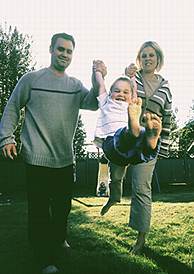
IT STARTS in one of two ways. It might begin with a vague -- but urgent -- call from a doctor: "Call me as soon as you get this message, I need to see you right away." Or it may start with a quizzical look on your family physician's face as she examines your child. They're trained to be calm under any circumstance -- don't panic the patient -- but those tactics are futile when it comes to diagnosing a baby with an unexpected life-threatening illness.
The Fosters and the Skidmores will have that 'first day' lodged in their memories forever. Each of their stories is full of detail emphasizing the medical traumas and the chain of miracles that have filled the days since Jarod and Alex were born.
Both couples, neither with prior medical training, are now walking medical encyclopedias. They can readily recall detailed procedures, toxin readings, a vast array of pharmaceuticals and their side effects.
But, even more vividly, they can look back, and with their memories paint vibrant scenes of God listening to tear-dampened prayers. They fear their descriptions of God's intervention will seem pat, cliched, trite. How do you truly express something so intimate as God touching the life of your special little child? Something so internal, so spiritual, it seems futile to confine the phenomenon within the mechanics of language. When these people use the word 'miracle,' it jumps from their lips and their faces like a fresh word.
Jarod's gift
Kevin Foster bends low to look into his son Jarod's eyes. "When do you think mommy will want her liver back?" he asks, jokingly poking his son's protruding bare belly. Jarod knows the game. He makes the best combination eyebrow scowl and crooked smile that a four-year-old can muster. "No . . . it's mine."
Jarod seems remarkably happy for a kid who knows he will be spending the day in the hospital tomorrow. His monthly blood work just turned up a high enzyme count in his liver. That means his body's fighting something, so he'll be heading to Vancouver Children's Hospital to visit all of his buddies -- doctors, nurses, students, technicians. "He's instantly friends with anyone wearing a white coat," says Jen Foster, who, to save her son's life, became the first living related liver donor in B.C.'s history.
Jarod's first memories include the sterile confines of a hospital. When he was 10 weeks old, it became apparent to the Fosters and their doctor that something was wrong with Jarod's liver. While it's not unusual for newborn babies to develop the yellow colour of jaundice, Jarod's case was prolonged and more severe than the norm. When they explored further, doctors discovered that a rare disorder named billiary atresia had ruined the bile ducts in Jarod's liver, not allowing the potent fluid to escape from the liver as it should, resulting in severe scarring of the organ. While the surgeons performed an operation designed to buy them some time -- cutting off the dead bile ducts, then stitching Jarod's intestine directly to the liver in the hopes that the bile would then drain out -- the bottom line was that he would need a new liver.
At that time, there was a three-year waiting list for a cadaveric liver (one from someone who donated an organ upon their death). But a new procedure that allowed a portion of a donor's liver to be cut off then secured inside a recipient's body became available to the Fosters. Though there were some risks involved, they jumped at the chance. It was clear that Jarod couldn't wait three years for a liver. Without the transplant it was unlikely that he would have made it to his first birthday.
Potential donors go through a series of tests which, among other things, screen their blood and check the physical shape and condition of one's liver. The initial blood test revealed that both Kevin and Jen, who attend Northview Community Church in Abbotsford, were a match.
Before they took any further tests, however, they had a discussion that few couples are ever forced to have. "It wasn't an easy decision for us," says Kevin. "You got down to brass tacks pretty quick . . . who can we afford not have to survive. It was pretty sick really."
Because living donor transplants -- where a person gives only a portion of their liver to the recipient -- were a fairly new phenomenon, there was a chance that the donor could die after the surgery. Forced to be pragmatic in an emotional situation, the couple had to envision what the family would lose if one of them died. Kevin, who is an executive with Coca-Cola is the breadwinner. But no one would argue that little boys need their mother. Neither scenario was appealing, but in the end, Jen became the donor.
After the surgery, Jen's body began to shut down. During the eight-week recovery period she had sunken eyes and was listless, barely having the energy to talk to anyone for more than a few minutes. But she recovered with full marks. And even learned a remarkable fact about the way God created the human body: when a portion of a liver is cut away, the organ begins to grow to its original size again, regaining 90 percent of what it lost within the first week alone.
And while they witnessed God's power to heal the body, they also felt the release that comes with giving your child to God. Kevin recalls Jarod's first surgery, and how the point hit him there in the waiting room.
"There was nothing we could do while he was on that operating table," he says. "After that, we never questioned 'why?' We're happy that God has let us go through something that we were able to deal with . . . It wasn't beyond what we could take."
Because Kevin works for a large corporation it would be easy to assume he has a degree in business. But that's not the case. He has a Bachelor of Science degree from Trinity Western University. "I think that degree prepared us for the years ahead," he says. With issues involving anti-rejection drugs -- many which have harsh side effects -- and new studies and treatments that could affect Jarod, Kevin's other job is to keep the dialogue going with his son's physicians.
"I believe now that [Jarod's illness] was a primary component in why I was led to choose that major. It has allowed me to think more objectively about medical issues than I could have otherwise."
All of the surgeries and hospital stays have had a lasting effect on Jarod. He is empathetic and compassionate beyond his years. When he sees other kids in the hospital the look on his face says "I know what it's like, I've been there." Jen and Kevin say he's noticeably concerned for his floormates, especially kids in wheelchairs. And recently he's taken to telling his mom and dad, with great conviction "I'm gonna die when I'm a hundred."
His brothers Connor (6) and Riley (2) don't like it when Jarod has to stay over in the hospital. But they understand the way it works. They'd like him at home playing with them, but they know he's got some business to take care of right now.
Awaiting Alex
Garry and Kirsten Skidmore both agree on the defining moment of their son Alex's young life. Since the moment he was born Alex's body was plastered with tubes and wires and he couldn't be moved from a hospital isolet. Kirsten couldn't even hold him for the first time until he was more than two weeks old. But the battle began long before Alex even drew his first breath. When Kirsten was pregnant with Alex, a routine ultrasound uncovered a problem. Alex had a blockage in his urethral tube that began a chain reaction of fluid buildup, starting with his bladder and working its way into his kidneys and toward his lungs, swelling the organs and damaging them.
A string of doctors and a genetic counselor at Children's Hospital in Vancouver explained the situation to the Skidmores, and the counsellor offered abortion as one of their options.
However, the couple didn't even give a fleeting thought to giving up on their child. Instead, they gave him a name -- because of the medical tests, they now knew they were having a boy -- so that people at Christian Life Assembly in Langley, and at Trinity Western University (where the couple both graduated from) could start praying for Alexander Skidmore.
Those prayers centred on Alex's first hurdle: his lungs. If his lungs sustained too much damage while in the womb, he wouldn't be capable of taking his first breath. As the doctors studied the case, they debated risky surgery to the baby while he was still in the womb. But in the end, they opted to let him develop naturally. On June 16, 1999, Alex was born into a world of invasive medical treatments and sterile tubing -- but his lungs hung in there. On to hurdle number two.
In the weeks after Alex's birthday, Garry would nose through doctor's charts, checking for the all-important number that measured the toxins in Alex's fragile frame. Because his organs had sustained damage and hadn't developed properly, Alex was in a fierce fight to rid his body of toxins that average children expel with ease. While a healthy child would score somewhere around 30 on the chart, Alex's toxins rose into the hundreds. When he reached 650, the doctors held an emergency meeting with Garry and Kirsten.
"It was to the point where they said 'we don't even have days anymore, we have hours,'" recalls Garry.
In the clinical way that doctors are charged with handling crisis, the medical team presented the Skidmores with two options. The doctors had exhausted all proven medical treatments for Alex's condition. Any further treatments would fall into the realm of the experimental, with the outcomes being extremely unpredictable. They could choose to proceed or to let nature run its course.
After two "bawling sessions" at the hospital and at their home in Langley, the Skidmores decided to drive back to Vancouver and, with just the three of them in the room, dedicate Alex to God. "I said, 'this little guy has been through a lot in the first four weeks of his life, he's not going to turn into an experiment,'" remembers Garry. Garry and Kirsten laid their hands on Alex and prayed a prayer that has become the moment where his life, and theirs, took a turn.
After weeks fighting for him, exhorting the doctors to march on, the Skidmores said to God "You take care of him. We want him to stay. But if you want him to live it's in your hands."
"It was the weakest point in our lives," recalls Garry, "saying 'do what you've got to do.'" Even some family members questioned their decision. Kirsten says people have to understand they weren't giving up on Alex during that bedside prayer. "We weren't giving up, we were giving him up," she says, raising her hands, palm up, as if she's lifting a little child to God.
But a small dose of peace came quickly after that. And two days later, Alex's toxin reading had started to go slightly down for the first time in his life. Garry spotted the reading, and told a doctor about it. "He said there was a blip in the system, that someone hadn't read it right," but the couple were certain, absolutely convinced, that good things were happening inside Alex.
In the days following, Alex's body continued to kick the toxins out where they belonged until his count reached a manageable 200. At that point, the doctors developed a new confidence in Alex's ability to bounce back. According to the Skidmores, the medical team that had given up hope were now ready to roll up their sleeves and start preparing Alex for his new life.
In a lot of ways, that turning point only signified the beginning of Alex's long recovery. He has a new kidney now, courtesy of his grandmother Clarice Skidmore, who was a perfect match and, like all transplant recipients, he will continually take anti-rejection medication. To say Alex just transformed overnight would be to trivialize myriad medical battles and sacrifices that the Skidmores, including their other two children, Cameron (5) and Erik (1), have gone through as the family has stuck by Alex, who is now three.
Of course, they all -- even Erik, with an open mouthed grin -- say it's worth it. You see, before his new kidney, Alex wasn't much of a playmate. His body used all of its energy to fight the toxins in his system, forcing him to see life through a hazy fog. "Now he's got all kinds of energy," says Kirsten, with a smile "and he's fighting for his rights!"
Reflections
As outsiders, we can catch only a small glimpse of the spiritual reality experienced by the Fosters and the Skidmores. While the whole picture is a collage of medical terms and mini dramas and victories, we can only focus on a few crucial scenes. Those moments, in their own way, have become success stories.
Different from the marks of achievement -- personal and career goals -- that young families naturally aspire to, these levels of success have come, in large part, through being part of a Christian community that cares. A community that emphasizes God's power and his desire to mend hearts . . . and other organs.