
February 2003
God's transforming power at work in Nigeria
BC Christian News, · International
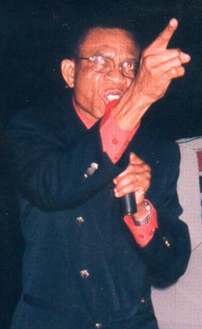
Nigerian-born evangelist Paul Ndukwe, director of New Westminster-based Link International Ministries, recently conducted an evangelistic crusade in the land of his birth. His 'Holistic Festival' travelled to several of Nigeria's cities. He offers the following perspective on the political, social and spiritual climate of one of Africa's most troubled nations.
ONE CANNOT talk about the political situation in Nigeria without relating it to religion. Every political program or event always has a religious overtone. Passion for religion also affects the economic climate of Nigeria.
Violence and fear of death are a constant threat to those living in Nigeria, due to the religious influence on politics.
One example is the recent riot and violence that erupted over the Miss World contest, which destroyed more than 10 churches and left many of the people of Kaduna homeless or dead.
One of the churches destroyed was a United Evangelical Church where my short-term missions team worshipped 19 days before the violence. It is still very difficult to understand why churches were torched and burned down -- and many Christians are homeless or dead. But it has to do with politics.
The majority, from the Hausa tribe, believe that only they have the right to rule the country. This belief has an Islamic religious root.
They feel that anyone standing against them must be dealt with -- and they do not mind dying for their beliefs, even if it goes against the rights of someone else or defies the constitution.
Fraud and mismanagement are rampant in Nigeria, and vigilante groups are on the rise. Militant Islamic groups seek to establish and enforce Islamic sharia laws -- even in states like Kaduna where there is a strong Christian presence.
In Katsina State, the Islamic legal administrators recently sentenced Amina Lawal, a peasant woman, to be stoned to death for having slept with a man who was not her husband.
During the Sharia Court of Appeal sitting January 23, Grand Khadi Aminu Ibrahim, the chief judge presiding over the case, was impassive when he said: "This case is an ordinary case. It is as simple as drinking water."
He added: "The best deterrent is the death sentence, for people to see what happens to a fornicator. They watch you be stoned to death; they wouldn't want it to happen to them. So it definitely would be a deterrent."
The verdict holds enormous significance -- not for Lawal alone, but for the future of Africa's most populous nation.
To put it bluntly, Nigeria is on the verge of tearing apart along Muslim-Christian lines.
Nigeria is technically a secular democracy; it is neither an Islamic nor a Christian state. However, sharia law has swept through its northern, largely Muslim, states over the last three years. It has emerged as a critical issue in the elections approaching in April.
President Olusegun Obasanjo, a Christian southerner responsible for holding together this country of 130 million, has had to walk a delicate political line on the matter.
If the Sharia Court of Appeals ultimately upholds the verdict of the lower courts, Lawal would be the first Nigerian to be executed under the Islamic code. Her execution would likely inflame religious passions, as well as bring the country's guarantee of states rights into conflict with its constitutional ban on capital punishment. Chief Obasanjo has declared that the Nigerian Constitution would see to it that Lawal's life is spared.
I attended a one-day prayer rally organized by Nigeria Prays, headed by General Dr. Yakubu Gowon, former head of state of Nigeria. I met briefly with Dr. Gowon, and he told me that we must not give up interceding for the country -- that peace must prevail over violence, fraud and mismanagement.
At the rally, he apologized to the Igbo tribe for his role in commanding the attack against them during the Biafra War in the 1960s (before he was an active Christian) -- asking that they forgive him and others like him for past actions, and that they strive to move forward in love, to unite the country.
He pleaded and prayed for respect, acceptance and tolerance for each other regardless of tribe, religion and tongue. He was very optimistic that Nigeria will once again become a country to be reckoned with and placed among the most powerful in the world.
Despite the violence and fraud in Nigeria, we have seen vigorous Bible-believing churches emerging -- fervent and strong in outreach and prayer, courageous against the powers of darkness and expectant of miracles.
A new sense of strong evangelical Pentecostalism has emerged over the past number of years despite persecution and intimidation. Also, the number of Nigerian missionaries and mission agencies are steadily increasing. Many Nigerian missionaries have a strong emphasis on Muslims and unreached people groups.
I was encouraged when I visited and worshipped at the Aso Rock Chapel December 15, with Chief Obasanjo.
Seeing some members of his cabinet, like the transport minister, the chief of staff, the minister of information and national orientation, and some members of the House of Assembly -- all worshipping the King of Kings and Lord of Lords, seeking his face for the country and crying out to him, to establish Nigeria in his will -- truly renewed my commitment to my home country.
I am very optimistic about the federal election coming up in April. We will see a flood of God's 'instruments' elected to lead Nigeria in righteousness.
I challenge each person reading this -- and especially prayerful intercessors -- to lift up Nigeria before the highest seat of mercy and justice, even the throne of God Almighty.