
April 2003
My family and other Anabaptists
BC Christian News, · Top Stories
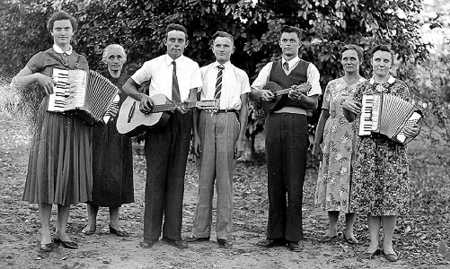
PEOPLE often don't believe me when I tell them I'm a Mennonite.
"Chattaway is not a Mennonite name," they say. And they're right, it's not. But then I tell them my mother's maiden name was Sawatzky, and her mother's maiden name was Derksen, and so on, and so on, and all becomes clear.
Or does it? Although I have become profoundly aware in recent years of the ways in which my upbringing has shaped my faith, I never gave all that much thought to being a Mennonite when I was young -- being a 'mere Christian' was more important to me -- and in some ways, I didn't really feel like a Mennonite at all.
Let's start with language. My relatives all spoke Plattdeutsch, or Low German; but my siblings and I did not, except for a prayer we recite to this day whenever we visit my oma, or grandmother, for dinner -- and even then, I am so unfamiliar with certain words that I am basically just reciting phonetics.
This language gap is due mainly to the fact that my mother was the only member of her family who married outside the Mennonite fold, and although my parents talked about sending my sister and me to German school -- if only so that we could get the jokes at family gatherings -- nothing came of it.
Then there were the theological and cultural differences between different kinds of Mennonites -- and it was not always clear where the line between theology and culture should be drawn. My parents were involved in a number of broadly evangelical churches and ministries in the early '70s before they settled on a Mennonite Brethren (MB) church; but the rest of my relatives were General Conference (GC) Mennonites (now Mennonite Church Canada).
Many of the differences between GCs and MBs are pretty superficial. When I was baptized, my pastor immersed me completely -- which wasn't hard, since I was only 11 at the time and most of me was already submerged once I stepped into the tank anyway. But when my cousins were baptized, their pastors sprinkled water on their heads.
When one of my cousins got married, there were two bowls of punch at the reception -- one with alcohol and one without -- and one of the guests joked that one line-up was for GCs while the other was for MBs.
More substantially, the church in which I grew up sometimes seemed to think that being identifiably Mennonite was a problem. I remember debates in the MB Herald, over whether we should change the denomination's name to something more generic; my own church eventually dropped the 'MB' part of its name, preferring to promote itself as a seeker-friendly 'community church,' and many of the MB church plants they have sponsored have done the same.
This sort of thing did not seem to be an issue for GCs -- in fact, they proudly proclaimed their distinctive culture and pacifist theology. In the '80s, when concern over nuclear war was at its peak, my sister came home after a day of picking berries on the farm owned by peace activist Henry Krause (see facing page) -- which was virtually next door to our oma's house. She told us about the T-shirts there, which said 'Make Borscht, Not Bombs!' My sister thought this was hilarious; but my father, being an MB and thus more ambivalent where the military was concerned, didn't care for the slogan at all.
Mennonites shy away from the idea that anybody can be born into the faith; each person must choose the faith for him or her self. So, from an early age, I had fun testing some of the beliefs that had been handed down to me -- including the very emphasis on making a personal decision for Christ!
At the MB Bible school I attended in Saskatchewan, we were asked to give our testimonies; so I said that, although I could point to moments of decision in my life if I had to, I had pretty much 'always' been a Christian -- because I could not recall any point in my life when Romans 10:9 ("if you confess with your mouth, 'Jesus is Lord,' and believe in your heart that God raised him from the dead, you will be saved") did not describe what I believed. In an environment where it seemed the phrase "I was raised a Christian" always had to be followed by a story about a conversion-like experience, a boring testimony like this seemed quite daring to me.
In later years, I found myself growing apart from the church in which I was raised -- not because it was Mennonite, but because it was, for lack of a better word, so generically evangelical.
Partly as a result of my studies at UBC, I wanted a deeper connection with my Christian heritage, including liturgical worship; deeper appreciation for the arts, beyond merely using it as a tool to lure potential converts; and a deeper engagement with pressing scholarly questions about the origins of the faith.
I found these things at an evangelical Anglican church, which in some ways is as non-Mennonite as you can get. Mennos baptize believers only; Anglicans baptize infants. Mennos emphasize the separation of church and state; the Church of England is, by definition, a state church. Mennos are pacifists; Anglicans display plaques commemorating those who died in battle. These differences did not matter so much to me -- although I did wince during the first infant-baptism ceremony I attended, which surprised me.
I have attended Mennonite services on only a handful of occasions in the past few years. I continue to feel more at home in services that follow a more liturgical format. But in my conversations with fellow Christians of an Anglican, Catholic or Orthodox nature, I find I frequently fall back on Anabaptist principles that I once just took for granted.
I still believe faith is something we choose. But I have also become profoundly aware of how my instincts, and thus my choices, have been shaped by the faith in which I was raised -- and by my ambiguous position as a person with one foot in Mennonite culture and one foot outside of it.
I may never be entirely comfortable in any one branch of the church. But I do believe, as my oma often says, that knowing and following Jesus is "the most important thing." And for helping me in that path, I will always be grateful to my Mennonite family, friends and forebears.