
April 2003
A brief history of the Mennonites
BC Christian News, · Top Stories
THE REFORMATION was more than a simple clash between Catholics and Protestants. Many Reformers could not agree among themselves on what form the new church -- and therefore society -- ought to take. Catholics and Protestants alike turned to secular princes for support; but one group questioned the very partnership of church and state itself.
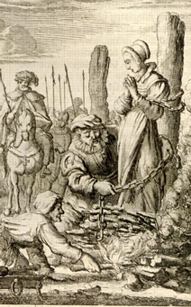
That group was the Anabaptists, a loose assortment of Reformers who earned their name because they had themselves baptized again. Unique for their time, they believed baptism should be performed not on infants, but only on adult believers.
The movement began in Switzerland in 1525, when Conrad Grebel and his fellow students broke from their mentor, Ulrich Zwingli. From the beginning, they emphasized the need to follow the teachings of Jesus, which in their view included missionary activity, a commitment to peace and a willingness to suffer -- rather than conquer -- in Jesus' name.
Because they would not take up arms in support of the state, Anabaptists -- or Radical Reformers, as they were also known -- were persecuted by Catholics and Protestants alike, and many of their early leaders were killed; Grebel himself died in prison in 1526.
Mennonites take their name from Menno Simons, a Catholic priest from the Netherlands who cast his lot with the Anabaptists in 1536, and who became one of the most influential Anabaptists partly because he survived these persecutions; he eventually died in 1561.
Simons believed strongly in discipleship and moral accountability, which he felt were lacking in Lutheran Protestantism. He affirmed the pacifism of earlier Anabaptists, and called on people to fellow Jesus' teachings as a community set apart from the world.
Mennonites had mixed success in finding a home for their views. In the 1570s, Dutch Mennonites made a donation to Prince William of Orange, who was leading a revolt against Spain. He exempted them from military service, and allowed them to dig ditches and perform other civic duties instead -- the first known piece of legislation allowing conscientious objection to military service. However, the exemption was revoked in 1799.
Over time, and in response to cultural pressure, the Mennonites in western Europe let go of their emphasis on non-violence, at least until after the First World War. Anabaptist pacifism may have survived best among those Mennonites who migrated to the Americas -- the first permanent settlement here was established in Pennsylvania in 1683 -- as well as to Russia, after Catherine the Great invited them there in 1770.
Russian Mennonites were promised exemption from the military "for ever" in 1800, but the government tried to introduce universal military service in 1870. Many Mennonites left Russia altogether for the United States and Canada; many settled on the prairies.
The Mennonite Brethren began in Russia around 1860 and were influenced by a revival among German Lutherans; this movement placed a greater emphasis on evangelism and personal conversion than on cultural practices. By the 1880s, MBs had begun to plant churches in Canada, and they were especially successful in British Columbia, which became the only province where the MBs outnumbered their General Conference counterparts.
Canadian Mennonites were harassed during the first World War because they spoke German, lived in their own colonies and refused to join the army; a number of them left Canada for Mexico and other Latin American countries. During the second war, conscientious objectors were allowed to build dams and work on other projects through the Civilian Public Service.
Thanks to post-war immigration from Russia and then Paraguay, Mennonites became one of the fastest-growing church groups in B.C. And they influenced other denominations as well.
Bob Burkinshaw, a historian at Trinity Western University, notes in his book Pilgrims in Lotus Land that nearly half of the pastors who served in Christian & Missionary Alliance churches in B.C. between the 1940s and 1970s had Mennonite family names.
Burkinshaw says MB churches have continued to grow, and attendance "just soared" in the 1990s; in fact, it nearly doubled, as the denomination kept planting new churches and reaching out to communities whose first language was neither English nor German but Spanish or Chinese or Punjabi. Burkinshaw says: "Of all the larger evangelical groups, it was the fastest growing in terms of percentage and in terms of total numbers."
--