
May 2003
The gospel according to His Bobness
 |
WHAT HAPPENS when the most important songwriter of the 20th century very publically accepts Jesus Christ as his personal saviour? All hell breaks loose, that's what.
When Bob Dylan threw down the gauntlet of Christian faith in 1979, and then embarked upon a fervently evangelical tour, he was met with derision, incredulity and outright venom by many audience members and critics. To add injury to insult, within a few years his profession of faith had been dismissed by some in the Christian community.
However, a lot of dust has settled since then, and two significant recent releases shed some light on the idiosyncratic singer's current spiritual stance. But first, some context:
Dylan has indeed cast a long shadow. As Stephen Thomas Erlewine states in a MSN Entertainment biography:
"Bob Dylan's influence on popular music is incalculable. As a songwriter, he pioneered several different schools of pop songwriting, from confessional singer / songwriter to winding, hallucinatory, stream-of-conscious narratives. As a vocalist, he broke down the notions that in order to perform, a singer had to have a conventionally good voice, thereby redefining the role of vocalist in popular music. As a musician, he sparked several genres of pop music, including electrified folk-rock and country-rock."
It is estimated that well over 100 albums consisting entirely of Dylan songs have been recorded by other artists -- there have been 350 versions of 'Blowing in the Wind' alone. Many artists -- from the Beatles to Bruce Springsteen -- have acknowledged their creative debt to the man.
The extent of his influence was celebrated at 'Bobfest,' a 1992 concert marking the 30th anniversary of his recording debut. More than two dozen major artists gathered to sing a wide spectrum of Dylan's material, including: Eddie Vedder, George Harrison, Neil Young, Eric Clapton, Ron Wood, Tom Petty & the Heartbreakers, Tracy Chapman, Johnny Cash, Stevie Wonder, Willie Nelson, Kris Kristofferson, the Clancy Brothers, the O'Jays, The Band, Mary Chapin Carpenter, Johnny Winter, Roger McGuinn, Rosanne Cash and Shawn Colvin.
And the 'Mystery Tramp' has impacted the culture in other ways. When it was announced last year that he was starring in the indie film Masked & Anonymous, his reputation inspired heavyweight Hollywood names such as Jessica Lange, John Goodman and Penelope Cruz to join the film's cast.
Further, a tribute entitled Forever Young: The Music of Bob Dylan recently made its debut in San Francisco. The production is a mixed blessing, as almost all of the show's two dozen songs date from before 1970 -- unfortunately reinforcing the 'sixties legend' media label so frequently attached to Dylan, and implicitly dismissing his often-extraordinary work of the past three decades. Nevertheless, the show is clear evidence of the astonishing impact his early music had.
And this legacy continues to be felt into the 21st century, with new generations discovering His Bobness (as he is affectionately known by some of his more dedicated fans). A good example is a recently released benefit CD called Peace Songs; one cut features 18-year-old Canadian pop sensation (and one-time gospel singer) Avril Lavigne singing 'Knockin' on Heaven's Door.'
At a time when Dylan's status as a 'pop culture legend' is being enthusiastically re-affirmed, it is most fascinating to see his faith in Christ being celebrated in a very high-profile fashion.
Jeffrey Gaskill, executive producer of Gotta Serve Somebody: The Gospel Songs of Bob Dylan (Columbia/Legacy, 2003), first saw Dylan at one of the singer's fabled 1980 gospel concerts. "I recognized he was taking a stand and doing something highly unusual for someone in his position, and I was amazed by that," he says.
Some two decades later, Gaskill launched a most worthy enterprise: to get some of gospel music's greats to present some of Dylan's best Christian material. "I felt the obligation to entrust these songs to the finest gospel singers to be found," he says. A true labour of love, Gotta Serve Somebody has been in the works for the past few years -- and it has been well worth the wait.
There was some confusion about the final version of the album in the weeks before its release. 'In the Garden' -- which, in my opinion, is one of very finest, most compact portrayals of Christ ever written -- was listed as one of the songs in some press releases and website publicity materials. The song's performers were listed as the Broadway Inspirational Voices, and a preliminary version of the album cover included the group's name. However, they are not on the album; whether there were technical, legal or quality problems with their performance has not been revealed.
While the loss of 'In the Garden' is a disappointment, the finished product is nevertheless a wonderful production. Most of Dylan's songs from the vastly underrated Saved album are included, as well as half of Slow Train Coming. One song, Solid Rock, features some of the superb backing musicians from Dylan's all-gospel 1979-80 tour -- including guitarist Fred Tackett, drummer Jim Keltner and pianist Terry Young -- as well as soul man Billy Preston on organ.
The album is being distributed to the Christian market by Integrity Music -- whose adoption of it gives it 'official' approval in the sometimes-fickle evangelical market. More importantly, considering the significance of black artists to the history of American popular music, the album has wisely been designed to immerse Dylan's songs in the black gospel tradition.
Thus, in a key way, the album brings Dylan's music full circle: after Slow Train was released, it was reported that Dylan had originally planned for the songs to be recorded by a black female vocalist.
The songwriter's take on Christ and faith has been embraced by some of black gospel's leading lights. Shirley Caesar provides a fine reading of the title song, appropriately adding a famous quote from Joshua: "Choose you this day!" 'When you Gonna Wake Up?' features modified lyrics, and Lee Williams & the Spiritual QCs replace the original's exhorting tone with a more questioning feel. 'I Believe in You' receives a heartfelt rendition by Dottie Peoples, as does 'What Can I do for You?' by Helen Baylor; and 'Are You Ready?' memorably gets the time-honoured a cappella quartet treatment by the Fairfield Four.
The standouts include 'Saving Grace,' which utilizes Aaron Neville's patented warble to touching effect; 'Saved,' done as a rollicking revival number by Mighty Clouds of Joy; 'When He Returns,' in which Rance Allen goes the extra mile for the Second Coming; and 'Pressing On,' featuring a stirring lead vocal by one-time Dylan backing singer Regina McCrary, propelled by the Chicago Mass Choir.
Producer Gaskill also scored a coup by getting Dylan himself to participate in a recording session last year. Ironically, the only thing that doesn't quite work involves the songwriter, as he engages in a hokey attempt at 'spontaneous' comic dialogue with gospel veteran Mavis Staples. But this is more than redeemed (pun intended) when the pair -- backed by Dylan's then-current touring band -- launch into a blistering version of 'Gonna Change My Way of Thinking,' featuring completely new lyrics.
For anyone who cares about truly classic Christian songs -- and outstanding black gospel performances -- this is an absolutely essential album. It should also put to rest any lingering doubts about the singer's faith; by participating in this project -- and even totally rewriting one of his own songs -- Dylan is obviously endorsing the message.
Most importantly, the album showcases some of his very best material. As drummer Keltner puts it: "I think it's interesting, 20 years now from that time, from that gospel period, [that] there's now a record with people singing those songs. So, 20 years had to go by for people to become aware of the fact that Bob Dylan is one of our great gospel writers?"
For those who want to explore other cover versions of Dylan's gospel-related songs, there are some fine choices.
'Gotta Serve Somebody' has been recorded by a variety of artists, including Booker T. and MGs, Scott Holt, Mavis Staples, Judy Collins and Phil Driscoll. 'Knockin' on Heaven's Door' has been done by performers as varied as Guns 'n Roses, Ladysmith Black Mambazo, Randy Crawford, Cat Power and Jimmy Cliff. There are fine versions of 'I Believe in You' by Sinead O'Connor and, surprisingly, Anne Murray.
'Every Grain of Sand' is given a graceful treatment by pop music icon Nana Mouskouri, as well as a grittier take by off-kilter Texas rockers Giant Sand. 'Ring Them Bells' is sensitively done by Mary Black, with Joan Baez -- and also by Gordon Lightfoot; 'No Man Righteous' is given the laid-back reggae treatment by Jah Mallah; Lou Reed has done an intense version of 'Foot of Pride'; and Tim O'Brien does 'Father of Night' and 'Man Gave Names to All the Animals.' 'In the Garden' is performed at peak volume by the Born Again Punks; Italian singer Rino Gaetano does 'Jokerman'; and Connie Scott acquits herself well on 'Forever Young.'
Some of the best performances include Emmylou Harris' soulful take on 'Every Grain of Sand,' produced by Daniel Lanois; 'Property of Jesus,' recorded by the Pretenders for an obscure charity benefit album; 'Lord Protect My Child,' by evangelical supergroup Lost Dogs; Sandra Payne's gloriously exhilarating rendition of 'Saved'; the Five Blind Boys' passionate version of 'I Believe in You'; Carolyn Arends' gentle country presentation of 'Forever Young'; and a recording of 'Death is Not the End' by Nick Cave and the Bad Seeds -- who are joined by P.J. Harvey, Kylie Minogue, an almost-sober Shane McGowan and other oddball vocalists.
The most powerful rendition of 'Serve Somebody' which I've ever heard is by R&B veteran Etta James, who simply singes poor ol' Satan's tail. But by far the most creative cover version I've heard is 'When He Returns,' done by legendary jazz vocalist Jimmy Scott on his album Heaven; his eerie voice and eccentric delivery take the song to a whole new level.
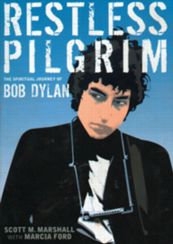
For those who still need to be convinced that Dylan has not (as some have presumptuously speculated) abandoned his faith in Christ, I'd also recommend Restless Pilgrim: The Spiritual Journey of Bob Dylan (Relevant Books, 2002) by Scott M. Marshall, with Marcia Ford.
The book covers all the key bases, from the biblical references in Dylan's lyrics (including many of his pre-conversion songs) to his fondness for traditional American gospel classics. It also squarely addresses the fact that Dylan's profession of faith confounds some evangelicals.
"Some skeptics in the church weren't convinced that his experience was authentic, like the distributor to some 2,000 Christian stores who initially refused to stock Dylan's albums," writes Ford in her introduction. She adds: "Today, neither the church nor the synagogue knows what to make of him."
The key reason, the book argues, is Dylan's rumoured embrace of traditional Judaism in the early 1980s. Ford states: "The word was out: Bob Dylan had renounced his faith in Jesus and returned to his Jewish roots."
Evidently, a lot of people had not heard of Messianic Jews, as Marshall makes clear: "The irony, to anyone who was paying attention to Dylan's own words during those years, is that he never left his Jewish roots. All along, he saw a direct connection between his identity as a Jew and his belief in Jesus as the Messiah. He could not have been more clear about that."
The book contains some telling quotes from other great songwriters, who did pay attention to Dylan's words. Calling Dylan "the Picasso of song," Leonard Cohen asserts: "People came to me when he put out [Slow Train Coming] and said, 'This guy's finished. He can't speak to us anymore.' I thought those were some of the most beautiful gospel songs that have ever entered the whole landscape of gospel music." There is also high praise from Dallas Holm, who refers to Slow Train as "an absolute monument of wonderful writing," adding that Dylan "wrote things as a new Christian that some of us struggle for years to figure out how to say."
The book affirms that various people found Christ during Dylan's all-gospel concerts. Says Regina Havis, one of the backing singers: "Some people that were there came in high, ready to just rock 'n' roll, and they ended up being saved." Dylan, she believes, "was sent to shed light on God's Word and how simple it is."
Marshall's book also proves that, in case the music gig doesn't work out, Dylan just might have a future as a preacher -- as evidenced by these quotes from one of his many 1980 between-song mini-sermons:
"There's only one thing that can save you, only one person went to the cross for you. And you can take it or leave it. Now if you don't believe in heaven or hell, you're [still] gonna die. You'll find out . . . .
"Don't you be deceived by the mockers of the truth. Lot of people praying. There's only one way -- praying all week, praying all year. God's got things in store for you, and I know He's calling to His people now. Some of you out there are nice people, maybe some of you aren't. But in the last days, He's gonna pour out His Spirit on all flesh. Now, you know if you're called or not. I know."
Hopefully, the increased appreciation for Dylan's gospel writing will inspire his record company to release a few special items, such as: the recordings which were made at a Toronto concert in April, 1980; unreleased performances of songs such as 'Blessed is the Name of the Lord,' 'Yonder Come Sin,' 'Sign on the Cross,' 'Cover Down Breakthrough,' 'I Ain't Gonna Go to Hell for Anybody,' 'Jesus, He's the One,' 'City of Gold,' 'Thief on the Cross' and Leonard Cohen's 'Hallelujah'; and rumoured recordings of the singer doing 'No Man Righteous,' and Dallas Holm's 'Rise Again.'
Topping my own personal wish list is that Dylan will finally record an acoustic album of the traditional hymns, spirituals and bluegrass gospel tunes that he has frequently sung in concert -- especially from 1999 onward. He has been known to perform 'Rock of Ages,' 'Peace in the Valley,' 'Pass Me Not, O Gentle Saviour,' 'Glory to the Lord,' 'This World Can't Stand Long,' 'Wait for the Light to Shine,' 'I am the Man, Thomas,' 'Be Not a Stranger,' 'Go Down Moses,' 'Hallelujah, I'm Ready to Go,' 'Somebody Touched Me,' 'Rank Strangers,' 'Precious Memories' and 'Little Moses.' Considering how well Dylan presented traditional folk material on his superlative early '90s albums, Good As I Been to You and World Gone Wrong, a similar acoustic gospel album -- perhaps with a band of bluegrass musicians -- is long overdue.
Of related interest:
The Dylan Companion (MacMillan London, 2000). An updated version of a 1990 book edited by Elizabeth Thomson and David Gutman, it features a good selection of mostly insightful appraisals of many aspects of the man's career; but for a book which bills itself as 'The Essential Companion to Bob Dylan,' it falls distinctly short of the mark.
Predictably, only one of the five articles about his 'Christian phase' presents his faith as a positive thing. The editors also show no appreciation for one of Dylan's most important works of art, his amazing 1978 film, Renaldo & Clara. They feature Pauline Kael's condescending and dull-witted hatchet job, so typical of most reviews of the film; positive reviews do exist, however, and the book includes none of them. The editors squandered a great opportunity to give Dylan's fans any worthwhile insights into one of his most significant -- and hard to obtain -- works.
The film, unfortunately, has never been released on video or DVD, and has only circulated through tapes made from a TV broadcast. However, music directly related to the movie was recently made available on Bob Dylan Live 1975 (Columbia, 2002).
Dylan took a film crew along on his first Rolling Thunder Revue tour. In addition to concert footage of Dylan, Joan Baez, Ronee Blakeley and Roger McGuinn, he had his fellow musicians and other friends -- such as poet Allen Ginsberg, actor Harry Dean Stanton and playwright Sam Shepard -- play roles in a variety of odd little fantasy scenes.
In 1977, Dylan blended the concert scenes and fantasies with poetry recitations and documentary sequences. The result was a dizzying collage of music, ideas, moods and images -- a complex and surreal circus staged somewhere deep in the songwriter's mind. Ringmaster Dylan played Renaldo, and his then-wife Sara was Clara -- an enigmatic pair of lovers. Woven into the whirling tapestry of concepts were subtle biblical references, and a sequence tracing the Stations of the Cross.
All told, Renaldo & Clara is one of the most astonishing achievements in experimental cinema ever conceived -- ranking with Stan Brakhage's Dog Star Man, Chris Marker's Sans Soleil, Jack Chambers' Hart of London, and Andrei Tarkovsky's Mirror. Dylan could have played it safe and released a conventional concert film full of great performance footage; instead, he took big artistic risks, and was rewarded with some very nasty and unperceptive reviews.
For those who want to see what they missed, clips of great performances from Renaldo & Clara are on a DVD accompanying Live 1975. Brimming over with energy and creativity, the double CD is a wonderful encapsulation of the original Rolling Thunder Review, the tour which produced the music for Renaldo & Clara. While none of the specific performances on the album appear in the film, the CD does contain similar versions of most of the songs which were in the film. It's a dynamic presentation of a phenomenal tour.
It should also be noted that Rolling Thunder first teamed Dylan with T-Bone Burnett, David Mansfield and Steve Soles, whose faith in Jesus no doubt helped inspire Dylan's decision for Christ.