
May 2003
Homer, Elvis, coffee and Christ
BC Christian News, · Top Stories
Two local churches balance cultural relevance and solid biblical truths as they try to change their community's perception of what a church should be.
By Kevin Krikke
YOU KNOW you're not visiting just any old church when the doorman is Homer Simpson. "Right this way," he beckons, donut in hand. The tardy are greeted with: "D'oh, late again -- come on in anyways!"
Of course, we're not talking about the real Homer Simpson (is there a real Homer Simpson?), but a cartoon picture painted on a sandwich board. And we're not talking about any old church, but the newly planted Home Church Fraser Valley, which meets weekly in Langley City's Nicomekl School .
Home Church pastor Jim Moerman says the Simpson patriarch is an appropriate mascot -- both because of his first name, and because he represents a segment of Home Church's target audience. "He's a family man who's in need of some help."
While some churches would shy away from affiliation with such pop culture icons as the Simpsons, the Home Church's approach is indicative of the growing number of Christians who have recognized, as Moerman says, "how easy it is for the church to ignore the culture we live in and operate in a secluded Christian world." He and his colleagues believe the church should be aware of the culture of the day, so that "the potential to connect with those who are not yet 'home' with God their father will be stronger."
In a typical Sunday service, a popular song like 'Everybody' (by Stabilo Boss) or a short clip from a recent movie such as The Fellowship of the Ring is used "as a springboard from which to launch timeless, biblical truths." Moerman knows that his culturally-connected approach won't appeal to everyone, but that was never his aim. After all, the official purpose of Home Church is "to invest in, and invite, prodigals to come home."
Making use of today's culture is one of the main components in Moerman's strategy to reach Langley's prodigals. While he draws inspiration from the likes of Bill Hybels, the father of the 'seeker-sensitive' church movement, Moerman has also based his ideas on years of ministry experience in the Reformed Church in America (RCA).
After growing up as a minister's son, he pastored Surrey's Grace Community Church for 10 years. This was followed by a six-year stint in Ontario as superintendent for all 48 of Canada's RCA congregations.
It was during this period, Moerman says, that his learning curve "mushroomed." He began noticing common patterns, obstacles and successes among the churches he worked with. The chance to put his observations and ideas to work came in 2002, when Moerman and his wife, Babette, decided to plant a new church in inner city Langley.
Since their official launch this past September, Home Church has held regular events to attract 'seekers' from the local community. Their Homecoming Weekends are specifically designed "to develop relationships with the unchurched, to express God's love in action, and to proclaim God's word."
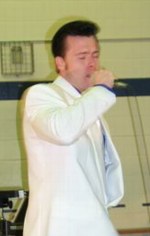
Events designed to attract the unchurched have included an Elvis impersonation act, a showing of My Big Fat Greek Wedding, and the recent Eggstravaganza Easter Egg Hunt. Expressing "God's love in action" usually comes in the form of a Clothes-2-U clothing giveaway, which has been well attended by the needy segments of the local community.
At each event, invitations to Home Church's Sunday service are handed out. Moerman is excited about the success of these events, and about their potential to create new bonds and to change the church's reputation among Langley's non-Christian community.
Another local pastor excited about forming new relationships and altering preconceptions among the un-churched is Graham Fletcher. In 2001, Fletcher and his wife, Patti, came from Australia to North Vancouver to plant Christian City Church Vancouver (C3V). The congregation is part of the rapidly growing Christian City Church International movement, which began in Australia during the 1980s.
C3V meets weekly at the Lonsdale Quay Hotel, with the service being directed towards "the young and the young at heart." Worship is conducted in "a rock 'n roll style. Music is a huge part of our church movement." Fletcher's focus is clearly on reaching Vancouver's youth; at 50, he describes himself as "the world's oldest living teenager."
After growing up in and then ministering to Australia's surfing culture, Fletcher chose to plant a congregation in North Vancouver because "there's a close connection between surfers, snowboarders and extreme sports people." He actually began his first church at an Australian surfing club (similar to a resort), and has continued to innovate ever since.
One of C3V's more innovative outreach ideas is known as Café Church. On a given Sunday, the congregation will take over a local café to "have fun doing the serious business of church." With several young members involved in the local film industry, Café Church is often capped by a multimedia presentation with a biblical message.
Fletcher sees this outreach as an attempt "to capture the ethos of Vancouver and express it in the church." He sees Vancouver as a city of global influence, particularly in terms of youth culture. Just as world youth trends poured out of southern California in the 1960s, he thinks the Pacific Northwest -- including Seattle, Portland and Vancouver -- has had that type of influence since the 1990s, and believes the church should position itself accordingly to take advantage of this.
Like Moerman, Fletcher emphasizes the church's need to be culturally relevant. While he professes a love for the church universal, he claims that it "has to catch up with the new millennium. There's a lost generation of young people growing up who don't come to church -- because there's a lack of relevance, style and appeal." Fletcher states that while the gospel is more relevant than ever, our style of communicating it is, unfortunately, often not effective.