
May 2003
Prof will spend his summer behind bars
BC Christian News, · Top Stories
Psychology professor Doug Hampson works to rehabilitate the most dysfunctional inmates in B.C.'s maximum security prison. His students benefit from his experiences -- particularly when Hampson invites ex-offenders to class, to share their stories.
By Julie Frizzo
THIS SUMMER, while most university teachers are focusing on research, writing books, or vacationing, Trinity Western University (TWU) professor Doug Hampson will be behind bars, in a maximum security prison -- but not for the reason one might think. For the past 10 years, he's been bringing hope to hardened inmates -- and their stories to his psychology students.
As a psychologist at Kent Institution in Agassiz, Hampson helps rehabilitate some of society's worst offenders -- some of whom are segregated from fellow inmates, because their crimes are considered heinous even by other prisoners. These men are housed in a special block known as the 'alternative to segregation' unit.
Hampson meets with the men individually in a small room, and carries an alarm to sound if his safety is threatened (he's never needed it). "My goal is to position myself as an advocate and help these guys to move to either a treatment centre ,a medium-security institution, a more program-oriented place where they can start addressing some of their root issues," he says.
Hampson's approach blends compassion and cognizance. "Society looks at these people in disdain -- and while I don't excuse their victimization of others, I think God sees them as individuals. There's a cycle. They've been victimized, and they've continued the pattern. Unless the past is addressed, and they see someone willing to help them learn a new way of life, a lot of these guys will be released and they'll just victimize again."
Working in prisons "can get pretty discouraging," he admits. "There are more bleak stories than success stories. Yet in the midst of that, my faith gives me hope that God is at work -- and even though things are very difficult, God can do the impossible. I try to communicate that hope to the people I work with."
The scope of Hampson's work is much broader than simply helping his clients move out of Kent. He follows the inmates to whichever lower security facility they are moved to, and monitors their progress.
"The heart of the issue, particularly in psychology, is combining the theoretical side and the pragmatic side. So it's ideal to have a foot in each. And, now and again, I try to bring my two worlds together. They're quite separate -- but, in fact, they complement each other."
For 10 years, he has utilized his prison experience in the classroom.
"It's mutually beneficial. In the prisons, I see these guys in a highly controlled environment. And on the other hand I see students in a secure campus community. I thought the students could benefit from hearing the stories of some of the people inside the prisons, and the ex-offenders could definitely benefit from seeing what happens in a university."
Hampson knows how fortunate he is to be at the front of the lecture hall -- he could have easily slipped into the same hopeless lifestyle as his speaking guests. He spent most of his youth in Young, Saskatchewan, a farming community with a population of 350.
Moving west to Vancouver after he graduated high school was a rocky transition for him.
"I drifted toward a negative crowd," he recalls. "I worked at a warehouse with a lot of young guys who were into the drug culture, so I got caught up in that scene for a while."
But Hampson didn't see himself following that path forever. "During those years, at the very bottom of my soul, I wanted to be a psychologist when I came out of that lifestyle." An opportunity to break out of the dead-end pattern came when he met some TWU alumni at a local church. "They recognized that I needed some support, so they drove me out to see the campus in '77."
Just over a decade later, Hampson had not only graduated from TWU with a psych degree, he had completed a Masters of Divinity at Regent College, and a MA in counselling psychology at UBC.
Then he hit the frontlines of rehabilitation work through positions with the local Salvation Army and Wagner Hills Farm Society.
Through it all, Hampson maintains a perspective of humility. "This position has taught me to listen more, to hear other people's stories, and dialogue with them. Even if someone is a violent sex offender, there is something in the way they've experienced life I can learn from."
To see lives transformed is a plus, but not Hampson's sole motivation. "I'm thankful that God has me where I'm at, considering where I've come from," he reflects.
"In a sense, I just work with individuals who not many people want to work with. At the end of the day I think that's a worthy calling."
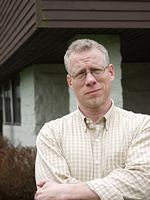
Professor Doug Hampson will spend his summer with some of society's worst offenders -- some of whom are even segregated from the rest of the prisoners in the jails they have been sentenced to. Photo: Mike Rathjen