
June 2003
20th century choral masterworks
BC Christian News, · Arts
AS THE DUST of the 20th century settles, some of its key composers stand tall as masters of the choral repertoire.
• Krzysztof Penderecki: Orchestral & Choral Works, EMI Classics, 2001.
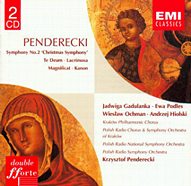 |
A giant among the composers of the past several decades, Penderecki here conducts two of his finest compositions: Magnificat and Te Deum. Some of the music is reminiscent of Russian liturgical music; there are sweeping orchestral statements with sustained choral underpinning; and a powerful use of bells with dissonant passages.
He takes a fascinating approach to the praise-oriented texts: his often discordant music doesn't immediately relate to the words, but it creates an atmosphere of otherworldly, almost eerie reverence -- somehow managing to be both dissonant and ethereal at the same time. While it might seem a rather odd approach, in the master's hands it conveys a sense of awe -- proving that praising God doesn't have to be conventionally melodic. This is some of the composer's most challenging music, with outstanding work by mezzo-soprano Ewa Podles and the Polish Radio Chorus of Krakow.
• Choir of St. John's College, Cambridge: Walton -- Choral Music, Naxos, 2002.
Likely best known for his powerful soundtrack for Laurence Olivier's classic film version of Hamlet, Sir William Walton is increasingly recognized as a major composer. His Symphony No. 1 is brilliant, as is his major sacred oratorio, Belshazzar's Feast. This CD highlights a good cross-section of his shorter choral works. Coronation Te Deum is marked by complex and imaginative melodic twists, as is Magnificat. Nunc Dimittis has a tranquil air of resignation, and a quietly imploring tone. Where Does the Uttered Music Go? is quite lyrical, and has a brief flirtation with dissonance. The Twelve, W.H. Auden's tribute to Christ's original disciples, is given an imaginative, varied setting, and comes to a joyful conclusion. Missa Brevis trades the Latin text for English, and also reorders the traditional sections -- ending effectively with the 'Gloria'; the piece is a capella until that last section, when an organ joins the voices for a joyful finale.
• Choir of St. John's College, Cambridge: Tavener - Song for Athene, Naxos, 2000.
John Tavener is known as a devout Eastern Orthodox believer, and his music clearly reflects that musical tradition. The best-known piece, Song for Athene (famously featured at the finale of the funeral of Princess Diana) is profoundly beautiful in its simplicity. God is With Us begins with a faint chorus, conveying subdued joy; at a strategic point, a mighty organ note and swelling choir burst forth. Magnificat takes a very assertive approach to Mary's famous proclamation in Luke. Other highlights include settings of poems by William Blake and George Herbert; and the sober -- but not gloomy -- Funeral Ikos. The standout is Svyati, a prolonged combination of solo cello and chant; it begins subdued, then asserts itself as the choir sings sustained notes, while the cello goes into high, almost Middle Eastern riffs. A lovely work.
• Helmuth Rilling: Requiem of Reconciliation, Hanssler Classic, 1995.
Commissioned to mark the 50th anniversary of the end of World War II, this extraordinary work brought together 14 composers from around the world. Each tackled a different movement, most using the traditional Latin Requiem text as their basis; the result was premiered on August 16, 1995, and preserved on this recording. Because of its sheer magnitude, it has not likely been performed live very often since.
Italy's Luciano Berio provides the 'Prologue,' which opens with a flourish of off-kilter trumpets -- followed by prolonged choral lines set against discordant instrumentation. The 'Introitus and Kyrie' section by Austrian Friedrich Cerha effectively combines murky dissonance with sweet, plaintively yearning choral lines. Germany's Paul-Heinz Dittrich gives us a chaotic 'Dies Irae,' utilizing jagged horns and mournful choral sounds. French composer Marc-Andre Dalbavie's 'Offertorium' combines tranquil a capella chant with ominous percussion and horns. Russian Alfred Schnittke's 'Communio' is melodic and ethereal; and Romanian Gyorgy Kurtag's 'Epilogue' powerfully ends the piece with several loud, lone drumbeats and whispered vocals.
This massive work is surely one of the great achievements of 20th century music, ably performed by several gifted soloists, with the Gachinger Kantorei Stuttgart and the Israel Philharmonic Orchestra under Helmuth Rilling's direction.