
June 2003
Overloaded Matrix sequel not so 'Christian'
BC Christian News, · Arts
• The Matrix Reloaded
 |
IT'S TOO early to say all that much about The Matrix Reloaded -- it's only the first half of a two-part sequel that won't be over until the next installment comes out in November -- but the film does force fans of the first movie to rethink everything they thought they knew about it.
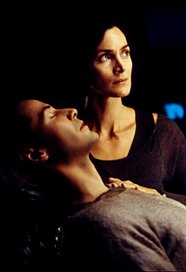 |
Ever since The Matrix came out four years ago, many Christians have had fun pointing out all the parallels between Neo (Keanu Reeves) -- the prophesied chosen one who fights back against the machines that have enslaved humanity sometime in the future -- and Jesus.
Never mind the film's glamourization of terrorism or its overtones of Gnostic mythology, Eastern religion and French postmodern philosophy. The film had a hero who died and came back to life again -- and that was enough to make the film okay in the eyes of many Christians.
But The Matrix Reloaded may cause Christian fans to rethink their appropriation of Neo's story, not least because the new film seems to undermine the very messianic overtones of the first film.
For example, consider how Morpheus (Laurence Fishburne), Neo's mentor, objects to the Matrix not because it is an artificial reality -- if anything, he seems to like the powers he has in cyberspace -- but because it is the means through which machines 'control' humanity. And then note how Morpheus believes in a 'Fate' that guides everyone's lives.
Without giving too much away, the new film asks whether there is any real difference between Fate and the Matrix -- it asks, in effect, whether prophecies and promises of salvation may be just another form of control.
Also, consider how, in the first film, one character said it is following our impulses that makes us human. The new film seems to question that idea, too, since it suggests that even our impulses may be nothing more than bio-chemical reactions, and our actions may be nothing more than the end result of a series of deterministic 'causes and effects.'
Thus, even if Neo rescues everyone from the Matrix, they might still never be truly free, because they have no free will.
We will have to wait until November to see how the Wachowski brothers, who wrote and directed these films, plan to answer these questions. Alas, pondering these questions is not as much fun as it used to be, since The Matrix Reloaded is basically just one fight scene after another, with little to give them the meaning or narrative purpose that the fight scenes in the first film had.
The new film also adds a new, and very awkward, element of sexuality to the story. The orgiastic dancing in Zion, the city of liberated humans, is especially tacky. It's enough to make you think Cypher, the traitor in the first film, may have had a point when he wanted to get away from all that.
• Bruce Almighty
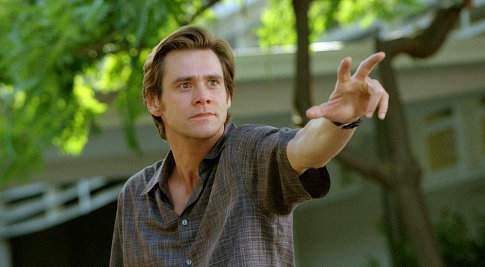 |
Free will is also a prominent theme in Bruce Almighty, which reunites Jim Carrey with Liar Liar director Tom Shadyac.
Carrey plays Bruce Nolan, a TV reporter frustrated with his job -- who, rather than focus on all the good things he has, vents his frustrations at God. To Bruce's surprise, God (Morgan Freeman) answers him and gives him the temporary use of his powers -- in effect, daring him to see if he could do any better.
Bruce is rude and selfish, so the miracles he performs at first tend to be rather base; among other things, Bruce makes a monkey come out of one nasty guy's butt, and he supernaturally spices up his sex life with his girlfriend, the not-so-subtly-named Grace (Jennifer Aniston).
But eventually, of course, he learns that there are more important things in life than self-indulgence, and he learns that relationship is about giving up control and allowing others to love you.
Bruce Almighty is not a terribly good film, or even a very Christian one. As often happens in Hollywood, the relationship between people and God is very direct and individualistic; and the film fails to recognize the role that communities of faith can play in bringing us closer to God. But it may give those who see it plenty of food for discussion.
• Early Jesus movies
Speaking of Christ figures, Image Entertainment has just released a new DVD featuring two of the earliest films ever made about the life of Jesus, and it's a must-see for Christian film buffs.
The Life and Passion of Jesus Christ was produced in France between 1902 and 1905, and at roughly 40 minutes, it is a superb example of early silent filmmaking.
Like most films of that time, it has a stagey, theatrical quality; most scenes are shot in a single wide take, and the actors tend to communicate through exaggerated hand and facial gestures. But the film works very well within its limitations, and it makes great use of the stencil colouring process developed by the Pathe studio.
The Life and Passion of Jesus Christ is also noteworthy for being one of the few films in its genre to include not only the crucifixion, but the resurrection, the ascension and the seating of Jesus at the Father's right hand, with the Holy Spirit poised above them as a dove.
Eight years ago, the Vatican included this film among its 15 recommended films about religion, but it was virtually impossible to find on video. Now, thankfully, everyone can see it.
The DVD also includes From the Manger to the Cross (1912), the first feature-length film about Jesus. Like the Jesus film that Campus Crusade for Christ produced nearly 70 years later, this film was shot mostly on location in the Middle East -- and it even includes a glimpse of the pyramids and the Sphinx as Mary and Joseph make their way to Egypt.
The film's narrative emphasis is a little odd -- nearly a third of it is spent on the birth and childhood of Jesus, and it ends, as the title suggests, without the resurrection -- but it's still a milestone of the genre, and worth seeing.
• Tarkovsky retrospective
The films of Russian Orthodox director Andrei Tarkovsky are haunting, mystical experiences, and you can spend hours trying to process them afterwards.
Each film deserves an evening to itself, but if you can handle two -- or even three -- of them on the same day, you're in for a treat, since the Pacific Cinematheque in Vancouver is hosting a retrospective of Tarkovsky's work June 20 -- July 2.
In addition to the seven films Tarkovsky directed between 1962 and his death from lung cancer in 1986, the Cinematheque will also show two documentaries on Tarkovsky (including one by La Jetee director Chris Marker), as well as Steven Soderbergh's remake of Solaris.