
June 2003
The end is near -- and profitable
BC Christian News, · Top Stories
 |
OF THE MAKING of apocalyptic books, there is no end -- not unless the end really is as near as these books say it is.
With the publication of Armageddon, the 11th installment in the Left Behind franchise, the saga begun by Tim LaHaye and Jerry B. Jenkins would seem to be almost over. The series, which began in 1995 as the world was just starting to get caught up in millennial fever, was conceived as a trilogy; but it was soon expanded into a 12-part storyline.
However, Tyndale, the company publishing these novels, has announced plans to create at least two new spin-off series, in addition to the three or four dozen comic books, non-fiction books and children's novels that have already been produced or are in the works.
Tyndale has hired Tekno Books, a 'book developer' that specializes in tie-ins to bestsellers by the likes of Tom Clancy and Dean Koontz, to create military and political thrillers based on Left Behind. Publishers Weekly reports that a series focusing on angels or the supernatural is also under consideration.
Left Behind is certainly not the first apocalyptic novel, and it won't be the last.
In 1970, around the time Hal Lindsey wrote The Late Great Planet Earth and two years before the film Thief in the Night was first shown in church basements, Salem Kirban released the Armageddon thriller 666; it was followed by a sequel, 1000. But it took the success of Frank Peretti's supernatural thrillers in the late 1980s and the Christian fiction boom of the early 1990s to make end-times novels the success story they are.
Following the runaway popularity of Peretti's This Present Darkness, several authors best-known for their non-fiction work -- such as Charles Colson, Pat Robertson and Larry Burkett -- began writing or commissioning novels of their own, many of which dealt with dystopic visions of a godless future, in which America falls prey to the forces of secularism.
LaHaye, too, had an idea for a novel, so he teamed up with Jenkins, a former ghost writer, to create a series of novels about the Rapture and the Tribulation. And the rest, as they say, is history.
Their success has spawned various imitators -- some of which have been dismissed as artistically inept. In 1998, for example, conservative talk show host Marlin Maddoux wrote The Seal of Gaia: A Novel of the Antichrist. Epinions.com critic Thomas Knapp.dismissed it as "an ill-conceived treatise . . . on the nature of things like 'the New World Order,' formatted as poorly written fiction."
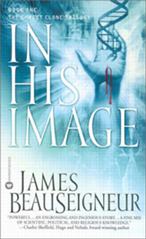
Nevertheless, even secular publishers are angling for a piece of the action. Earlier this year, Penguin Books published the first two installments of The Prodigal Project, a series of end-times novels by Ken Abraham (co-author of Lisa Beamer's Let's Roll) and Daniel Hart; and in January,Warner Books published In His Image, the first book in the 'Christ Clone trilogy' by James BeauSeigneur. ArmageddonBooks.com describes the latter book -- which posits the cloning of Jesus from cells on the Shroud of Turin -- as "combining the visionary power of Tim LaHaye and Jerry B. Jenkins with the scientific suspense of Michael Crichton and the tense global thrills of Tom Clancy."
Some have been critical of the LaHaye-Jenkins books. Last year, Lisa Ruby of the U.S.-based Liberty to the Captives published a scathing critique of LaHaye's theology, entitled God's Wrath on Left Behind: Exposing the Antichrist Agenda of the Left Behind Series.
In a lighter vein, Idaho-based Canon Press, publishers of The Mantra of Jabez, released Right Behind, a "parody of last days goofiness" by Nathan D. Wilson and 'Mr. Sock'. An ad for the book declares: "You won't want to miss all [the] body parts, cats, and youth pastors left behind . . . or the climactic struggle with the Tulsa Antichrist in a Christian 'book store..'
-