
November 2003
Death and moral choices dominated Fest films
BC Christian News, · Arts
IF ONE theme dominated Canadian films at this year's Vancouver International Film Festival, it was death – more specifically, terminal illness and the questionable moral choices that some characters make as they face their impending demises.
This theme was there right from the opening gala, which featured a screening of The Barbarian Invasions, Denys Arcand's sequel to his Oscar-nominated 1986 classic The Decline of the American Empire.
In the new film, which is due to be released this month, Remy (Remy Girard), the serial adulterer of the earlier film, is now divorced and estranged from his children, but his friends and family reunite when he finds himself confined to a hospital bed with just a few months left to live.
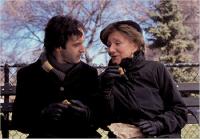
Christians may find the new film especially intriguing because it also brings back not one, but two, characters from Arcand's other widely praised film from the bygone past, namely 1989's Jesus of Montreal. But more on that in a moment.
The key thing to remember about Arcand is that he was a historian before he became a filmmaker, and his training comes through in many of his films. In The Decline of the American Empire, a comedy about sex and upper-middle-class decadence, a professor states that moral depravity is often a sign that an empire is in decay; thus, there is a serious social point to be made beneath all the philandering the film depicts.
This is also the backdrop against which Arcand's following film, about a troupe of actors who put on a revisionist passion play based on the 'historical Jesus', needs to be seen.
Jesus of Montreal is about the search for meaning in a world where political ideology and crass hedonism have both led to a dead end. And, since Arcand had already identified modern America with ancient Rome in Decline, he now asked if an actor playing Jesus on the fringe (Quebec) of the fringe (Canada) of the American empire might be able to point us to some sort of deeper meaning, the way that Jesus, a man on the fringe (Galilee) of the fringe (Palestine) of the Roman empire, once did.
Daniel Coulombe (Lothaire Bluteau), the boat-rocking protagonist in Jesus of Montreal, died at the end of that film, partly because of the appalling conditions in a public hospital. And to judge from The Barbarian Invasions, things have gotten even worse since then – during the opening credits, the camera follows a nun down a crowded corridor as she passes numerous patients and staff, wires dangling from the ceiling as technicians fumble about. The whole scenario reeks of the so-called Third World.
And then we discover something surprising. The nun, it turns out, is Sister Constance Lazure (Johanne-Marie Tremblay) – the very same woman who worked in a soup kitchen before joining the other actors in Jesus of Montreal. Constance appears in only a few scenes in The Barbarian Invasions, but her presence adds an interesting spiritual element to a story that is mostly about the despair with which Remy faces the end of his life.
Throughout the film, Arcand juxtaposes personal mortality with other kinds of mortality, such as the death of nations and ideas. In one scene, an academic on TV compares the September 11 terrorist attacks to the invasion of barbarians that brought down the Roman empire – no longer are the outsiders being held off in Germany or wherever, but now they have struck the centre of power itself.
When Remy's son Sebastien (Stephane Rousseau) goes looking for heroin to ease the old man's pain, a narcotics officer makes a similar comment about dealers "invading" Canada from other countries. And so the empire is still in decline.
This is where the second Jesus of Montreal cameo comes up. In one brief scene, a priest takes Sebastien's girlfriend to an underground warehouse, where a lot of religious art is sitting in a state of decay, unwanted and unused. The priest laments the death of religion in Quebec and asks if the church can sell any of this stuff off – and the priest in question is Father Leclerc (Gilles Pelletier), the compromised, jaded cleric who commissioned the ill-fated passion play in the earlier film.
These are fascinating parallels, and they make an old favourite even more interesting than it already was. As for the death theme in general, The Barbarian Invasions is not a very hopeful film – it is filled with sadness, confusion and regret – but it comes by its grief honestly.
The same could not be said for The Event, Maritime director Thom Fitzgerald's manipulative and sentimental tribute to euthanasia. The film stars Parker Posey as a New York cop who investigates the death of an AIDS victim (Don McKellar) who went out with a bang by throwing a party for his friends and family the night that he planned to kill himself.
The film is actually fairly entertaining, despite its serious subject matter, but the fact that Fitzgerald knows exactly how to push our buttons just makes it all the more offensive that his film is such a blatant work of propaganda.
Fitzgerald tut-tuts every single character who would dare to question the righteousness of suicide, and the film goes on and on about how much love it took for the gay man's friends to kill him at his request.
And of course, there is the usual patina of religiosity to make it all acceptable – like when the gay man's mother (Olympia Dukakis) says things like, "Sometimes the only way to protect a defenceless child is to let him go back to God."
What makes the film even more disturbing is the way it rubs our noses in the idea that, as the cop's own aging mother puts it, "Getting old sucks." AIDS victims, in other words, are not the only people we should consider killing out of the goodness of our hearts. You cannot help but wonder what goes through an old actress's mind when she is given such lines, especially in service of a film that goes out of its way to romanticize death.
In other news, Mel Gibson has finally found a distributor for his death-of-Jesus flick. The Passion of Christ – Gibson had to change the title because Miramax had already registered 'The Passion' for an adaptation of the Jeanette Winterson novel of that name – will be released in February by Newmarket, the company that handled Memento and Whale Rider.
While the debate over the film's alleged anti-Semitism has not quite died down, some Christians have begun to raise concerns about the film's possible obsession with the graphic details of crucifixion.
Gregg Easterbrook, a Presbyterian, suggested in his online blog at The New Republic that Gibson may be sensationalizing the death of Christ, the same way his other historical films have sensationalized violence.
Frederica Mathewes-Green, who is Orthodox, wrote a Beliefnet column (and a follow-up essay on the history of the atonement on her web site) exploring the possible theological problems that arise from fixating on the wounds of Christ, rather than on his triumph over death.
And Archbishop Stefan Soroka of the Ukrainian Archdiocese of Philadelphia, who has actually seen the film, called it "shallow" in an article for his archdiocesan newspaper. "Frankly, without the hype, this movie will not interest many viewers because it fails to offer hope," he wrote.
"I would not recommend the movie to my friends nor to the faithful – and particularly the young – because the film, while interesting in the way some things are portrayed, particularly evil, lacks content to really engage my interest."
The weirdest news yet, though, is a report in one of Variety's supplementary magazines, in which Passion of Christ producer Scott McEveety says actor Jim Caviezel, who plays Christ, and an assistant director were both struck by lightning while shooting the film. Just a coincidence? As of this writing, there is no word yet on what the star of Signs thinks.