
November 2003
Influential musicians have fascinating faith stories
BC Christian News, · Arts
By John Cody
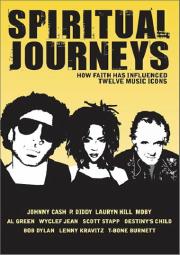 |
• Spiritual Journeys, Relevant Books, 2003.
THIS BOOK, written by Steve Beard, Denise Washington, Jason Boyett, Scott Marshall and Chad Bonham, is subtitled 'How Faith Has Influenced Twelve Music Icons.'
It profiles mainstream acts, each of whom (to varying degrees) is significantly influenced by their Christian faith. While none falls into the rigid confines of the CCM world – and in some cases their faith is hardly orthodox – they all point to Christ; and often, the music they create is far more genuine than a lot of what is released under the 'Christian' banner.
Sean 'P. Diddy' Combs served as an altar boy in a Catholic church in Harlem. Raised in such a setting, he was exposed in equal measure to the sacred and the profane. His grandmother – a devout Catholic – had a strong influence on his thinking.
In 1999 he appeared in a video for rapper Nas, which featured a mock-crucifixion scene. Diddy was incensed at the final edit, and resorted to extreme measures to quash the video, including breaking Nas's manager's arm and jaw.
Justifying his response – which resulted in a court-ordered anger-management class – Diddy commented that while money, women and friends will come and go, "no matter what I do, I can always go to church. If I disrespect God and make a mockery of God, I can't even go to church."
The book's writers argue that Diddy's faith is as complex and contradictory as King David's; surrounded by wealth and death, he frequently partakes of most of the temptations this world has to offer – and yet he addresses mortality and ultimate judgment. At times his behaviour appears extreme; but he has never shied away from discussing his faith, questioning publicly whether his trials are a means of preparing him for something God-ordained.
The members of Destiny's Child are active churchgoers, and aren't afraid to sing about their faith. Beyonce Knowles recently maintained that her faith is compatible with the revealing outfits she wears, saying: "I honestly believe [God] wants people to celebrate their bodies, as long as you don't compromise your Christianity in the process."
However, she does draw the line at attention-grabbing faux-lesbian displays, and commented last month on the Madonna/Britney Spears kiss during this years' MTV awards ceremony: "I couldn't do what Britney and Madonna did. I knew it was going to happen from rehearsal, but it was still a shock when they did it."
Destiny's generation has grown up in an environment where school shootings, broken homes and gangsta rap are the norm – so, in the overall scheme of things, the outfits may be less of an issue.
Lauryn Hill has long proclaimed her faith in Christ. Even before The Fugees' debut release, she shared her beliefs while acting in the film Sister Act 2:Back in the Habit.
"Talking about God doesn't embarrass me. It doesn't make me less cool or less popular or make me corny." At the Grammy award ceremony, when accepting an award for The Miseducation of Lauryn Hill, she carried a Bible to the podium and recited scripture. She followed up with a double live disc that was even bolder in acknowledging her faith.
T-Bone Burnett is hardly a household name. His own records have never placed on the best-seller charts; but his influence is wide, in part due to his lengthy list of production credits, which includes Counting Crows, Los Lobos, Wallflowers and Elvis Costello. He recently garnered a Grammy as producer of the soundtrack for O Brother Where Are Thou.
Burnett describes his journey in refreshingly honest terms; "For the last 20 years, I have been endeavouring to truly be 'in the world but not of the world.' But I'm horribly of the world, and I screw up."
Entertainment Weekly described the material on 1992's The Criminal Under My Own Hat as "deeply religious compositions [that] tilt nobly at the windmills of human weakness . . . Of such honest, cathartic communications are masterpieces made."
He has expressed frustration over the media's tendency to equate Christianity with right-wing fundamentalists.
"We are Christians because we are redeemed. People like myself, Bruce Cockburn, Bono and Bob Dylan have tried to bring love and perspective and Christ to people who can't hear Jerry Falwell." He describes his songwriting approach succinctly: "You can sing about the Light, or you can sing about what you see because of the Light. I prefer the latter."
The others profiled – Bono, Johnny Cash, Moby, Wyclef Jean, Scott Stapp from Creed, Lenny Kravitz and Bob Dylan – have equally interesting stories.
At times, the writing can be pedestrian; and a fact checker could have been put to good use; for example, Greil Marcus is referred to as "noted music critic Marcus Greil."
While this book profiles 12 key musicians, numerous others could have been included. It shows that, more than ever, there are faith-informed musicians in the mainstream