
Bonhoeffer's meanings lost in translation?
BC Christian News, · Editorials
March 2004
Bonhoeffer's meanings lost in translation?
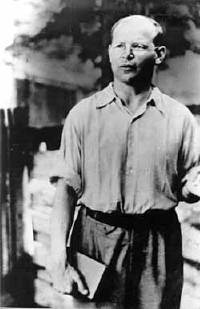
German theologian and martyr Dietrich Bonhoeffer will be the subject of Bonhoeffer: Film & Dialogue, a March 25 presentation at Regent College -- featuring John S. Conway, author of The Nazi Persecution of the Churches 1933-1945. Conway offers the following appraisal of some of Bonhoeffer's poetry.
ON DECEMBER 19th ,1944, Dietrich Bonhoeffer, in his bleak prison cell, wrote a Christmas letter to his fiancée, Maria von Wedemeyer, which included a poem.
Days later, he sent a slightly different version in a letter to his parents. The poem has since become widely popular in church circles. It is available in various editions, which have differing translations. Which one should be regarded as the most authentic?
One version of the poem -- variously titled 'New Year' or 'Powers of Good' -- was turned into a hymn. This transition inevitably brought rhythmic constraints. A 1972 version of the final verse runs: "By gracious powers so wonderfully shelter'd /And confidently waiting come what may /We know that God is with us night and morning /And never fails to greet us each new day."
The translator was likely stressing the universal, timeless character of the words, and so omitted the personal and new year's references in Bonhoeffer's original text. The result is a more sentimental and predictable version, and the translator has cut any of the author's references to the Christmas season, or to the terrifying predicament in which Bonhoeffer and his closest relatives found themselves. This version therefore runs the risk of being used as a form of spiritual band-aid, a piece of pietistic pain-reliever.
A very different version is found in the more recently published Love Letters from Cell 92. The final stanza now runs: "By kindly powers so wonderfully protected/ We wait with confidence, befall what may/ We are with God at night and in the morning/ and, just as certainly, on each new day. "
The attractiveness of the phrase 'kindly powers' certainly outweighs the more concrete image of the 'powers of good.'. But does it do justice to the implied contrast with the forces for evil, which were so brutally present in Bonhoeffer's life at that very moment?
In the second line, the idea of comfort is not fully superseded by the notion of confidence. Nor is it clear why the translator had to make the inversion of the third line, when Bonhoeffer clearly and deliberately asserts that the initiative comes from God, not the other way around. The theological content of Bonhoeffer's final stanza seems simple and clear: the assurance of God's continuing daily presence. It stands perhaps in contrast to the much more intense fervour of the prayer contained in the earlier stanzas, with their strong overtones of Jesus' own prayer in Gethsemane.
It is interesting to compare two versions of one of those earlier stanzas. First, the hymn version: "Yet is this heart by its old foe tormented/ Still evil days bring burdens hard to bear; /O give our frightened souls the sure salvation/ For which, O Lord, thou taught us to prepare."
The other version is, surely, truer to the author's original intent: "The old year still torments our hearts, unhastening;/ The long days of our sorrow still endure; /Father, grant to the souls thou hast been chastening/ That thou has promised, the healing and the cure."
Bonhoeffer inverts the usual expectation of a joyous salvation prepared for the faithful by God, but insists instead that God prepares the faithful for the kind of salvation to be granted "to the souls thou hast been chastening.".
Here is a very literal translation of stanza three, which seems to capture the original poem's atmosphere of reluctant acceptance of a tragic imminent fate: "But should you tend your cup of sorrow/ To drink the bitter dregs at your command, /We accept with thanks and without trembling,/ This offering from your gracious, loving hand."
But another, more poetic translation surely captures the nuances -- and accentuates the contrast between the flinching recipient and the gracious donor: "If thou shouldst offer us the cup of sorrow,/The bitter brimming chalice we'll withstand/And thankfully accept it, never flinching,/From out thy righteous and beloved hand."
We can only infer how prayerful and psalm-filled was the conscience of someone who so courageously faced, in the Gestapo's main prison, the imminence of his own trial and execution -- without flinching, and still affirming God's goodness.
This stanza can surely be seen as recalling a passage from Bonhoeffer's July 21st letter -- written the day after the failure of the assassination plot against Hitler -- anticipating all the consequences that he could well envisage the powers of evil inflicting upon him.
Contrary to what the 'religious' man expects from God --namely his own preservation from the perils and dangers of this world -- Bonhoeffer explicitly suggests that the role of the 'powers of good' is to enable and empower men to share God's suffering at the hands of a godless, alien society.
Thus, the true purpose of the 'new year' poem is not to promote an other-worldly, pietistic escapism -- but to call men and women to participate in the sufferings of God in the secular life. As such, it reflects and repeats the sentiments expressed in the July 21st letter: "How can success make us arrogant, or failure lead us astray, when we share in God's suffering through a life of this kind? . . . That, I think, is faith . . . and that is how one becomes a man and a Christian."
This brief assessment shows the difficulties faced by translators seeking to remain faithful to an author's intentions. In the case of Bonhoeffer, his rich spiritual sensibility and adventurous hypotheses demand the utmost care in preserving the nuances and profundity of one whose insights made him one of the most influential theologians of the 20th century.