
March 2004
'I am Canadian,' says Nisga'a treaty opponent
BC Christian News, · Editorials
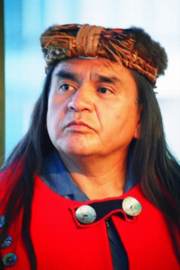
At the sixth annual Mel Smith Lecture at Trinity Western University February 12, John D. Weston of Access Law Group in Vancouver spoke on the topic of aboriginal self-government. The following is an adaptation of his speech.
IN MY VIEW, the concept promoted in the Nisga'a Treaty is that there's actually a third order of government with independent law-making power. This is something which I call the New Sovereignty Principle.
Before their Liberal Party came to power in B.C., Gordon Campbell and Geoff Plant took the unprecedented step -- as Opposition Leaders -- of suing the government, alleging that the Treaty was unconstitutional. They lost their case and, once elected, performed a 180-degree snap turn, abandoned their appeal, and supported the Treaty in the courts.
I am now General Counsel for several Nisga'a people, including Chief Mountain, and Mercy Thomas, an esteemed matriarch. A courageous man, Chief Mountain takes his responsibilities to the Nisga'a seriously. His title was formerly held by the most prominent of the Nisga'a Chiefs in the late 1800s. The Chief Mountain of 1881 led the Nisga'as' initial delegation to Victoria to pursue their land claim.
Chief Mountain and his Nisga'a supporters filed a claim in the B.C. Supreme Court, which alleged what Treaty detractors had been saying. The Treaty is unconstitutional, he claimed, because Nisga'a law cannot prevail over Canadian or provincial law. That would create a new nation, or a "third order of government" -- both prohibited by the Constitution.
Ranged against the Plaintiffs are three governments: Canada, B.C., and the Nisga'a Government, supported by the apparently limitless funds of taxpayers. The Plaintiffs, on the other hand, have no money -- as they are people of almost no means, who have no access to the large treasury of the Nisga'a Government.
Today, Chief Mountain dares to stand against his own Nisga'a leaders. He rejects the New Sovereignty Principle -- preferring to live under Canadian rule, with all the rights of Canadian Citizenship.
He says that the elites who negotiated the Treaty traded away his rights -- in exchange for powers never sought or imagined by his ancestors. And he says the rights he lost were not just any rights -- but special aboriginal rights protected by Section 35 of the Constitution.
Chief Mountain alleges in his claim that the Treaty must be declared unconstitutional. If he succeeds, any actions based on the Treaty would also be invalid, and must be reversed.
Chief Mountain says his ancestral lands and many other Nisga'a lands were surrendered by the Nisga'a negotiators in exchange for unconstitutional authority that gave them great power -- but power they were never eligible to have. He wants his lands back, and he does not want to be subject to an aboriginal government with powers that cut him off from the benefits of Canadian Citizenship. As he says in an affidavit: "I am Canadian".
Notable among Chief Mountain's supporters were three retired superior court judges: William McIntyre and the late Bud Estey, formerly of the Supreme Court of Canada; and Michael Goldie, formerly of the B.C. Court of Appeal. In their brief to the Senate, delivered in March 2000, they concluded that the Treaty purported to create an independent nation-state whose laws may override those of Canada or British Columbia -- and that the New Sovereignty Principle behind the Treaty is unconstitutional.
Chief Mountain argues that there are at least four reasons to distinguish between his case and the Campbell case.
Firstly, there will be a full trial rather than a decision based on affidavits. Secondly, the plaintiffs are aboriginal persons -- in fact, Nisga'a persons, who act with the authority of ancestral leaders; so their motives cannot be so readily dismissed. Thirdly, the pleadings refer to aspects of alleged constitutional transgression not pleaded in the Campbell Case. And fourthly, they have material human rights complaints to buttress their argument that Canada's Constitution has no place for local governments seeking to act outside the Constitution.
Apart from the Campbell Decision, the case law has consistently concluded that Canada has sovereignty over its own territory -- and that this sovereignty is divided exclusively between two levels of government.
Chief Mountain's vision is for "peace, order and good government" -- the very goal set out in Section 91 of our BNA Act. These words lack some of the energy of the U.S. Constitution, but they still convey the major underlying values that have consistently framed our legislative system and our governments.
"Peace, order, and good government" has, as a phrase, come to mean a context of our parliamentary democracy -- wherein the weak have a safety net to prevent them from falling further; all have an opportunity to prosper; and everyone benefits from the fruits of well-established human and democratic rights. How hard we Canadians have fought for peace, order, and good government in the past -- whether in opposing tyrants with force abroad, or in opposing Quebec separatists in Parliament at home.
Why would we give up willingly what we previously fought so hard to keep? In our zeal to reach a treaty -- any treaty -- we have undermined the very foundation of our peace, order and good government.
Chief Mountain desires an autonomy that would facilitate the blossoming of Nisga'a culture, language and traditions. But he still wants to have his full rights and protections as a Canadian. This, he says, is possible simply by changing the Treaty to say that, in the event of conflict between Nisga'a and Canadian or provincial law, Nisga'a law will not prevail.
A court date has been tentatively set for November 2004, but this will rely heavily on the ability of Chief Mountain to muster funding soon. Do you think it should be left to penniless aboriginal people to fight a battle so critical to all Canadians?
If we have an obligation to those who won for us the country we cherish, we also have an obligation to aboriginals and other fellow Canadians today. Are we to stand by while aboriginal citizens are relegated to a constitutional dust bin?
A third obligation is the most important: the duty to future generations. It is through faithfulness to past generations that we pave the way for future ones.