
March 2004
Priest/artist Massey's Celestial Banquet
BC Christian News, · Arts
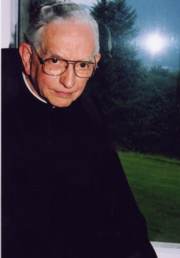
WATCHING Father Dunstan Massey climb briskly up the scaffolding to a platform near the ceiling of Westminster Abbey's communal dining hall inspires a profound appreciation for the Benedictine monk's dedication to his art.
The hall will be the home of his new four-storey fresco of Christ and the apostles in heaven entitled The Celestial Banquet. The fresco, a painting created on wet plaster, will be the crowning achievement of a remarkable career.
Probably the only contemporary artist painting large religious frescoes in Canada, the 78 year old Massey is considered a modern master of the fresco style, according to Metro Productions producer Sharon Bliss.
In October, Massey began work on Banquet, which will be the centrepiece of an hour-long documentary film produced by Metro called In the Footsteps of Michelangelo: Art, the Church and the Renaissance.
Massey's over half-century of monastic life and even more years of artistic creativity will be chronicled, along with stories of artistic masters such as Michelangelo. The documentary will be shown on B.C.'s educational broadcaster, Knowledge Network, early next year. Metro Productions plans to package three 20-minute videos for use in schools across the country.
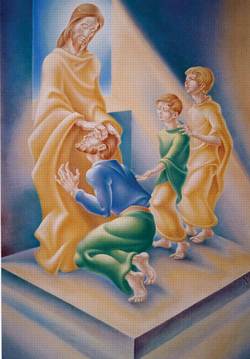
The "great gift" of being involved with the film, Massey told The B.C. Catholic, is that sacred works of art will be accessible to a much wider public than is usual. The videos, in his opinion, will educate young people not only about religious painting but also about religious life and how priest-artists through the ages have been inspired by their faith to create great art.
Said Bliss, "The videos will provide a Canadian context to this tradition seen through the eyes of a prolific and immensely talented Canadian who, although out of the world so to speak, has much to teach younger artists."
Although it has taken him years to bring this project to fruition, the painting has existed in Massey's mind and heart for decades, certainly through his completion of 22 life-sized bas-reliefs for the abbey church. The church was blessed in 1982, but work on the sculptures, he said, began even before construction was under way. Today, walking through the church, and seeing how the bas-reliefs, each weighing about 500 pounds, seem to float on the walls of the magnificent structure, the task appears daunting, especially for an artist working essentially alone.
Early last fall, Massey sketched The Celestial Banquet figures of Christ and the apostles on a huge grid on the dining room wall. This was preceded by the drawing and painting of a fresco template on the wall of his converted shed-studio down the hill from the monastery. It was also where he experimented for 30 years with plasters and paints to make sure they would adhere to the hall's brick facade.
Even as Massey perches like a bird on a wire high above the monks' dining hall, daily life goes on at the abbey.
As one of his Benedictine confreres remarked with a gentle shake of his head, "I confess it's a bit nerve-racking, but also hard to take your eyes off him while we're at lunch. I find myself continually looking up as the larger-than-life figures take shape before my eyes. I marvel as, like some medieval alchemist, he draws forth the brilliant colours which glow in the light. It's absolutely fascinating."
Born William Harold Massey in Vancouver, the Benedictine's early prodigious talent was recognized when he was offered a one-man art show at the Vancouver Art Gallery when he was just 16.
Three years earlier, he had dropped out of high school and, with his parents' permission, enrolled in evening courses at the Vancouver School of Art. Trained by the renowned Jack Shadbolt and befriended by Group of Seven luminaries Lawren Harris and Jock Macdonald, his rare talent could have brought him fame and fortune. Instead, at age 18, he entered the seminary.
He made his first vows in 1950 and received the name Dunstan. He earned two degrees, in arts and theology, was ordained to the priesthood in 1955, and has lived within the Benedictine community ever since.
He intends that Banquet conform to the goals for artists set forth by Pope John Paul II in a 1999 Letter to Artists, in which the pontiff stressed that the church "needs art to communicate the message entrusted to her by Christ." The Pope, said Massey, "reminded us that Christ made extensive use of images in his preaching, fully in keeping with his willingness to become, in the incarnation, the icon of the unseen God."
When he started work on The Celestial Banquet, Massey's seminary teaching timetable was rescheduled to allow him to paint for whole instead of half days.
He said he is getting used to maneuvering around on the scaffolding, and joked that it has given him the chance to experience what Michelangelo must have felt when he was painting the Sistine Chapel ceiling. "It's no wonder that, after a few years, he developed a permanent curvature in his back!"
Like Michelangelo, whom he greatly admires, Massey is a master of both sculpture and fresco and, like Fra Angelico and Fra Lippi, his work is carried on within the confines of a monastery.
Certainly abbey visitors are familiar with the contribution Massey's art has made to the abbey. Those visiting for the first time come away amazed at his extraordinary Temptation of St. Benedict, a stunning light-infused fresco which he painted in 1971 and which has an angular and monochromatic appearance that impressed art critics and led to his being profiled in Time magazine.
Simplicity of style, Massey said, is his goal for The Celestial Banquet. Although the interpretation will be modern, the roots of the fresco style are firmly embedded in the 16th century, as Massey follows in the footsteps of his medieval predecessors who painted in oils and tempera.
Massey is very aware that completing his newest work could prove quite a challenge. "I'm not as spry as I used to be," he freely admitted. However, with an enthusiasm that would be admirable in a man half his age, he said he is counting on some divine help to "pull it off."
He is inspired by a poster-sized reproduction of Michelangelo's Creation of Adam on his wall -- showing God stretching out his finger to give Adam the gift of life.
With a big grin, Massey pointed to the picture and said: "I put it there to keep me humble."
Courtesy The BC Catholic.