
Changing times a challenge for Islamic Morocco
BC Christian News, · International
 |
Written and photographed by Marten Youssef
 |
"Ladies and gentlemen, welcome to Casablanca, Morocco. The local time is 11:35 am and the temperature is 32 degrees . . . "
YOU do not need to leave the airport to get a glimpse of the extremes of this culture. But once you do, be prepared to witness the juxtapositions of a lifetime.
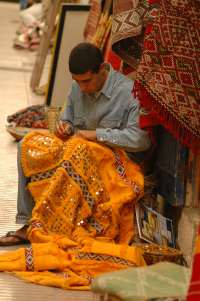
Bright, traditional cloths which have stood the test of time are sold on the same rack as the latest European fashions. Move beyond the cloths, and walk the centuries-old alleys of Marrakesh. Stores sell plasma screen TVs; and just a few steps away is a sweet shop. A BMW drives past a donkey carriage selling produce. In the morning, be enchanted by the mysterious sand dunes; in the evening, dine in the finest of restaurants in Casablanca; at night, sleep among the desert dwellers beneath the stars, or be pampered in the five-star resorts.
These extremes exist, but the modernization here threatens one thing: Islam. Morocco, as a nation which upholds the traditional values of Islam, is a culture in transition. Can these values exist simultaneously with the values of this day and age?
Shadow of sharia
The teachings of Islam, in its traditional form, require women to veil their faces. Islam has denied women the right to divorce a man, but permitted men to divorce women. It has allowed men the right to more than one wife - and in some eyes, has treated women as lower-class citizens. Islam has employed stoning as a penalty for adultery, and has required non-Muslims to pay a tax to the state.
These values, embedded in the Islamic law known as sharia, cannot co-exist within a developed and democratic country. Morocco has officially disregarded many of these teachings, in exchange for a prominent place in world politics.
The government has not formally replaced these sharia-based rules, but it has not enforced them - partly to accommodate the tourism industry, which accounts for a significant portion of the country's economic well-being.
Various factors have drawn Morocco away from the teachings of Islam - specifically, those values which contradict democracy. Although Morocco is situated in the western corner of Africa, the European influence is notable. The south of Spain is only a 20-kilometre ferry ride from the tip of Morocco.
The tourism industry has exposed Moroccans to European values, fashions and lifestyles. Perhaps in the beginning, it was difficult for the locals to accept these new influences; but now they are a familiar part of everyday life. Morocco has actually submitted various applications for membership in the European Union; so far, it has been rejected.
Aside from the European influence brought about by physical proximity, another agent motivates Morocco toward change: satellite TV.
It's a small world after all
 |
To those of us who think TV is the root of all evil, here is a challenging argument. Morocco owes a great deal of its development to a curved metal disk, connecting it to the world. One of the most amazing sights as you travel throughout the country are the little satellite dishes perched above the mud houses in some of the most remote villages. They tell Moroccans what we wear, what we eat, how we live and what matters to citizens of the West.
Although Western media faithfully portrays the Middle East as harbouring hatred toward anything Western, Morocco has an unspoken fascination with Western civilization. Moroccan society now reflects this - in some of its fashions, entertainment, food and government policies.
In our global village, it has become more difficult for governments to regulate what influences its citizens; it is nearly impossible to restrict access to satellites, or to limit certain stations. The availability of the satellite exposes the citizens to all kinds of religions - contrary to the preferences of the government. Christianity, being the dominant alternative, draws people to its programs. Admittedly, the satellite dish is not a direct agent of change. But it does create exposure, inevitably leading to possible acceptance of change.
In one of the narrow, crowded markets of Essaouira, I walked past a man apparently watching Michael Bublé on MTV. A second look confirmed my suspicion. I smiled at how close I felt to home, while so far away from it.
In Fez, the cultural capital of Morocco, I managed to convince a satellite retailer to tune in to the Miracle Channel, one of the largest Christian broadcasters throughout the Middle East, offering faith-based programs in Arabic and English. I was reminded that the impact of satellite TV extends not only to cultural matters; it also scratches the surface of the country's most controversial topic, religious conversion.
A closed country
A Moroccan French magazine, Le Nouvel Observateur, recently featured an article claiming there are active "conversion campaigns" led by "secret" missionaries in Morocco.
The article contended that this campaign is backed by America - and more specifically, by President George W. Bush. The writers criticized local authorities for not cracking down on these missionaries.
Because of the sensitivity of this topic, any concrete numbers regarding missionaries, converts or even churches would be uncertain.
However, both missionaries and the public recognize that more and more Muslims are converting to Christianity. This is a very risky and daring move for any Muslim; in many cases, it leads to death. Therefore, this information is often kept secret until the new believers have either fled the country or miraculously converted their family. Giving such details would threaten the lives of those evangelizing in Morocco.
 |
Missionaries are working hard in the country, and the government is aware of this. But government officials do not often pose a threat. Rather, it is usually the hardliners and fanatics who attempt to impose their own sense of justice and their interpretations of sharia law.
Although it is illegal to establish a church without the permission of the government, churches do exist. The sole reason for their existence is to be 'international churches,' to minister to the foreigners serving in Morocco; they are not open to the general public. Despite possible danger, some locals still attend.
On the brink of change
It is clear that, in order for democracy or even civilization to prevail, certain entrenched values of Islam must be challenged. They certainly have been in Morocco, as throughout the Middle East. Islam is getting a very intrusive face-lift, which may alter it beyond recognition.
As a church, our traditional ways of doing missions are being challenged. We are excited about the adventure, and thrilled to serve the Lord in a persecuted country - but we still want to stay at arm's length.
However, the fact is that, while satellite and media ministry may seem impersonal, they are effective and cost efficient. The internet has also opened the gates for ministry. The Moroccan government does not restrict access to any sites or servers.
There is a lot of room for utilizing non-traditional means to reach Moroccans; but traditional missions work is still needed - and is just as effective.
Marten Youssef graduated from Trinity Western University, where he studied political science. He is currently a photographer and journalism student at Langara College in Vancouver. He was born and raised in Egypt, and now resides in Surrey.
Quick facts about Morocco:
Population: 32,725,847 (January, 2005)
Languages: French and Arabic
Area: 446,550 square kilometres
Religion: Muslim 98.7%, Christian 1.1%, Jewish 0.2%
Capital: Rabat
Literacy: 51.7 %
Numbers based on CIA World Fact Book
A portrait of thoughts . . .
By Marten Youssef
 |
Journal entry after voyage
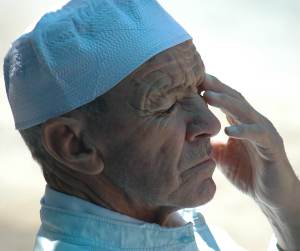
Evidence of age, forbidden beauty, untouched space, child's innocence, the scent of mystery, the face of poverty and the pace of a culture; it was while looking through the lens that I lost myself in a maze wilder than the sand dunes of the Sahara. I accepted the challenge of illustrating life with these pictures.
My intention in taking these pictures was not to remember an unforgettable journey. It was to capture the images that moved my heart in a direction I could not resist. I realized that freezing the innocence of carefree children playing in the alleys of Marrakesh was a reflection of my craving for the innocence I lost to my youth. In capturing those who stood as still as a portrait, I understood the desire for stillness in my own life. In immortalizing the wrinkles of an old man, I accepted my longing for the wisdom that comes with age.
As the camera rested in my hands, I struggled with whether I should be a part of what I am capturing or merely capture what I want to be a part of. The kids playing soccer on the street, the men who found fulfillment in silence, the crafters testing the drums they built - all appealed to me. But many times, I cowered behind the camera at a distance that brought no attention.
Like words, photography became a language I could speak - and in it I found a thousand scattered thoughts to utter. And those became the spoken portraits of my thoughts.