
Readers' Forum
Wrestling with Christian doubts
Re 'Are Christians doubting Jesus?' (September): The people interviewed equate doubt with several things: illiteracy in apologetics, a lack of zeal for conservative culture and a reluctance to use state power to implement 'Christian' values.
According to them, doubting people are those who can't fit their faith into a grid constructed by philosophers and theologians.
One should not conclude that people who fail in all the areas listed in the article do not personally believe that Jesus is the anointed one of God. Many students I meet accept as true that God acted decisively in Christ to bring salvation and defeat death. They believe this strongly enough to stake their lives on it.
I find much hope in Christians suspicious of using coercion to bring about God's kingdom. Their stance seems closer to the spirit of Jesus than are those who look to governmental force when their own witness fails to convince.
John Klassen,
Department of History,
Trinity Western University, Langley.
The fact that young Christians today are virtually indistinguishable from their non-Christian peers when it comes to embracing relativism is a sad commentary.
Yes, people are having their spiritual needs met and finding contentment in church. But where is the cultural and intellectual engagement that characterized much of the history of the church?
Today, most of that engagement by Christians is happening in academia or parachurch organizations. The local church, by and large, has abdicated the life of the mind to secular culture. Many Christians are unable to 'make a defence to everyone who asks you to give an account for the hope that is within you' (1 Peter 3:15).
If anyone thinks this is an overstatement, then ask some Christians in your church questions about basic biblical and theological knowledge.
It's remarkable that otherwise intelligent people, who have spent years of study and lots of money achieving success in their profession, have no more than a Sunday School knowledge of their faith. Surely, if a relationship with the living Lord of the universe is the most important thing in their lives they should spend some time reading serious Christian books.
The church needs Christians characterized by both spiritual devotion and intellectual prowess. The fundamentalist withdrawal from culture during the early 20th century removed many of God's people from the centre of the battle for minds, allowing secular forms of thought to become dominant.
Unless evangelicals choose to enter the fray of today's intellectual battles, it will make evangelism even more difficult in the 21st century.
Dennis Kim,
Coquitlam.
The church must outgrow its narrow focus on Jesus, and embrace an ecumenical God of Love. Jesus' primary teaching was to love our God and our neighbours, not to worship him. Jesus Christ is a cultural, folk idea while God is the universal, fundamental idea.
The Christian church does good when it teaches love, forgiveness and spiritual growth. It does harm when it teaches Jesus Christ is the only way to God. I hope and pray for the day when the church will grow up spiritually.
John Johnston,
Burnaby.
I am puzzled by a comment made by Kent Bergstrom. He says a factor that contributes to skepticism among Christian students "is the assumption that the relativism which is inherent in the sciences and mathematics must be universal."
The scientific method dictates that any theory in scientific exploration is in principle testable and verifiable. In math, the procedures and principles of calculus are true in any culture, and can be used by any person to solve problems. Isn't that the very essence of absolute truth?
We should be able to extend the absolute truth and objectivity of true science into the spiritual realm. If God created the physical universe with laws that apply to everyone, is it not reasonable that he would build absolute truth into the moral and spiritual dimensions of the universe?
The objectivity of science is one of the strongest protections we have against skepticism. I believe the relativism Bergstrom is thinking about comes not from good science but from philosophical assumptions lurking in the so-called social sciences.
Keith Hostetler,
Abbotsford.
Coming to Benny Hinn's defence
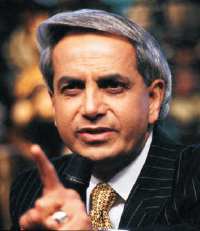 |
Joel Mawhorter ('Benny Hinn crusade questionable,' Readers' Forum, September) was wrong to say that Benny Hinn's crusade was emotionally manipulative.
No person in this world could manipulate an event like the one at GM Place without the Lord's presence. If indeed it was manipulation, then those 15,000 people were just robots. Mawhorter is not watching what God is doing through the Hinn ministry worldwide. No ministry will grow on its own just through human tactics.
Some people just see Hinn the person, and refuse to see the Jesus in him who is doing all the work. I was at the crusade, singing in the choir - and I can tell you that Hinn did not plead for money. He said: "I am not going to tell you how much you will give - that is up to you and the Lord."
Is Hinn a deceiver when he says he is not the healer, but that it's Doctor Jesus? Is he a deceiver when he says that, although physical healing is a great miracle, the greatest miracle is salvation? I saw the power of God displayed that night. Not everyone was healed; but only the Lord knows why, and I am not going to question God.
When do we stop looking for the negative in any ministry, and start looking for what God is doing? What about those many souls that ran forward to commit their life to Jesus that night?
No matter what Benny Hinn does, he will always have critics; but no one can put down what Christ has planted. Why do we limit what God can do? Let's not allow the enemy to win.
Remy Andres,
West Vancouver.
Benny Hinn has been vilified by the secular media, ignored by Christian newspapers and most local pastors, and even burned in effigy by anti-Christian extremists abroad, and yet his worldwide crusades are sweeping ever-increasing millions of souls into God's kingdom.
In Vancouver August 12, we saw him minister over four hours of pure gospel message interspersed with beautiful worship music. Thousands responded to his invitation to receive Jesus, thronging the stage and filling the aisles. Salvation packets containing a list of local churches were freely distributed to everyone who accepted the Lord. Near the end, many people who had received a healing touch from the Lord lined up to give their testimonies. We are very grateful that Hinn came to Vancouver.
Sandra Marcus,
Burnaby.
I agree with everything Joel Mawhorter stated about Benny Hinn, and I salute him for writing it in a mildly-tempered manner.
But there is a problem here which is greater than any questions about Benny Hinn. Once we take leave of honest scholarship in proclaiming God's word from behind the pulpits in America, we open wide the doors to precisely what has taken many churches by storm: sensationalism. This is what drives many ministries and some denominational movements today, rather than exegetically defensible biblical teaching.
Honest scholarship in biblical exegesis is not the defence of views, but the pursuit of truth. Fundamental to the process of honest scholarship is the need to disengage ourselves from denominational thinking, to avoid slanting biblical interpretation in favor of a particular system of belief. Exegesis is not intended to be inventive. It is intended to earnestly and honestly present what is revealed in the total context of scripture, and not make the scriptures say something they do not say.
The message to the church in the 3rd millennium is found in Jude 3: "Contend for the faith, which was once for all handed down to the saints."
Walter Rachinski,
Vancouver.
I was a little skeptical about Benny Hinn because of the NBC Dateline piece about him. But my husband and I found Benny Hinn to be a man of prayer. I felt emotional healing, as well.
Joel Mawhorter writes of Peter's warning about false teachers. In 2 Peter 2:1, it says that such people will deny the sovereign Lord. I definitely feel Hinn teaches the truth about the sovereign Lord. If God wasn't happy with Hinn, he would have shut down his ministry a long time ago.
It saddens me that Mawhorter didn't enjoy the evening with Hinn - because it was awesome.
Sharon Lambright,
Pitt Meadows.
I went into Benny Hinn's meeting determined not to let showmanship throw me off. I had one question: would everything line up with scripture?
Hinn shared what he believed to be a word God had spoken to him in prayer, as a warning to the church. First, terrible weather storms would hit North America. Second, there would be a false revival through all of North America - a 'revival' with no mention of Jesus.
I personally believe Benny did hear from God. He used this prophecy of a false revival to launch into a completely Christ-centred message; Billy Graham couldn't have preached a more theological sermon.
He bluntly stated: "If you don't receive Christ as your saviour, you will spend eternity in hell." I have never heard a false prophet say that.
After the altar call, however, I felt his message went terribly astray. He did teach that the Bible says you can live until you are 80 in perfect health, if you have the faith. He quoted many Bible passages to sell the idea that if you don't get healed, it's your fault.
But I still think it's a stretch to call him a false prophet. He didn't say that everyone at GM Place would be healed; he said they could be. As for his appeal for money: it was tacky, but no more tacky than what I hear every Sunday morning.
Earl Banks,
Vancouver.
Some still not so wild about Harry
I was very surprised to read all the good things Peter Chattaway had to say about the latest Harry Potter book ('Half-Blood Prince focuses on doing the right thing,' August).
It seems that he sees it only skin deep, and not as it is. It's easy to find out J.K. Rowling's influences. The book seems to portray good themes, such as love; but it opens young children up to witchcraft, portraying it as something that can be used for good - and encouraging kids to start practicing it.
We are to be set apart; God says, "Be holy, as I am holy." How can we, if we feed our minds the same trash the world does?
Parents will read reviews in your paper and make decisions for their children. So please use integrity and discernment before praising a book or movie.
Michael D. Bald,
Abbotsford.
The theme of Harry Potter books is that power can be taught and wielded by witchcraft, and that it resides in human beings. The message is not subtle, so naivete cannot be claimed. Even if this power is used for good, it is from an unacceptable source. Nowhere in these stories is God given glory.
Cherryl Katnich,
Maple Ridge.