
Mega church: Is bigger always better?
BC Christian News, · Island Insight
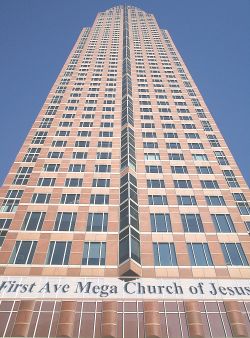 THEY CALL them seekers: people who swell the seating at many supersized American evangelical churches - looking for comfort, for uplift, for the vague amorphous spirituality those churches have grown rich delivering.
But America's mega church phenomenon, according to evangelical theologian David Wells in his just-published Above All Earthly Pow'rs (Eerdmans), is more about marketing than about evangelism. Wells maintains that some churches have thrown out truth - along with traditional music, creeds, symbols and other offensive things. Can churches strive too hard to attract bigger congregations?
Don Crawford, pastor at one of Victoria's biggest churches, Lambrick Park, thinks they can. He says Lambrick Park is better for having shrunk from 1,400 a few years back to 1,000.
However, based on his own experience at an American mega - Cherry Hill Church in Denver, Colorado - he also thinks Wells is overstating the case.
"What he is describing may have been truer in 1996. Since then there has been a trend in the other directions. Creeds, liturgies, especially art, is coming back with evangelicals. And even in terms of what was true back then, it is not fair of him to tar them all with the same brush."
Nonetheless, Crawford acknowledges, when churches get too big, they become "machines" that drive themselves with less and less thought given to the original goal of providing a spiritual community to do God's work. "They have full-time accountants, human resources directors. Community and communications get lost."
He thinks one way Canadians are different from Americans is that they are skeptical of bigness. There are fewer mega churches by population, he believes, and they aren't so mega.
Moreover, he believes there is a trend in both countries to support middle-sized churches of 350 adults. Lambrick Park has itself reformed into Sunday morning and Sunday evening congregations, attaining both tighter communities of the smaller churches and the economies of scale of the bigger.
"The payoff of the mega church is that when you reach a certain critical mass you can staff specific ministries."
At Lambrick Park, team ministries with part-time staff direct larger volunteer teams in children's, youth, teaching and pastoral care.
The downside, says Crawford, is that "people can hide. They can go and take in the worship and teaching and ministry to kids and be relatively anonymous. They come, they consume and they go." Mega churches such as the Meeting House in Oakville, Ontario have responded to this by emphasizing small groups, which confront individuals with the life-challenging propositions of Christianity.
Frank Martens, the interim pastor at Abbotsford's Northview Community Church, says his church - which has1,700 members, as well as another 1,700 non-members who attend - has also addressed the challenge of size with small groups. "We want people to be accountable, not to get lost."
There are groups for women who have been abused, for sex addicts, for their partners, for 'parents in pain' with hard-to-raise children, for women, for men, for children. There are outreach groups to help street people, and some four dozen missionaries working in Canada and abroad.
Northview is a member of the Mennonite Brethren (MB), but chose the 'community' appellation when it started 25 years ago to reach out to people beyond the Mennonite tradition. Belonging to a denomination is one way Northview ensures its own adherence to orthodox Christianity.
Harvey Roosma, the new pastor of Victoria's Christ Community Church - which is definitely not a mega church - thinks the trend in that direction is reversing. For example, "people are wanting more symbolism," and less of the stripped down and lean style of the megas.
But Roosma's experience of American mega churches is not entirely negative. "Some of them do an excellent job calling people in the language they can be reached."
Community churches often choose that designation to overcome denominational barriers. Roosma's church was originally connected to Victoria Christian Reformed Church. Roosma chooses his words carefully so as to not mystify members who aren't from Reformed backgrounds. "I have to explain 'sovereignty' and 'covenant' - which are very basic concepts to those raised in the Reformed tradition."
While Christian Reformed churches, whether calling themselves 'community' or not, make an effort to welcome everyone, they continue to maintain doctrinal positions that sometimes surprise and confront, such as their adherence to infant baptism.
Congregant Hank Visser says: "Our doctrine has not changed to be more palatable. But out style of worship has changed."
To meet the tastes of a young congregation, Christ Community has moved from organ music to piano, guitars and drums.
"We're more upbeat," says Visser, adding: "But we still say the Apostle's Creed together."