
A new initiative for Mustard Seed
BC Christian News, · Island Insight
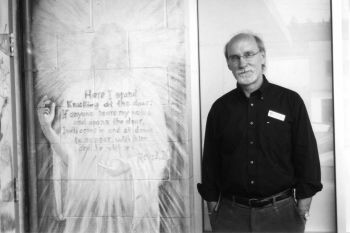
FIVE THOUSAND - that's a lot of people who look to Victoria's Mustard Seed Street Church food bank for help every month.
The ministry began humbly enough. According to the church's website, it literally originated in "a prayer closet in a store on Government Street." It expanded to a facility on Pandora Avenue; and it has been on Queens Avenue since 1995. What began as a modest church grew to incorporate food and clothing banks; street ministry; prison visitation; counselling; and advocacy services.
Attending to the many problems of Victoria's most impoverished citizens is a complex, labour-intensive task.
"We look after their physical needs, and we try to look after their spiritual needs," says Rev. Chris Riddell. "We watch their day-to-day struggles and see so many that are caught in cycles of addiction, poverty or destructive behaviour, and they are unable to break out of them."
The ministry is now providing yet another alternative for these people - an alternative with an appropriate name.
Hope Farm is the Mustard Seed's latest major project. The facility is a 32-acre former dairy farm on Drinkwater Road, near Duncan in the Cowichan Valley.
In addition to his pastoral duties, Chris Riddell is now serving as the farm's project manager.
Hope Farm will accommodate 10 men who truly want to change their lives, and escape the destructive cycle they are caught in.
It will take them away from the city, which is a magnet that tends to draw them back to their old habits. The farm's activities will teach them both the vocational and social skills they need to become productive citizens.
It will also give them a chance to meet Christ as their Great Physician.
"We want to look after the whole person", says Riddell, "the physical and the emotional, certainly, but also the spiritual. That is vital."
What skills can they learn on a farm?
The farming itself, of course, for starters.
Hope Farm will produce vegetables and fruit which will be distributed free to food banks on Vancouver Island. Prior to distribution, the produce will need to be warehoused.
Experience in warehousing will equip the participants for jobs in any number of places - such as Thrifty's, or large department stores.
Farms have equipment like tractors - requiring various mechanical skills, which the participants will be taught. Other skills are also needed in running a farm, and instruction in these areas will also be given. Some of the residents won't have their grade 12 education, and they will be given help to attain it.
Perhaps the most important skill these people need, in order to function normally in society, is the ability to deal with others in constructive ways.
Living together with nine other men in one house will give plenty of opportunity to practice those social skills.
This will be an important area, where counsellors will show these men patterns of thinking and behaviour which they will need to abandon, and help them learn more constructive ways of dealing with life.
How long are the residents expected to stay on the farm?
"This is not a jail," says Riddell.
The participants, he emphasizes, " are free to leave." Nevertheless, he says, "we ask for a commitment of one year minimum. It may take longer for some to step back into society equipped to succeed, in fact - perhaps two or even three years."
Who will qualify to stay at Hope Farm?
"We are still developing the intake criteria. But in principle, it is for anyone with a serious problem who wants to put his life back together."
Many of the candidates, he says, "will have drug addictions; others will have emotional problems or depression. They have to be willing to go away, and to buy into the idea of community living for an extended time."
Perhaps most importantly, he say, potential participants "also need to know the whole endeavour is Christian, and that Christ is presented as the healer."
Who will staff Hope Farm?
"There will be a house manager, who will live there full-time. Then a farm manager, and a counsellor."
Additional instructors, he says, "may come on a contract basis, or as volunteers. Right now we are just getting the farm up and running."
And what about finances?
"The total purchase price was $865,000." He points out that this project "has been a long-time vision of the Mustard Seed, and we have been setting funds aside for it since the 90s, so that we were able to make a down payment of $465,000.
"The $400,000 mortgage we hope to pay off within two or three years."
In addition, he says, "there are the operating expenses - we budgeted for $200,00 for this year. But Victoria has always been very generous towards the Mustard Seed, and we hope it will support this project."
A final word to our readers?
"It's important to know that this is part of the ministry of the Mustard Seed Street Church. It is a new seed we are planting in the Cowichan Valley.
"The love and the care we offer the people here at the church, we are extending into the Hope Farm."
The ultimate gift, which Mustard Seed can only facilitate, is "the hope that Jesus will transform lives - that he will make the seed grow."
Chris Riddell can be reached at 250-953-1575 or revchris@mustardseed.ca. Further info: MustardSeed.ca