

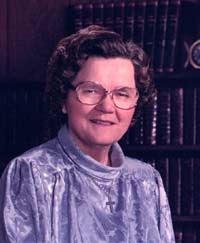
 Bernice Gerard, one of B.C.’s most respected Christian leaders, passed away November 1 (see tribute on page 14). The following account depicts the key turning point in her life.
JUST BEFOREƒ she signaled recess, our grade four teacher called us to attention. “Beginning Sunday, there will be gospel meetings here in the Jubilee School. The preachers are Miss Frances Layden and Miss Clara Manary. Everyone is welcome. Boys and girls, please tell your parents.”
Up went my hand. “Please, miss, what is a preacher?” A little amused, the teacher replied, “A preacher is one who speaks from the Bible.” Still in the dark, I followed with a logical question, “What is a Bible?”
In response, she drew from her desk a mysterious black book with ‘Holy Bible’ in letters of gold on its front cover, and gave us a few words of explanation. Our curiosity having been satisfied, in a few minutes we were all happily playing in the schoolyard, completely unaware of the effect the coming meeting would have on some of us.
Somewhere to go
Somehow I managed to be there for the meeting that first Sunday night – not out of love of the gospel, because I had not the slightest idea what it was, but simply because it was somewhere to go. Side by side in the same double desk we used in the daytime sat my pal Helen and I.
Never will I forget that first gospel meeting! The preacher chose someone to give out the hymn books, which the greener among us regarded with curiosity. When we began to sing, the words were more or less the same stream of thought as had been coming to me recently:
“We are fading too, like the flowers / That but yesterday were in their bloom / Oh how many pass with the hours / O’er our path falls the shadow of the tomb.”
There was something soul-stirring about the plaintive melodies, and the solemn words – the logic of which it was impossible to escape. Had I not so recently seen Aunt Sina lying in the coffin? She had faded like the flowers.
Out came the mysterious book – the Bible. The preacher read a few lines and then started to tell the most wonderful story I had ever heard. Spellbound, I drank in every word.
It was about a man who was so wonderful that even his enemies could find no fault in him.
He took the little children in his arms and blessed them. He healed the blind and gave the lame power to walk. He even loved the unlovely Mary Magdalene, out of whom were cast seven demons. He cared for people no one else loved.
Thirteen years of age, mature beyond my years, I was for the first time hearing of the marvelous Man of Galilee. The meeting was quiet, the singing poor (nobody knew the hymns), but the preaching moved me deeply. Jesus Christ was everything wonderful that one could imagine and much more.
The lady with the book pictured his sufferings in the Garden of Gethsemane and then in the judgment hall before Pilate; then dramatically we walked the way of sorrow with him, feeling his anguish, wanting to share the load of his heavy cross.
Rescue on the way?
When the procession reached the summit of the hill they called Calvary, I felt certain that the story would soon be ending. Some kind of rescue must be on its way. I was sure that some person of authority would arrive at the last moment and set free the innocent one.
To my surprise and horror, his persecutors threw him roughly to the ground, nailed him to a cross, and lifted him up to die. Everything inside me was churning in revolt against this unspeakable injustice. Then the preacher looked down at me, right into my eyes so it seemed, and asked: “Do you know why he died?” Breathlessly I waited for the answer.
She continued, “He died because he loved you. For God so loved the world, that he gave his only begotten Son, that whosoever believes in him should not perish, but have everlasting life.”
Could it be that he loved me? Nobody had ever loved me. I was the little Gerard girl who would never come to any good, the black sheep leading the other little lambs astray. In 13 years, I had lived in many households, but belonged in none of them. I was nobody’s child. Now the preacher was saying this man loved me enough to die for me!
| Previous article Our joy in God is only a shadow of his joy in us | Next article Abbotsford couple see Uganda’s struggles |
 |  |
| Page 2 | Page 3 |
“Preacher,” thought I, “you wouldn’t tell a beautiful story like that if it were not true, would you?” If that was what she was doing, for some purpose of her own, it was the meanest thing I could think of. In any case, I could not take my eyes off her. I wanted the story to be true, and Jesus to be real.
If what she said was true, if God really did love me so much that he gave his Son to die for me, I would give myself to him and follow him all the days of my life. The thought of rejecting the gospel never occurred to me – but I was plenty worried that he might not want me.
Had the preacher asked us that first night to go forward and take a stand for the crucified one, I would have done it. Nothing in me was saying ‘No.’ My heart was painfully tender and without a single prejudice against him. My own unworthiness overwhelmed me.
Purity and pardon
Knowing nothing about my natural parents, I feared I had been born out of wedlock. What little information I had gleaned on that subject had been from questionable sources, and filled me with a sense of shame. But worst of all was the burden of my own sin, which had nailed Christ to the cross. I longed for the purity and pardon that the preacher said would come when I confessed my guilt.
She quoted: “If we confess our sins, he is faithful and just to forgive us our sins, and to cleanse us from all unrighteousness.” As we got out into the fresh air at the meeting’s end, Helen and I heaved a sigh of relief.
She said: “I am no sissy – but . . . if they had kept on with the meeting, I would have been crying.” Relieved to find that she, too, had been shaken up, I said: “I am no sissy either; but I could have cried, too. I felt very funny inside when the preacher told that story.”
It was not the number of meetings I attended that made the impact, as I had the opportunity to get to only a few. One night, having begged my father to allow me to go, I walked alone through the woods about three miles to the meeting. The blobs of phosphorus casting an eerie glow in strange formation along the wooded trail usually terrified me; but now they seemed insignificant. The sound of the gospel had become sweet music to my ears.
When the school house series came to a close, the meetings moved to a house – where, on the first Sunday, the preachers planned to ‘test’ the meeting. In a whisper, someone asked me if I had made up my mind whether or not I wanted to follow Jesus Christ, adding: “We will be asked to make known our decision on the last hymn.”
My decision was already made.
At a shivaree the night before, a few of us had been discussing the gospel meetings. The neighbours, having deposited coats and babies in the bedroom, were expressing their good wishes to the newlyweds by dancing until the rafters trembled. Most of the participants had drunk quite a lot, and the housewarming was turning into a rough party.
Sitting on a large wooden barrel in the corner with a few others around me, I voiced my disapproval of the celebration – and to my own surprise, spoke out loudly in favour of the gospel meetings: “When I grow up, I am going to give my life to God like the preacher women have done.”
In the face of a flurry of comments, favourable and unfavourable, I stood my ground.
From Bernice Gerard: Today and For Life.
December 2008