

 THE CHRONICLES of Narnia may be coming to a premature end.
The movie series, based on C.S. Lewis’ seven-part series of books, began three years ago with Andrew Adamson’s enormously successful adaptation of The Lion, the Witch and the Wardrobe. But it stalled this year with Prince Caspian, which earned only a little more than half as much money at box offices around the world.
Several reasons have been proposed for the film’s disappointing performance at the multiplex, including: a script that abandoned too many of Lewis’ themes; serious competition from other summer releases, such as Iron Man and Indiana Jones 4; and a shift in demographics, as the ‘echo boomers’ – the children of the original baby boom – grow up and move on to grittier fare like The Dark Knight.
Whatever the reason, we are now beginning to hear reports that Walden Media and Walt Disney Studios, the companies that made the first two films, have not yet been able to agree on a budget for the next one, The Voyage of the Dawn Treader.
 The film is currently slated for a May 2010 release, but the start date has been put off repeatedly. At one point, the cameras were going to start rolling last summer; then, in April, producer Mark Johnson said they would start shooting in October; and then, in October, one of the actors stated they might start in April 2009.
Meanwhile, Walden Media – a movie production company created several years ago by Christian billionaire Philip Anschutz – has undergone a massive upheaval, as many of its top staff have left the firm. This includes Walden co-founder Cary Granat, though he will reportedly stay as a “creative consultant” on Dawn Treader.
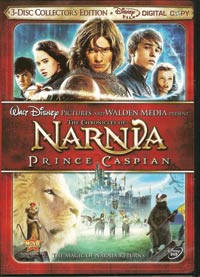
Whether The Voyage of the Dawn Treader itself will ever be made – and, if so, under what sorts of budget constraints – will depend, it is said, on the home-video sales for Prince Caspian, which comes to DVD and Blu-Ray December 2.
The disc is available by itself, or in a three-disc package that includes a bunch of bonus features and a digital copy of the movie. The bonus features are fun enough, though trivial – looking at everything from the weather problems that plagued the set to how the children who play the Pevensies have grown up since the last film.
The best featurette is probably one that looks at how an entire town in Slovenia was taken over by the filmmakers, as they filmed several scenes at a nearby river in which a bridge is built and then destroyed.
Curiously, a featurette on Warwick Davis, who plays the dwarf Nikabrik, neglects to mention that he played the mouse Reepicheep in a BBC-TV version of Prince Caspian nearly 20 years ago.
The set also includes just a few seconds of the pre-production that has been done for Dawn Treader. We will just have to wait and see if the film itself ever gets made.
* * *
Talk about irony. Last month, I caught a press screening of Milk, the movie that stars Sean Penn as Harvey Milk, an activist who became one of the first openly gay men elected to public office when he became a San Francisco city councillor in 1977.
| Previous article www.canadianchristianity.com - the third generation | Next article Jazz can be fertile ground for sacred compositions |
 |  |
| Page 16 | Page 17 |
And then I came home and discovered a video on YouTube, showing Christians being hounded out of the very same neighbourhood that Milk had worked in 30 years ago.
Among other things, the movie makes the point that gay men in the Castro district did not trust the police to look after them, so they carried whistles with them and called for help whenever they came across gay-bashers.
The YouTube clip, however, shows the men there using their whistles almost as a form of intimidation, as the Christians are carefully escorted out of the district by a group of policemen.
Other parallels abound. The movie shows how, in 1978, Milk campaigned against a proposition that would have required schools to fire gay teachers – and of course, the movie is coming out only weeks after Californians voted in favour of Proposition 8, which explicitly denies marriage rights to same-sex couples in that state.
So does the movie show how nothing has changed, or does it show how everything has changed?
Do gay people face the same stigma now that they did in Milk’s day? Or do they have enough power now, that they have to be careful not to abuse it?
For the most part, the movie is an exercise in hagiography, showing how Milk saved people from shame and suicide – before a fellow councillor shot both him and the mayor with whom they had worked. However, the film offers just a hint of a warning to the attentive viewer who might sympathize with Milk’s agenda.
In one scene, after Milk has been elected, a friend remarks that he has now become part of the “machine” that he once decried. And in another, the mayor draws an ambivalent comparison between Milk and ruthless politicians such as the Daleys in Chicago – prompting Milk to marvel that he has become “a homosexual with power.”
For the character, it’s a point of pride. But the challenge is still there, for both gays and Christians, to speak the truth in love and grace – and to not get carried away with the sorts of power games that would make the streets unsafe for anybody.
December 2008