

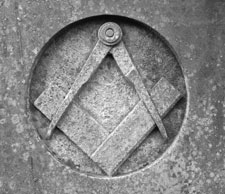
If you believe in coincidences.
Victoria stonemason Chris Trenholm doesn’t. In a March 21 presentation, Sacred Victoria, he argued that the positioning of many of the capital’s century-old public buildings conform to a grand design befitting the universalist pretensions of their architects and builders – who were members of the Freemasons.
Freemasonry probably began as a medieval craft guild for master masons, who traveled from city to city to work on great projects such as cathedrals. When it was revived in the early modern period in London, however, few of its members got their hands dirty. They were leaders of society: lawyers, doctors, clergy and believers in Enlightenment values of progress through industry, thrift and empirical science.
What set it apart from other men’s clubs or the British Royal Society was its arcane rituals, its claims to ancient lineage, and its vows of secrecy upon pain of death.
Some of this arcane flavour was conveyed at Trenholm’s presentation by the setting, the darkened Alix Goolden Hall – formerly the nave of a decommissioned United Church.
Before settling into the mundane job of lining up B.C. buildings using Google Earth, Trenholm warmed up his small audience with a video from Charles Gilchrist, an American promoter of the concept of sacred architecture: that the physical universe is rational, and conforms on different levels to geometric patterns that are expressions of ideas.
Trenholm next showed a BBC educational video about the facades of medieval Gothic cathedrals: how hundreds of demonic, human, saintly, angelic and divine figures taught the literate and illiterate how all creation fit within a God-given disposition – with everything in its place.
Trenholm leapt from there to the layout of the Parliament Buildings – designed by Freemason Francis Rattenbury.
Rattenbury, says Trenholm, aligned his buildings in accord with the “law of harmony,” as did other builders. “Certain historic sites in most cities are arranged geometrically, which is to say they are arranged to form predetermined patterns.”
Rattenbury may not have done so deliberately. “The extension of these design elements beyond the buildings themselves is perhaps the natural consequence of working within this theme of universal harmony.”
For Freemasons, there is a design underlying the universe – put there by the nondenominational Great Architect of the Universe.
This idea of a generic, non-trinitarian deity compatible with all religions is one reason why Freemasonry has been condemned by a wide range of Christian denominations.
The Catholic church denounced Freemasonry from its modern outset in the 1700s; American evangelicals got behind the anti-Masonic movement in the early 1800s. By then, Masons were, for many Americans, no more than a fraternal organization with pleasantly arcane trappings, as well as a business networking organization.
| Previous article Port Hardy church has big plans for hotel | Next article Good neighbours plant churches |
 |  |
| Island Page 2 | Island Page 3 |
By the Civil War, anti-Masonism had died out and Masonry had revived. James B. Twitchell, in Where Men Hide, lumped Freemasonry rather innocently in with other male hideaways (from women) such as fraternal organizations, sporting clubs, military reserve units – and, lately, Bible studies.
Gary Bennett, pastor of Victoria’s Church of the Nazarene, says his denomination’s rejection of Freemasonry is based on the group’s secrecy.
“We believe, as Christians, that we are called to open witness, to live lives of openness and transparency. The Masons are a secret society bound by oaths of secrecy. And it is like a religion unto itself, with its oaths and rituals and its own belief system. Some of those beliefs get pretty dark.”
The anti-cult Christian Research Institute asserts that it is “inconsistent for any Christian to swear the oaths of Masonry . . . when Masonry’s own ritual, doctrines, and impact in history have denied and opposed biblical teaching.”
A chief Catholic concern is that Masonry teaches the notion that all religions are the basically the same, and therefore, Christian revelation as found in the Bible is nothing special.
But Masons themselves insist that they seek merely to prevent members from falling out over religion, and so express their views on deity in as generic a manner as possible. Their B.C. website asserts that they take no position on religion.
As a secret society, however, the Masons are bound to be accused of much that they cannot disprove. While there are Islamic chapters, many Muslims accuse them of being an instrument of Jewish conspiracies to rule the world. Other critics see the Masons as a front for the Jesuits, the once-powerful Catholic order, and its alleged conspiracy to rule the world.
Trenholm, who is not a Freemason, dismissed the charges against the group, saying: “Most Freemasons are Christians trying to do good works, and don’t deserve all the bad press.”
Freemasons, he said, were “immensely important in Victorian society.”
April 2009