

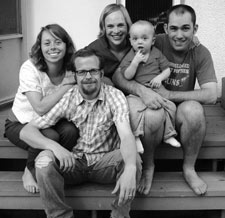
Wilton is working out of office space provided by Church Of Our Lord (COOL) and Withrow is adding his church plant activity to his part time pastoral role at St. Mary’s Open Gate in Langford.
COOL is an historic downtown Reformed Episcopal congregation and St. Mary’s Open Gate is part of the Anglican Network in Canada. And both are part of an Anglican-rooted coalition as an alternative to the Anglican Church in Canada over such issues as biblical authority and the definitions of same-sex blessings and marriage covenants.
Wilton credits Rod Ellis and Sharon Hayton, the rectors, respectively at COOL and St. Mary’s, with a good deal of encouragement for what they are trying to do.
The story of the church planting in this setting, Wilton says, is more about reaching out in neighbourhoods than it is about theological turbulence.
Island Insight interviewed Wilton recently about the church plant project.
Both men come from Washington State, Wilton from the Seattle area and Withrow from just across the Columbia River and state line from Portland.
They and their wives did their undergrad work at Western Washington University in Bellingham. They started to work out their common vision of the future of the church while engaged as tour guides in Alaska before beginning graduate studies at Regent College in Vancouver.
Both their wives are named Katie, and, as it happens, are both in the final stages of pregnancy as this press deadline is approaching. (The Wiltons already have one child. For the Withrows, this is their first.)
While completing their Regent studies, both men worked in Vancouver area churches.
Wilton was at St. John’s Shaughnessy – one of the leaders in the Anglican Network movement. Withrow was in a Presbyterian setting.
Following their Regent work, they sensed Victoria was a good place to become involved in church planting, after passing up some preliminary checks of the Comox Valley.
“It is a different model, more like a pomegranate,” Wilton points out, explaining they are a bit like “old school Jesuits, translating the faith to those burned by Christianity or tired of the rhetoric.”
They want to avoid drawing people who are already well established in the church into their clusters.
“Our intention is not to ‘steal sheep’, not to create transfer growth. We need strong families who can reach out to their neighbours, then become what we call ‘site pastors’ in the clusters. Andy and I will concentrate on developing new clusters.”
Their hope, Wilton says, is that “I would form a downtown cluster – of twentysomethings – getting 20 people moving from house to house, developing it to a group of 30 or 40. Then launch a team, with the originals as the ‘bones’ of the group.”
| Previous article Freemasons left their mark on Victoria | Next article Rhythm Art: fund-raising goes creative for Africa |
 |  |
| Island Page 2 | Island Page 3 |
There would be Sunday (evening) services, prefaced by a meal, “a weekly get together and common training for two or three clusters – and occasional common worship, with special services, say, on Ash Wednesday.”
In effect, Withrow would do something similar in Langford, but adapted to the dynamics of a suburban community.
Some people, Wilton says, might call this “a house church on steroids, or some, a bottom up, small group model. This way, it helps with the intimacy.”
Other proponents of church planting want to get a service going, he says.
“Both are necessary. Our hope is to be able to love our neighbours well. We are not aiming at a regional church, but one that is neighbourhood-based.”
Wilton says they want to” do good in the setting in which they are placed. One idea, downtown, would be to develop an urban garden, do some marketplace ministry and maybe do a Wednesday service at lunch.”
The garden concept would help to “give, out of our abundance, to the poor.”
In Langford, the orientation will be more to families.
They are encouraging the churches with which they are connected to “vision cast” both as to working out the model and finding a name for it.
One name being considered is ‘The Table.’ That, says Wilton, communicates both the “symbol of communion with God and fellowship with one another.” And the garden idea adds to the symbolism, because, figuratively, it brings something to the table.
People ask what the style will be, says Wilton. “We answer: ancient-future. We want to be evangelical, charismatic and catholic. There are three words beginning with ‘s’ that reflect what we want to be about: the spirit, the scripture and the sacred.
“We want the connection with history – but not the same thing every week.”
April 2009