

In 2007, the B.C. government announced it was constructing 12 social housing complexes in Vancouver.
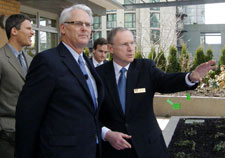
On March 17, it announced that six of those complexes have gone through the design, permit and tendering stages, and that construction will begin soon. The announcement was made by Premier Gordon Campbell, Vancouver Mayor Gregor Robertson and federal MP Andrew Saxton.
The setting for the announcement was Kindred Place, a complex operated by More Than a Roof (MTR) Mennonite Housing Society. MTR was founded in 1984 by Mennonite Central Committee British Columbia. It now operates nine social housing complexes, and has developed a level of expertise that has gained it the respect of governments.
Construction of Kindred Place on Richards Street in Vancouver was begun in 2007, and the 87-unit complex is now filling up with its first residents.
The residents come from a waiting list of people needing housing, which was compiled by B.C. Housing, a branch of the provincial government.
The building is modeled on the 63-unit Candela Place a couple of blocks away, which opened in 2002 and is operated by MTR. One of the six complexes about to be built is Karis Place, on Seymour Street just behind Kindred Place, which will also be managed by MTR.
The government will build the six other complexes in Vancouver and 11 in seven other communities once the permits are in place. More Than a Roof and some other Christian non-profit organizations will be involved in some of those projects as well.
The residents of the three MTR complexes in downtown Vancouver are designated as “low income urban singles.” Some have physical disabilities, and receive rooms modified for wheelchair access. Some have mental health issues, and receive on-site support from a health professional. Still others have overcome drug or alcohol addictions.
Each resident is given a 340 square-foot bachelor suite with bathroom and kitchen. The suites are clean, bright, attractive and functional. The residents pay rent out of their social assistance payments and other income.
These complexes are joint efforts. The city often provides the land, the federal and provincial governments provide the bulk of the funding, and non-profit organizations operate the complexes.
Governments can supply bricks and mortar, said B.C. housing and social development minister Rick Coleman, “but somebody has to put the heart into the building.”
Residents of the MTR complexes receive a clean, safe room – and are incorporated into a community through common areas and a variety of group activities; this provides residents with the social support they need.
Vital to MTR’s success, said executive director Lorne Epp, are the support staff – who work for less money because they have a “Christian service mindset,” and dedicate their lives to helping people. Finding these people does not come through newspaper ads as much as through personal contact with people – and discovering “a mutual sense of calling.”
| Previous article Shack’s author stokes debate over the cross | Next article Family celebration of the hope found in Easter |
 |  |
| Page 1 |
Especially encouraging is that some of the staff are former residents of MTR complexes – people who come with “total buy-in” to the program.
The B.C. government used the March 17 news conference to announce a variety of capital spending projects, amounting to $800 million. It is not often that such announcements are accompanied by prayer. but, Adam Wiggins was asked to do just that.
Wiggins, pastor of Pacific Church, a Mennonite Brethren church plant which meets a few blocks from Kindred Place, reminded those present that Jesus “brought good news to the poor.” He prayed the social housing complexes would be “places of healing and hope.”
While the politicians were holding their press conference at Kindred Place, a handful of protesters were demonstrating on the vacant lot across the alley.
Streams of Justice (SOJ), a Christian social action group, staged a two-day demonstration, walking to all 12 proposed social housing sites in Vancouver to raise awareness of the problem of homelessness.
SOJ’s Dave Diewert said the government had promised construction would begin on six of the sites by the end of 2008, adding it has not shown the same urgency in building social housing as it has in building 2010 Olympic Games venues.
He pointed out there are 10,000 people on the waiting list for social housing, and “endless postponements prolong the suffering.”
Since it costs the government $18,000 more per person per year to care for people on the street, compared to those in social housing, it would save money if the complexes were built more quickly.
While ministries such as MTR “work on practicalities,” Diewert sees his organization as having a different ministry – examining structural issues, walking in solidarity with the disempowered, and calling leadership to account on issues of justice.
April 2009