
Passing the Kwak'wala language torch
Mission Fields,
THE WRITTEN WORD was unheard of along the Kwakwaka'wakw region of north Vancouver Island and the north central coast of B.C. until 1882. That year, Canadian Missionary Society worker Alfred Hall arrived at Fort Rupert, the home of the Kwagiulth people.
Hall found that, not only did the scriptures not exist in the language of the people, but there was no written Kwagiulth language into which to translate the word of God. He began the painstaking work of creating a phonetic alphabet into which – between the years 1882 and 1897 – he would translate the four gospels and the Acts of the Apostles.
Unlike many of the published works written about these people, by writers such as Franz Boaz and Edward Curtis, the work of Alfred Hall lay forgotten – languishing, until recently, in the archives of the Anglican Church of Canada.
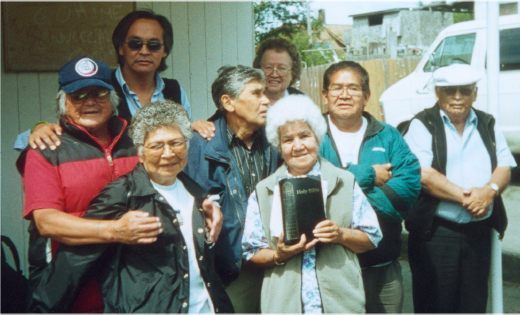
While beginning as preacher at Glad Tidings Pentecostal Church in Alert Bay, B.C., I came into possession of copies of Hall's original materials. After obtaining the publication rights to these historical documents, I began a language restoration project among the Kwakwaka'wakw people – with the help of 78 year old Kwagiulth elder Beatrice Scow.
The purpose is two-fold: to see the documents republished in their original form; and also to tape record readings of the materials, returning the extant written text to its oral traditions.
The work has been painstakingly slow. Hall's originals must first be read in both English and Kwak'wala, and the original intent of Hall's translation must be deciphered.
In many instances, words do not exist in this very limited language which would express the intent of the koine Greek of the original New Testament text. Hall had to seek out unique Kwagiulth cultural idioms that would express God's intent, but for which words did not exist.
For example, Matthew 3 states that "wise men came from the east." In a society where directions made no sense, and where there was thus no word for the direction east, Hall sought and found culturally sound expressions which would convey the text's meaning. He expresses the Matthew phrase as: "many wise men came from where the sun hangs."
The current project is complicated by the fact that, today, a new ethnography exists among the Kwakwaka'wakw people; they have a new alphabet which more succinctly expresses the sounds of the language.
Very few among them can read the phonetic words of Alfred Hall. Were it not for the vision of Beatrice Scow, the written word might not be found among the people before the old language is lost completely.
Beatrice hopes the work of Alfred Hall will once more be heard and spoken by the people of the remote island community in which she lives. To this end, she has worked tirelessly with me to translate the old text and to record it in Kwak'wala.
This wonderful vision, held dearly in the heart of this elderly member of both the community and the church, is today being passed on to my heart -- like the baton in a relay race.
Recently, I preached a sermon at Glad Tidings featuring this famous passage from In Flanders Fields, by Colonel John McCrae: "To you from failing hands we throw / The torch; be yours to hold it high. / If ye break faith with us who die / We shall not sleep."
These simple words took on a different meaning for both me and the little congregation that finds itself in my care. They reflect the ongoing work of a little band of Jesus' followers who find themselves working together against the clock in a desperate attempt to preserve not only a language, but to preserve it in a form that will allow the production of a new translation of the gospels and the Book of Acts to be read in Kwak'wala by future generations.
Contact: 250-949-9542 or hales@telus.net