
Witnessing to Muslims: more than just disputation
Mission Fields,
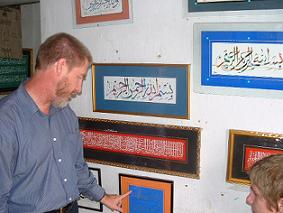 |
MR. NAYEEM is an expert in the ancient art of Arabic calligraphy. His specialty is painting verses from the Qur'an in tight, balanced blocks of curved lines, dots and squiggles. When I first saw his shop in old Jamaal Market in Hyderabad, I knew that an original work from Nayeem Saahib would be the perfect souvenir of our time in India.
I chose a couple of verses from the fifth Sura of the Qur'an which speak in a very favourable way about Eesa (Jesus) and the Injeel (gospel). The verses contain the striking phrase, "Let the people of the gospel judge according to what God has sent down therein" (5.47). I brought these verses with me to Jamaal Market.
Nayeem was clearly delighted that this westerner wanted him to paint verses from the Qur'an. But the text I requested was not in his repertoire, and he took some time to work out the best aesthetic approach.
One day as we were chatting in Urdu about the Arabic words of the verses, I pointed out the words Eesa and Injeel and told Nayeem that these were special. He remarked that yes, there had once been a Gospel worthy of the high praise of these verses, but that now it is corrupted. I replied that this was not true. If fact, I added, I was doing research in the very earliest commentaries on the Qur'an, and was finding quite a different message there.
Nayeem's face fell. He seemed to lose interest in the project. What's more, his body language said that he wanted me to leave. In the following weeks, whenever I visited Jamaal Market, it appeared that the calligrapher had put my project aside.
The problem which I had run up against was the popular Muslim belief that the Bible was falsified by Jews and Christians in the past. That accusation has been one of the most difficult charges for Christians to hear. How do we respond appropriately?
There is a right time and place for taking a stand for the truth of the Bible, including in public dialogue. Certainly there is a great need in the world for Christians who can make a case for the gospel intelligently and skillfully among Muslims. But there is more to Christian witness than disputation.
I decided not to worry whether Nayeem would paint my verses, and began to focus instead on this fascinating individual. Then one day he mentioned that a female relative of his was deathly ill. I told him that I knew some women who prayed for the sick, and asked him whether he would like them to pray for his sick relative. Nayeem said yes.
So two young Indian evangelists whom we were training, Rebecca and Krupa, met Nayeem Saahib at his shop. Rebecca is the daughter of a convert to Christ from Islam, and her home language is the local Urdu dialect. Nayeem was intrigued and pressed her on a number of points of faith. Rebecca would not back down from a full confession of Jesus. But she punctuated every sentence with respect and a friendly smile.
Rebecca and Krupa then proceeded to the hospital to meet and pray for the sick woman. Unfortunately, the woman later passed away. But Nayeem was impressed with the young evangelists and grateful for their caring act.
The next time I visited Jamaal Market, I noticed that Nayeem had taken up my project once more. He worked at it diligently and finally achieved the aesthetic balance which only a true artist knows.
Nayeem's beautiful painting now graces the wall of my office.
Gordon Nickel is assistant professor of intercultural studies at ACTS.