
Flying high for the faith
Mission Fields,
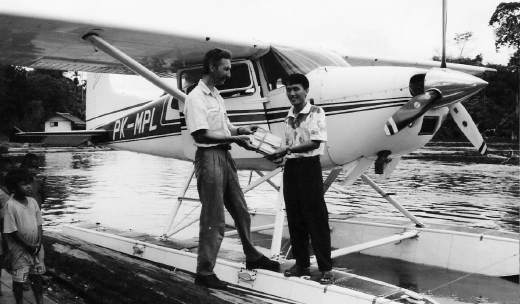
The 50th anniversary of Mission Aviation Fellowship (MAF) is being celebrated in 2006. Begun as the Christian Airmen's Missionary Fellowship, the ministry's first initiative was a 1946 flight from California into Mexico. With the attention garnered by the 1956 murders of MAF pilot Nate Saint and four others (see below), interest in missionary aviation was "catapulted . . . into the consciousness of Christians everywhere," according to former MAF pilot Jon Lewis. Since 1988, B.C.-based Remi van Wermeskerken has worked with MAF Canada (MAFC) in Indonesia. He shares some highlights of his experiences.
ONE of the greatest compliments I ever received for MAFC came from the US-MAF head of human resources. He was visiting many of MAF's overseas bases to find out why US-MAF was losing so many people.
He very quietly asked me if I knew of any more Canadians who might want to go on loan to US-MAF - because, he said, his superiors "have figured out that they can send Canadians to the most awful, remote, difficult places and they'll do fine, but that their own personnel just don't last there."
Barriers
MAFC exists to overcome practical obstacles such as distance, geography, jungles and swamps. The ministry has done a great job at breaking down many of these barriers - reducing weeks or even months of travel time to days, hours or even minutes.
In many Asian countries, people tend to help only members of their own tribe. Now imagine a foreigner coming from another country and helping them.
Everyone now knows our two float planes as the 'church planes.' They associate good things happening to them with the fact that we are Christians.
For example, I have carried many kilos of gold from river prospectors to the capital city. The owners would not even trust their own family members to bring it downstream, and there are many robberies on the rivers; however, they had no problem just giving all this gold to MAF pilots to bring to the city.
Even when we said that we would not be responsible for protecting the gold, they had no problem. Again, they trusted us and knew us as 'the Christians.' It was a great way to show that believers are honest, and can be trusted.
Church planting
In 1995, MAF asked our family to move to Central Kalimantan to start a new MAF operation. It was an incredible amount of work, and at times very discouraging; but one result of this new operation was a plan to plant 500 evangelical churches in a province with less than 50 at that time.
We flew around 50 hours, mapping the entire province, noting language groups, churches, mosques, et cetera. Then this information was presented to the national church, which decided to pour most of their resources into Central Kalimantan for the next five years, to plant the projected 500 churches. After three years, 300 had been planted.
Because of the lack of pastors, my wife Tjandra and I could see that there was going to be a big problem supplying the church planters. We helped start a Bible school in Central Kalimantan, to assist them.
Almost all the graduates are still in ministry in new projects, while most of the workers from other islands have gone home due to the extremely harsh life in Central Kalimantan. This Bible school is totally focused on the church planting program, and the needs of the local population.
Tsunami
The December 2005 tsunami in Asia touched the hearts of people all around the world. We were in Canada on furlough; but Heli Mission asked if I would be able to immediately go to Banda Aceh in Indonesia to help them start up a helicopter operation there. Seeing the devastation caused by the tsunami was an experience we will never forget.
Before I went, it was known that the Acehnese were the only Indonesians who had official Islamic law; that they did not want Christians or foreigners in their province; that they wanted to separate from Indonesia; and that Christians there needed to fear for their lives.
When we arrived there to help, the locals quickly saw that their 'Muslim brothers' had not shown up to help in any major way - but that most of the help came from Christians, and people from what they consider 'Christian countries.'
This really softened their hearts - and after several months, they did not want the Christians to leave! It was a tremendous breakthrough in an area which was completely closed to Christianity before the tsunami.
Challenges
Our greatest challenge in the field is the number of tasks we must perform. When was the last time you saw a commercial pilot who also: maintained his own airplane, loaded it, sold the tickets, weighed the passengers' luggage, refueled the plane, figured out the weather enroute, scheduled all the flights (with constant changes due to emergencies), counted millions of rupiahs daily, did all the paperwork and statistics at the end of the day - and was also an instructor, base manager, personnel manager, administrator and accountant?
On top of all that, we have to raise our own support, stay in regular contact with supporters, family and friends, and then still find time for our own families.
There are also constant requests to get involved in the local church - preaching, teaching and helping financially. There is simply too much to do.
However, this job has taught me to be much more of a 'do-er' - to not only proclaim that I am a believer, but to put into action what I am learning from God's word.
I come from a country where people do not suffer much, nor have major crises in their lives on a daily basis. Being married to an Indonesian pastor, and having lived in Indonesia for 17 years, has shown me that we Christians must make it a priority to get involved in the lives of believers who are undergoing extreme persecution.
It has also shown me how much we can be a blessing to churches worldwide - by being open to what God calls us to do.