
Violence narrowly averted at Dalit rally
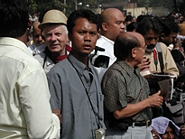 |
IN INDIA, the Hindu-based caste system -- although technically illegal -- is still very much in evidence. One people group, known as the Dalits, have been traditionally regarded as the lowest of the low. In recent years, a movement has developed among them, advocating the repudiation of the caste system through the rejection of Hinduism. Considerable excitement was recently generated when a rally was scheduled for November 4 in New Delhi, where thousands of Dalits would be invited to become either Buddhists or Christians; various evangelicals became involved, hoping to baptize large numbers of Dalits. Stuart Spani, a freelance Christian video producer from North Vancouver, attended the rally. Upon his return, he sent a detailed account via e-mail, in response to several questions.
BCCN: Some Christians were promoting the idea that literally millions of Dalits would accept Christ as a result of the November 4 event. Do you feel that some of these projections were irresponsible?
Stuart Spani: This is a question that I have pondered ever since I heard of the possibility of the event. I think the only one who can answer it completely is God -- it has too many complexities for human understanding. Saying that, I will try to express some of my fumbling thoughts on the subject. First, one has to consider the background.
Who are the Dalits, and why do they want to quit Hinduism? The Dalits are those considered untouchables by high caste Hindus. There are about 300 million Dalits, close to the population of the United States. Why are they untouchable? Unlike Christians or Jews, who believe that men and women were created in the image of God and that we live once, die and face the judgment of God, Hinduism teaches that God created the Brahmins, the priestly caste, from his head; the warrior caste from his arms and chest; the merchant caste from his belly; and finally, the servant caste from his feet. (While there are four major caste groups, these are sub-divided into more than 6,000 sub-castes.) Further, they believe in reincarnation -- where one's caste is due to their "karma" from a previous life.
The word karma is often used in western society. In fact, I was recently in Indigo Books -- and there was a jar to put money in, claiming that this gives good karma. In the Hindu religion, good karma or bad karma have nothing to do with what we in the west consider good or bad deeds. Good karma, for a Brahmin, would be living within his caste, expecting to be served by the lower castes; bad karma would be doing jobs, such as cleaning, which is the work of a lower caste. With a Dalit, or untouchable -- for example, a sweeper -- good karma would be spending one's life sweeping and bad karma would be to try to better your position in life.
The point is that the caste system has been used to force the lower castes to stay in their place and to serve the upper caste -- not really that different from how aristocracy thrived in Britain for centuries. Education has gradually changed the class system in Britain -- and it is slowly forcing change in India. The Indian Constitution is based on Judeo-Christian principles and declares that everyone is equal before the law. This is in direct opposition to Hinduism, which is by far the major religion in India. Further, the law provides that a certain percentage of the lower castes and "backward tribes" must receive education.
Try to imagine the tension this causes. Because of the law, a person born as a sweeper can become a doctor, a space scientist, a cabinet minister -- yet, because of the religion, that person is treated as being lower than an animal. It is not surprising that the Dalit are rebelling, and are declaring that they have had enough and are not going to take it anymore.
Ram Raj, the leader of the Dalits, is well educated and is a senior civil servant; however, everyday he faces injustices, like all of his caste. He is determined to break the system, and realizes that the only way to do this is to destroy Hinduism. Did he get carried away in predicting that large numbers of people would reject Hinduism? Probably. Were his motives right? You be the judge.
Did Christian groups get carried away with these same numbers and use hype to collect money? Probably. But again, look at the motives. If indeed one million Dalits rejected Hinduism in one day, and 20,000 were baptized, there would need to be a massive amount of discipleship -- which would cost money. Ram Raj had originally challenged the church to baptize a minimum of 20,000, and had authorized the distribution of one million copies of the Gospel of John and a million copies of Vishal Mangalwadi's new book, The Quest for Freedom and Dignity. If this had happened, it would have been the greatest one-day conversion to Christianity the world had ever seen -- perhaps the greatest spiritual event since the resurrection of Jesus. However, in retrospect, one could not imagine that the privileged upper castes would allow this to happen without a struggle. At no time in history has a privileged class handed power over voluntarily.
The "hype" around the November 4 event -- if hype is what it indeed was -- caused me to drop everything and to head for India, to become part of a video team dedicated to record this event. But just before the rally, things began to unravel. A fundamentalist Hindu group declared that they had 20,000 well-armed volunteers in place, to disrupt the event. Everyone got nervous. I got the warning by e-mail, while I was in Mizoram, on the way to Delhi. I was given the opportunity of not coming into what looked like a dangerous situation.
Everyone reacted differently to the threat. Ram Raj, determined to have the rally -- mainly to focus world attention onto the injustices of the caste system -- denied ever suggesting conversions to Christianity, withdrew the invitation to distribute Christian literature -- and at one point, stated that there would be no conversions to Buddhism, but only a celebration of the long history of Buddhism in India. Rightly or wrongly, the Christian groups agreed to these new terms.
The Hindu group, sensing weakness and disunity in the Christians, pushed harder and demanded the rally be stopped completely. The government responded by withdrawing the permit to meet, and putting many heavily armed guards at the gates of the grounds where the rally was originally to take place.
BCCN: What actually prevented the planned mass baptisms from happening?
SS: I believe the short answer is God -- and the prayers of his people, for non-violence. If the baptism had gone ahead, there would have been bloodshed -- quite likely on a massive scale. Would it have been right to baptize people, mainly for political reasons? They would not have been discipled at this point, and would be under the threat of being killed.
BCCN: What influence did militant Hindu factions exert on the situation?
SS: Plenty. Their threats produced fear and confusion -- and caused the government to try to prevent the rally from happening. Dalits, trying to travel from all over India, claimed to have been detained. In at least one case, an American woman was refused entry at Mumbai Airport, even though her visa was in order. The explanation was that her presence would pose a threat to Indian security.
BCCN: Why would extremist Hindus allow the Dalits to accept Buddhism, but not Christianity?
SS: My theory is that many of the upper caste don't really believe that there is truth in Hinduism, but only use it to subjugate the lower caste. They also consider Buddhism an empty threat, but fear the power and truth of the gospel. The promise of everlasting life is what sets us free from fear. If the Dalit lose their fear of karma and reincarnation, the Brahmin lose their power.
BCCN: How much danger would Dalits put themselves in if they publically accept Christ?
SS: The threat of violence is very real. The militant Hindus had claimed this was a western Christian conspiracy, and swore they would stop it at all costs. If the baptisms had gone ahead I believe there would have been bloodshed. Rather than inflame an already tense situation, the church backed off on public conversions, baptisms and the distribution of Christian literature, and only offered support to anyone seeking freedom from the caste system. Without these compromises, we may well have been responsible for some physical deaths of new converts. We are called to be as wise as serpents and gentle as doves.
BCCN: To what extent did divisions among Indian Christians contribute to the failure of the November 4 event?
SS: I don't believe November 4th was a failure -- only a detour. Many Christians in India view this event from completely different perspectives. I have dear friends, whom I respect greatly, on both sides of the question. I rely on Romans 8:28 -- I believe the outcome was and is in God's capable hands, and that that is where it must remain.
BCCN: What prevented bloodshed from occuring?
SS: It is a miracle that it didn't. I believe it was prevented by the prayers of God's people. It had all the potential of getting completely out of hand, especially at the end of the rally.
When it was over, I headed to the originally planned meeting place and to the train station. The plan was for the tens of thousands at the rally to march on these two sites -- first to free those held at the train station, and then to force their way into the originally planned grounds. I went between the two sites for hours; no one arrived. That night, I learned the reason.
Just after I had left the rally, about 5,000 of the Dalits, including most of the leaders, had come out of the walled grounds and onto a parking lot -- and then the army moved in. They sealed the gates of the compound and erected barricades around the parking lot. Thus began a 2 1/2 hour standoff, with 5,000 Dalits facing almost as many soldiers across a hastily erected barricade. The tension was described as electric. About fifteen minutes into the standoff, one of the Dalits tried to hit a soldier with a stout staff. Someone behind him grabbed the end of his weapon and prevented the blow. An eyewitness showed me a picture of this action; he said his first thought was, "Here goes, this is going to get bloody." It didn't -- but tensions remained near a breaking point. Ram Raj finally got on the top of his rally bus with a megaphone, and exhorted his people to non-violence -- and then negotiated with the army to let everyone out, a few hundred at a time, with the promise not to reassemble. Violence was very narrowly averted.
BCCN: What do you believe will happen among the Dalits in the next several months?
SS: I may be overly optimistic, but I believe I witnessed the beginning of the end of Hinduism -- at least in India. The New Age Movement, the westernized form of Hinduism, is another matter. I do not believe such an evil, controlling system can survive modern communications and education. My prayer is that, through many avenues, these oppressed people will find freedom through the gospel of Jesus Christ.
An Indian colleague spent much time witnessing to Ram Raj. She told me: "My heart broke when I witnessed Ram Raj kneel in front of a statue of Buddha and renounce a religion of 300 million gods and accept one with no gods." Then she said: "What a vacuum. Will the churches have the courage and wisdom to fill it with truth?" That is the question for the churches of India and for every Christian in the world to answer. It is our job to witness; if we do, the Holy Spirit will do the rest.
To summarize: without the so-called "hype" generated before the event, the following would not have happened:
The western press would not have covered the event, and begun to tell the world of the injustice of the caste system, and exposed the lack of religious freedom in India.
Vishal Mangalwadi might never have published his powerful book, The Quest for Freedom and Dignity. He wrote and published this in record time in order to distribute it at the rally; while it could not be distributed as planned, it is still a powerful tool for evangelizing India.
Ram Raj, still a Buddhist, would not have come to the USA and met with George Bush and many other secular and church leaders -- and then travelled extensively in India, meeting with all of the top political leaders.
The Dalits, and all of India, would not have been given the hope that they will be allowed to choose their own religion. This is man's greatest freedom, the freedom to seek truth, without fear of reprisals.
This phenomenon opened the way for even greater ministry, through the many agencies dedicated to witnessing Christ in India. These include all of the Christian churches in India and the many parachurch groups using diverse methods to introduce the gospel to this dark and hurting land.
On a personal note: without this 'hype,' I would have missed out on some of the most meaningful spiritual moments in my life. On my way to the rally, I spent time in Japan, and saw what the Holy Spirit is doing there through the Alpha Course; and I witnessed a great revival in Mizoram, the most Christian place on earth.
Let me describe my most emotional experience in India. Just as the rally was finished and our group was working our way to the exit, a man stood up right in my face. He said, "I am an untouchable -- in fact, I am an outcast, the lowest of the untouchables." It was a distinct challenge to see how I would react. I first reached out and took his hand in both of mine, then gave him a hug. What it started was amazing; literally hundreds crushed around me, to touch and to be touched. Some even threw themselves at my feet and kissed them. I wept; I could not comprehend their need to be accepted as people with worth. It is hard to fathom the emptiness of never having been touched by someone who is outside of your caste.
If I learned anything from my experiences during this event, it is that what makes us equal in God's sight is not our station in life, not our gifts, not our achievements, not our wealth, not our influence or power, not anything we feel makes us important. What makes us all equal is that each one of us, high and low, saint and murderer, is that we are all sinners -- we are all desperately in need of a saviour.
In conclusion: we have to realize that the battle in India is not between people, but is being waged in the heavenlies, between the forces of good and evil, between Jesus and Satan, as they wrestle for precious souls. India will be brought to Christ through the demonstration of Christian love and concern, and the preaching of the gospel. I believe God will bring much fruit from man's fumbling attempts to bring justice to the oppressed of India. To him be the glory.