
Comment: 'Shock and awe' -- and a deep sense of outrage
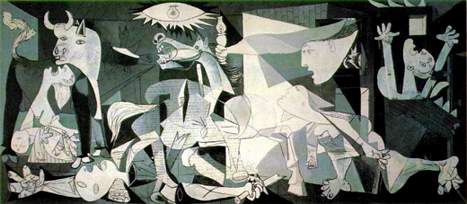
I WAS doing okay until they covered up Guernica; then, for the first time in all the weeks of war-talk, I felt a deep sense of outrage.
You may recall that, in early February, U.S. Secretary of State Colin Powell was scheduled to present his case for war against Iraq to the UN Security Council; Powell and other foreign ministers would then address the press in the corridor outside the council room.
On the wall in that corridor was a replica of an extraordinary anti-war mural by Pablo Picasso; it was named after the Spanish town of Guernica -- which, in 1937, became a testing ground for the Nazis. For the first time in history, civilians were slaughtered through a massive aerial bombardment; Picasso's impassioned response drew the world's attention to the atrocity.
UN officials decided that the image should be covered by a blue curtain displaying the flags of Security Council members. Why? As the Vancouver Sun put it: "The reason for covering up the politically charged image of the Nazi war machine comes down to the practical necessities of today's image machine -- television coverage . . . Cameramen complained that the brown and white, disjointed [image] made for awful TV."
To me, this was a clear sign that a kind of madness was setting in as some nations pushed for war against Iraq. I had to wonder: How had we entered an era so benighted that one of the most powerful anti-war statements of all time could be censored for such a banal reason, at a time when eloquent peace statements were so sorely needed?
Nightmare scenarios
These are nasty times. Anti-war protesters are frequently portrayed by blinkered columnists and politicians as supporters of Saddam Hussein -- or 'Saddamites' -- not to mention cowards, traitors and whiners. Some American politicians threaten dire economic consequences for Canadian businesses because of our government's non-participation in the war.
Then there's the backlash against France for not 'getting with the program.' While it's wonderful to see French toast and French fries being liberated from culinary servitude to Jerry Lewis fans, I fear for the fate of thousands of accordions (Pardonnez-moi). But all kidding aside, there is a sinister edge to this new fad: just before the war broke out, vandals set fire to a California business called French Cleaners.
Further, many observers believe events could potentially spiral out of control into any number of nightmare scenarios. Turkish and Kurdish forces could end up fighting on Iraqi soil; Iraq could attack Israel with missiles; terrorist attacks could be inflicted on the U.S. or its allies; Iraq could prove the U.S. accusations correct by ordering the use of biological or chemical weapons; other countries might decide to support Iraq militarily; and extremist Muslims could manipulate these events, to rouse moderates to defend Iraqi Muslims.
Meanwhile, what about North Korea's nukes? the India / Pakistan arms race? the Israeli / Palestinian quagmire? It's all enough to make me echo Leonard Cohen's immortal lament from 'The Future': "Gimme back the Berlin Wall." Amen brothah!
'Madman' Hussein
The case against Saddam Hussein is clear enough. Among other things, he showed his willingness to use chemical weapons to kill thousands of his own people at Halabja; he happily doles out money to the families of Palestinian suicide bombers; and his 1991 torching of Kuwait's oil fields was criminally psychotic. Obviously, we would all be better off without him in power.
It is also fair to say that some peace activists have not sufficiently come to grips with the threat posed by such a man. But where is the long-rumoured irrefutable proof that he has weapons of mass destruction? Where is the undeniable evidence that he is directly linked to terrorist poster boy Osama bin Laden and the Al-Qaeda country club?
Indeed, Hussein is one nasty piece of work, by all appearances. But he is not, as is so often claimed, 'the next Hitler.' Where is the evidence that he has truly committed genocide? The ruthless slaughter of one's opposition, ghastly though it may be, does not equate to attempting to wipe out an entire people. As broadcaster Gwyn Dyer once put it so well, Hussein is "just an average, run of the mill Middle Eastern thug." Demonizing him only increases the likelihood that we will focus only on him, and forget about the people who will suffer as 'collateral damage' in the push to get Hussein.
Further, does Hussein's behaviour prove that he is a madman, as many claim? If he was truly insane, why did he refrain from using chemical weapons during the first Gulf War? Clearly, Hussein could be called a cruel tyrant, a creep, a jerk and a brute -- but not necessarily a madman. And no matter what your opinion of him, ask yourself: Considering the probable motives of the people running this war, is it really the best way to get rid of him? Was there no other possible alternative?
Consider the following assessment by two experts on the situation: "While we hoped that [a] popular revolt or coup would topple Saddam, neither the U.S. nor the countries of the region wished to see the breakup of the Iraqi state. We were concerned about the long-term balance of power at the head of the Gulf.
"Trying to eliminate Saddam, extending the ground war into an occupation of Iraq, would have violated our guideline about not changing objectives in midstream, engaging in 'mission creep' -- and would have incurred incalculable human and political costs. Apprehending him was probably impossible. We had been unable to find Noriega in Panama, which we knew intimately. We would have been forced to occupy Baghdad and, in effect, rule Iraq. The coalition would instantly have collapsed -- the Arabs deserting it in anger, and other allies pulling out as well.
"Under those circumstances, furthermore, we had been self-consciously trying to set a pattern for handling aggression in the post-cold war world. Going in and occupying Iraq -- thus unilaterally exceeding the UN's mandate, would have destroyed the precedent of international response to aggression we hoped to establish. Had we gone the invasion route, the U.S. could conceivably still be an occupying power in a bitterly hostile land. It would have been a dramatically different -- and perhaps barren -- outcome."
And now the punchline: the preceding quote is from 'Why We Didn't Remove Saddam,' a 1998 Time magazine article by Brent Scowcroft and . . . wait for it . . . George Bush Sr.
Flimsy evidence
The fact is that, according to chief weapons inspector Hans Blix, the Iraqis were cooperating with UN inspections to a large extent. In January, he told the New York Times: "I think it would be terrible if this comes to an end by armed force, and I wish for this process of disarmament through the peaceful avenue of inspections."
At last count, the Iraqis had destroyed 68 missiles. If the inspection process had been given more time, they might conceivably have been pressured into disarming -- or failing that, the extra time might at least have enabled the U.S. and Britain to find a way to work with the UN. Why could we not have given the Iraqis more time?
Aside from Iraq's possible possession of prohibited weapons, supporters of the war have long maintained that Saddam has attempted to export terrorism. This may, of course, be true. However, a previous attempt to prove this allegation fizzled out. A year ago, a purported meeting in Czechoslovakia between one of the 9/11 hijackers and an Iraqi official created quite a stir; but the story gradually fell apart, and was dismissed by mainstream sources such as Newsweek.
Nonetheless, Bush administration officials have resolutely maintained that Iraq has pulled off a gigantic deception, cleverly hiding weapons of mass destruction and plotting to use them in terrorist actions worldwide. Colin Powell gave it his best shot in his widely touted February presentation at the UN. While it was hailed by some as an airtight case, convincing arguments against Powell's contentions came from sources as varied as foreign policy analyst Phyllis Bennis and Palestinian writer Ali Abunimah.
Perhaps the most telling response was given by an Iraqi expatriate. Imad Khadduri worked for the Iraqi nuclear program for three decades, and fled the country in 1998. While he can't vouch for whether Iraq is harbouring chemical and biological weapons, he has clearly asserted that Iraq's push for nuclear weapons was crippled by the first Gulf War, and that it never recovered.
Khadduri has disputed the Bush administration's much-vaunted 'evidence' that purportedly proved Iraq had viable weapons of mass destruction. He has written dismissively about what he refers to as "flimsy . . . untenable . . . threadbare arguments."
In a CBC interview March 19, he also said he believed that some people in the U.S. government were capable of what he called "dirty tricks," such as planting incriminating evidence on Iraqi soil during the current war. An outrageous libel, some would say. But if one looks at certain actions of key American administrations, Khadduri's claim sadly acquires credibility.
Gulf War syndrome
Some background is necessary at this point. Many of you may recall a key moment from just before the first Gulf War: a tearful young woman was shown on TV, testifying before a U.S. congressional hearing. The 15 year old, named Nayirah, related the horrifying story of Iraqi soldiers raiding a Kuwaiti hospital, and confiscating incubators. The courageous girl said she witnessed these heartless barbarians taking babies out of incubators, and leaving them to die a slow death on the cold, hard floor.
In the ensuing weeks, a righteously angry President George H.W. Bush repeatedly referred to this outrage in his speeches. Some observers believe this atrocity was instrumental in persuading many of the more dovish members of congress to support the president's military plans.
But there was a tiny problem with Nayirah's poignant tale: it never actually happened. As has been well-documented -- by news outlets such as the CBC, the Guardian and the Christian Science Monitor, and programs like 20/20 and 60 Minutes -- the incubator scam was concocted by international public relations giant Hill & Knowlton (H & K). The strategically vulnerable Nayirah, it turned out, was actually the daughter of the Kuwaiti ambassador.
CounterPunch columnist Mitchel Cohen, and many other critics, have pointed out that H & K also created a group called Citizens for a Free Kuwait, which Cohen describes as "a phony 'human rights agency' set up and funded entirely by Kuwait's [leadership] to promote its interests in the U.S." H & K was ideally placed to help Kuwait's oligarchy, according to Peter Wirth, CEO of a PR firm called GW Associates. The CEO of H & K, Craig Fuller, "had access to the power elite in Washington, as he had served as the President's chief of staff when Bush was Vice President under President Reagan."
Hill & Knowlton's sleazy machinations helped bring about a war which became an environmental disaster and produced an estimated 100,000 Iraqi corpses. The company has never been punished for these despicable actions; according to one report, they even bragged about it. I'm sure they are doing just fine, thank you -- probably selling used incubators in a city near you.
Some critics suspect that a similar manipulation of the media was attempted in the leadup to the current Iraq war. Last August, CNN broadcast a story claiming that dozens of Al Queda videotapes had been found in Afghanistan. The most dramatic material showed dogs evidently being killed in experiments with chemicals. Critics lambasted the presentation, insisting that the gruesome tapes had likely been concocted by U.S. government operatives.
A scathing critique, entitled 'Wag the Gassed Dog,' was issued by an organization entitled Unanswered Questions, which represents American citizens who are examining various aspects of the 9/11 attacks and their political aftermath. Author Michael Rivero wrote: "Until proven otherwise, the safest course is to assume this latest 'shock video' is just another hoax by the public relations firms which grow rich and fat off of your tax dollars by lying to you for the U.S. Government.
"Anonymous U.S. officials have declared this to be 'unquestionable' evidence that Al Qaeda has chemical weapons. I find it very questionable. For one thing, compare the quality of the dog video with that of the famous Osama 'confession' tape, or even the most recent Osama tape. Why does a dog get much better video quality than the boss?
"Add to that the cuteness of the dog, as if intentionally selected by central casting to provoke the greatest feelings of sympathy in the viewer, instead of just grabbing any old mangy stray mongrel to use in such a test. Yes, this video is shocking, but the shock is intended to shock people past questioning the claims of where the video came from. All day long, the media has been blasting the 'Arabs kill puppy dogs' story all over the airwaves, trying to create a linkage between Arabs and chemical weapons where none can be proven to factually exist."
There is another parallel between the buildup to the current war and the campaign which led to Gulf War I. In recent weeks, Colin Powell produced satellite photos to bolster his case against Iraq. In a January article entitled 'Selling A War: The Conning Of America,' Wirth cited another set of photos, which played a similar role a dozen years ago.
According to the Christian Science Monitor, he wrote, American military officials claimed to have "top-secret satellite images." The Pentagon "estimated that up to 250,000 Iraqi troops and 1,500 tanks stood on the border of Saudi Arabia, threatening the major supplier of oil for the US."
The St. Petersburg Times in Florida, Wirth continued, "acquired two commercial Soviet satellite images of the same area, taken at the same time, which showed no Iraqi troops visible near the Saudi border . . . Jean Heller, the Times journalist who broke the story asked Secretary of Defense Cheney (now Vice President) for evidence refuting the Times photos, offering to hold the story if proven wrong. The official response: 'Trust us.' To this day, the photos cited by Pentagon officials remain classified."
Wirth comments: "It is hard for Americans to accept that, at times, we are lied to or intentionally misled -- in order to build support for a foreign policy decision."
Thus, it is pretty obvious that the Bush Sr. administration instigated the first Persian Gulf adventure with the help of deceptions which dwarfed the Gulf of Tonkin 'incident' (the famously fabricated skirmish which was used to justify the escalation of the Viet Nam war). While the preceding items have been given some journalistic coverage in recent months -- mostly by credible internet sources -- they appear to have gotten little attention in the mainstream media.
Strange bedfellows
What, you might well ask, has all this chicanery to do with the price of oil in Medicine Hat? Well, aside from the distinct possibility that the evidence which was mustered to instigate the current war may very well be bogus, there is good reason to believe that the Bush Jr. administration is being directly influenced by another suspect organization. The Committee for the Liberation of Iraq bills itself as an independent, non-governmental organization (NGO) "formed to advocate freedom and democracy in Iraq."
Another CounterPunch writer, Kurt Nimmo, maintains that "NGO is a misnomer for this particular organization -- because its advisory board is stacked with former government types . . . In essence, the Committee is a PR front for the Bush 'attack Iraq' policy." Further investigation appears to confirm this.
Some key Committee members have clear connections to the current Bush administration; others were directly involved with engineering the first Gulf War. Committee president Randy Scheunemann worked for Defense Secretary Donald Rumsfeld in 2001; former Secretary of State George Schultz, who was a key figure during the first Gulf War, is a member of the Committee.
Another member is Barry McCaffrey, a former general who has been accused of presiding over an extraordinarily savage massacre of retreating Iraqi soldiers during the cease-fire that ended the first Gulf War. The charges, brought by Pulitzer Prize winning journalist Seymour Hersh in a 2000 New Yorker article, have been dismissed by the U.S. Army. Hersh's allegations got relatively little media coverage, and no independent investigation has ever been conducted.
One of the Committee's key officials is Gary Schmitt, who is also executive director of Project for the New American Century (PNAC), a radically conservative think-tank whose charter members include Donald Rumsfeld and Vice President Dick Cheney. In 2000 -- more than a year before September 11 came along to justify a huge military buildup -- PNAC produced a document entitled 'Rebuilding America's Defenses' (which is readily available on its website).
'American peace'
The purpose of PNAC, the authors state, is to build upon "the defense strategy outlined by the Cheney Defense Department in the waning days of the [George H.W.] Bush Administration." Further, "this report proceeds from the belief that America should seek to preserve and extend its position of global leadership, by maintaining the pre-eminence of U.S. military forces.
"Today, the United States has an unprecedented strategic opportunity. It faces no immediate great-power challenge; it is blessed with wealthy, powerful and democratic allies in every part of the world; it is in the midst of the longest economic expansion in its history; and its political and economic principles are almost universally embraced. At no time in history has the international security order been as conducive to American interests and ideals. The challenge for the coming century is to preserve and enhance this 'American peace.'"
This peculiar 'peace,' they confirm, will be guaranteed by refinements of weapons of mass destruction: "There may be a need to develop a new family of nuclear weapons, designed to address new sets of military requirements -- such as would be required in targeting the very deep underground, hardened bunkers that are being built by many of our potential adversaries."
Further, while acknowledging that biological weapons are disavowed by the American government, the document's authors contemplate their potential practical uses: "Advanced forms of biological warfare that can 'target' specific genotypes may transform biological warfare from the realm of terror to a politically useful tool."
Perhaps most chillingly, the PNAC report declares that one of the "core missions" of the U.S. military is to acquire the ability "to rapidly deploy and win multiple simultaneous large-scale wars." It also states that the U.S. must "maintain nuclear strategic superiority."
Regarding the Middle East, the document indicates that deposing Saddam Hussein is only one component of a wider strategy:
"In the Persian Gulf region, the presence of American forces -- along with British and French units -- has become a semi-permanent fact of life. Though the immediate mission of those forces is to enforce the no-fly zones over northern and southern Iraq, they represent the long-term commitment of the United States and its major allies to a region of vital importance. Indeed, the United States has, for decades, sought to play a more permanent role in Gulf regional security. While the unresolved conflict with Iraq provides the immediate justification, the need for a substantial American force presence in the Gulf transcends the issue of the regime of Saddam Hussein."
The implications of the latter statement are clear: for these people, removing Hussein is only a stepping stone in a much more ambitious master plan for control of one of the planet's most crucial chunks of geopolitical real estate.
What does this all add up to? To put it bluntly, the policies which control the use of the world's deadliest military machine are being directly influenced by jingoistic zealots with clearly dangerous motives.
Hypocrisy
America has done many admirable things, culturally and socially; however, the foreign policies of many of the country's governments have frequently been breathtakingly hypocritical, self-righteous and arrogant. Some American administrations have propped up dictatorial regimes, when it has been to their economic and political advantage. Have we forgotten about U.S. support of Pinochet's Chile, Somosa's Nicaragua, Suharto's Indonesia or the Shah of Iran?
Further, while members of the current U.S. junta pontificate about the scourge of unconventional armaments in the hands of 'rogue states,' who is it that keeps building and fine-tuning the most phenomenal arsenal of weapons of mass destruction in human history?
In late January, the Bush administration proposed the biggest increase in military spending since the insane days of Ronald Reagan (who, not coincidentally, also had a devoted following of well-meaning but politically naive conservatives who were evidently patriots first, morality police second and Christians third.) This president has also attempted to revive Reagan's idiotic Star Wars missile defense program.
Like Reagan, Bush is essentially functioning as a hotshot salesman for the armaments industry. And just as Reagan's incredibly reckless arms buildup was falsely credited with ending the Cold War, the Bush buildup will presumably be hyped as essential to combating the never-ending 'terrorist threat' -- which will, no doubt, conveniently keep popping up in various other countries long after Iraq is laid waste.
Which brings me to another key point. While the case can easily be made that America's leaders are going to war for access to Iraq's oil, there is another factor to consider: the good ol' reliable Military / Industrial Complex (anyone remember that?) which President Dwight Eisenhower so astutely warned us about just before he left office.
During Gulf War I, John Stockwell -- a one-time CIA employee turned peace activist -- gave a lecture in Vancouver. He made a strong case that, with the Communist threat no longer a viable reason to build up armaments, George Bush Sr. needed a new all-purpose villain to justify his own huge defense budget and keep his friends in the arms industry happy. Saddam Hussein, Stockwell pointed out, was made to order for the role of Hitler wanna-be. And by a happy coincidence, certain U.S. companies -- along with like-minded entrepreneurs in other Western nations -- had already given ol' Sad just enough weapons to make him a credible threat.
And these benevolent corporations continue bestowing innovative new consumer products upon a grateful world. They even have a bomb which can simulate a nuclear explosion. Some days before Gulf War II -- the mother of all sequels -- began, the U.S. military tested what it dubbed 'the mother of all bombs.'
According to the National Post, the Massive Ordnance Air Blast bomb "sends up a cloud similar to a nuclear explosion, and its use is partly to terrorize the enemy." A U.S. Air Force spokesman called it "a psychological weapon." It is also incredibly irresponsible. What if the bomb is used and, in the heat of battle, an enemy believes the U.S. has set off a tactical nuclear weapon? Such a bomb could easily trigger a nuclear response.
Infomercial
But the American military seem more interested in boasting of such weapons, repeatedly asserting that their attack on Iraq will 'shock and awe' the enemy. One could make the case that they are also using this opportunity to display their spectacular new weapons for all to see. The media coverage of the war could be seen as a monstrous, extended infomercial for U.S. military might. The message? 'Don't mess with us,' it would appear.
Indeed, image manipulation is the order of the day. The impressive room where General Tommy Franks is giving his press briefings was reportedly devised by a Hollywood designer. As several commentators have pointed out, this whole sorry affair is creepily reminiscent of the plotline of Wag the Dog (which was evidently inspired by the Kuwaiti incubator sham) -- which depicted a movie producer helping an American president concoct an excuse to go to war. Considering that some of the key people running this war also perpetrated Gulf War I -- and were quite possibly involved in its attendant deceptions -- the issue of trust inevitably arises.
The U.S. government has confidently assured us all that they will find clear proof that Iraq has been hiding weapons of mass destruction. For all I know, they may very well prove their point -- in which case, I would be more than happy to retract some of my criticisms.
However, given the untrustworthiness of certain American regimes, a disturbing question must now be asked: Could some in the Bush administration be so desperate to vindicate their position that they might actually plant evidence of chemical and biological weapons on Iraqi soil, as Imad Khadduri suggested? Let us hope that, if such evidence is produced, it will be examined with the utmost care by independent experts.
America's quandary
Meanwhile, whither America? Firstly, it's crucial to remember that the majority of Americans are, no doubt, fine people. Certainly, all this lunacy and stupidity has not triumphed, as the very substantial and courageous American anti-war movement clearly demonstrates; this gives us good reason to be both thankful and hopeful.
The 9/11 atrocity rightly drew a lot of compassion from most people worldwide. Indeed, who could help but be deeply moved by such a profound tragedy? Under those circumstances, many were willing to give George W. Bush a chance to prove that his 'war on terrorism' was indeed a noble cause.
But by pursuing his current foolhardy course of action, Bush is squandering this good will; and in the process, he and his cohorts may have wrecked the UN and NATO -- which will virtually guarantee international chaos for decades. The only people who will profit from this debacle will be arms manufacturers; international respect for the U.S. will likely wind up at an all-time low -- and many decent, peace-loving Americans will suffer undeservingly.
Thus, I must ask: If this president is truly a believer in the Christ of scripture, why does he run the risk of killing fellow Christians in Iraq? And what about the possibility that this war could trigger a backlash against Christians by Islamic extremists in countries such as Pakistan and Indonesia?
Personally, I hope brother George re-reads Matthew 5:38-46 really soon -- and then very carefully ponders the meaning of Jesus' words.
Meanwhile, may Christ have mercy on us all.