
Filling the gap left by the banks
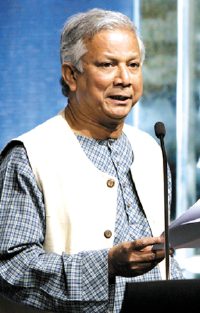
OPPORTUNITY International (OI) is a prominent Christian organization utilizing microfinance to combat poverty. OI Canada has worked with 2006 Nobel Peace Prize winner Muhammad Yunus, whose Grameen Bank was a pioneer of the microcredit approach. He recently discussed the subject with OI's Keela Keeping.
CC.com: The average Canadian . . . is probably hearing about microcredit for the first time. Can you explain what it is, simply?
Muhammad Yunus: Well, microfinance is about lending money to the people who are extremely poor -- particularly women. A tiny little money, for income generating activity, this is done without any collateral because banks require collateral. In microcredit, the kind of programs that we run, we don't require any collateral. We don't require any guarantee from anybody we don't require any legal instrument between the lender and the borrower. And it works. People take the money and pay an income for themselves -- and pay back the money. Globally, microcredit finance, which is spreading all over, the repayment rate has been very high, 98 percent to 99 percent, it's almost a global standard.
CC.com: Dr. Yunus, there are still those who question whether or not microcredit works in the long run to alleviate poverty. What do you say to that?
MY: Well, our experience is what we have done in Bangladesh, it works very well and people who have little money, starting self money, start earning money and paying back the bank loan, get on with their life and send the children to school [and have] better food on their table. So it works well. We survey the situation of the borrowers and how they're moving out of poverty; the most current information that we had last year [was that] 58 percent of the Grameen borrowers had moved out of poverty. We have nearly 7 million borrowers in our bank, Grameen Bank. And out of them, those that have been with us for five years or more, 58 percent of them have moved out of poverty. So there are very clear indications that people do benefit in a very positive way from the microfinance. And they own the bank. Those borrowers are also the owners of the bank. We make sure that children are at school. A hundred percent of the children are at school. We give loans for higher education. Many of them are moving into higher education and becoming doctors and engineers and professional people, the entire financing for their education is done by Grameen Bank.
CC.com: Much has been learned about microcredit over the years. From what you've seen in Bangladesh and elsewhere, what are the primary characteristics that make a microcredit organization effective?
MY: For us, particularly from our perspective, focusing on the poorest and focusing also on the women works much better as far as the family is concerned. And also to see how they move from stage one to stage two of their lives. So it's not a one shot given loan and then we walk away from that. It's a continuous process, people keep on coming back, and step taking. It's like walking to go someplace: it's not one step then you sit down, you keep on taking steps until you've got there. So this is what you're trying to do, you're trying to move out of poverty. And you take the first step. It's encouraged you to make some progress. And then you take the next step and make some more progress and move on like that.
CC.com: What do you see as the main challenges for the global microcredit community in the coming years?
MY: Well, there are several issues that, as a broader community of microfinance practitioners, we should be looking forward to. One is outreach: reaching a large number of people who remain unreached by the banking system. We see it as our mission to fill the gap left by the banking system so that everybody can be reached and financial services provided. So that outreach becomes very important to us. Another thing is to create a legal home so that the activities that we are involved in now -- it's not covered by law -- so you are kind of out there without any legal coverage. So we need that legal coverage to create a law which will allow us to function in the way we can function and we want to function. So we can give loans legally and we can take deposits so that we can get enough money coming from the deposits to lend money to the borrowers. So that's an important aspect of it. When we are doing that we also need a regulatory environment so we create regulatory agency which will be looking after the kind of work we do. After all, we are doing transactions with money so we need a kind of overseeing how things are done in a proper way. In a transparent way, people don't take advantage of each other. And this is the area that we should be looking forward to: we do the outreach, we do the quality job with a legal structure in which we function.
CC.com: Microcredit is not only about alleviating poverty. What do you mean when you say it has an impact on things like peace and terrorism?
MY: Well, it's all in the same box, it's not separate pieces. We work on the poverty so it tells people to generate income for themselves and move from one level of income to the next level of income and that helps overcoming poverty. After all, poverty is [the] absence of income, so if you have income, you are no longer poor. And poverty is a threat to peace. If you are overcoming poverty, you are contributing to the peace. The more you overcome poverty the closer you come to the level of peace that you desire. So that's why this Nobel Peace Prize was awarded to Grameen Bank and myself for establishing that link, recognizing that link between poverty as a threat to peace. So what we do in microcredit, suppose it does help overcome poverty, then it's contributing to the peace. So on the peace aspect also if you look at the income itself and the health issues, education, these all come in together. These are not isolated items [as if to say] "Okay, you do the microcredit and then figure it out, now we have to do education then we figure out, you have to do health" -- they don't come in a kind of isolated fashion. They are integrated with each other. One way I usually describe [it] for poor people [is that] income is the best medicine -- cause if you have income you eat well, good food, good meals, most of your nourishment and nutrition is taken care of so that you don't have poor health. Poverty and poor health are synonymous most times. In poverty you are also in poor health. So if you can improve your economic situation you are in better health because you are no longer poor. Your intake is better than before. So you are not [as] vulnerable to diseases as you would be if you were malnourished, sick and so on.
So that's again linked . . . You become more conscious about health as you go. And also as in Grameen Banks, sending their children to school when they themselves are illiterate [becomes important]. In Grameen Bank, 100 percent of the children are in school. We inspire them, we help them to think that way and as a result we achieve that, and not only they went to school, they stayed in the school and went to higher and higher grades of education. And a result, there are many of them out in the colleges and universities and becoming doctors and engineers and so on. So again you are creating a totally new generation. You didn't do anything extra as a kind of previous planned-out thing and all you did is what came naturally to them and we didn't spend any extra money on that. They become conscious [and ask themselves], "Now that we have money, what are our priorities? Priority is to have the children go to school." They did that, and we give education loans to the children. As part of our microcredit business we provide education loans to the children of Grameen families. Right now there are more than 12,000 students studying in medical schools [and] engineer schools in Bangladesh. [There is] no university in Bangladesh which doesn't have Grameen Bank students studying there. So you're creating a totally new generation and that's how you move from one level of living to the next level of living.
March 8/2007