
Aid worker's 'adventures' are a reality check
Mission Fields,
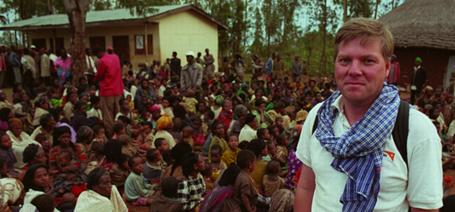 |
PEOPLE THINK Philip Maher’s job is glamourous. After all, he’s where the action is. He’s all over the globe, travelling to the world’s hot spots with journalists from Reuters, CNN and the BBC, giving us first-hand accounts of the famines or conflict ravaging those areas. In the same breath he can talk about being shadowed in North Korea and sleeping in a bombed out building in Somalia. There aren’t too many places that he hasn’t at least flown over. Over the past two decades, he’s been to 80 countries.
ut the communications worker for World Vision wants people to know the whole story. Speaking with Maher, you get the idea, loud and clear, that he resists the ‘adventurer’ label every day of his life. He’s not a hero and he doesn’t get an adrenaline rush from working in dangerous places. He says he’s “cause motivated,” and scanning the world is only a necessary part of his job. “Doing this job because you want to see the world is a bit like saying ‘I want to be a fireman because I’ll get to ride the fire truck,” says the 46 year old.
Pain, not pleasure
According to Maher, too many people see relief work as an exhilarating ride around the globe. And he says things won’t get done unless people adopt a Mother Teresa, not an Indiana Jones, attitude. He gets emails and phone calls all the time from college grads who want to do what he does but don’t understand the deeper issues inherent in his line of work. “There are people – journalists in particular – who tell me they envy my job. ‘You get to go to all the hot spots, where things are happening,’” he laments. “I don’t think people understand the frustration, the sense of helplessness that comes with the territory.”
That frustration manifests itself in many ways. Maher frequently sees people facing what he calls “their greatest pain.” He’s heard the calls of people trapped under rubble after earthquakes in Colombia, and been powerless to help them. He’s met families who have no choice but to raise their children in the shadow of Chernobyl in Belarus. Then there are the countless famines, wars and disease in Africa – Sudan, Kenya, Rwanda. His frustrations come amidst these backdrops.
World Vision, well known for its child sponsorship programs and famine relief efforts, works on a broad range of issues, most of them involving kids. It works together with other groups to raise awareness about land mines, child labour and sexual abuse in developing countries. But Maher says the organization concentrates more on the “experiential” rather than the theoretical aspects of tragedies. So his job is to see things first hand. Though World Vision may lobby for UN treaties and tougher laws in some cases, they concentrate most of their efforts on helping people with their immediate needs. “We know what land mines do because we deal with the victims. We know what happens when people travel [to poorer countries] to sexually abuse children because we deal with the victims and the families.”
Eyewitness
The average Joe has trouble visualizing the magnitude of turmoil and pain that’s out there. One of Maher’s jobs is to make the picture a little more clear for the uninitiated by helping journalists cover stories in countries that are closed or tough to travel in. He takes photos for World Vision and encourages Western and European journalists to put the spotlight on those who will die if the rest of the world looks the other way.
Six years ago, World Vision was among the first to get the word out about the starvation caused by the conflict between Christians and Muslims in southern Sudan. “We had heard about an area where there was desperate need . . . it was everything that you hope you won’t find.”
Maher is also well known throughout media circles as a good guy to seek advice from before touching down in an unstable country. Over the years he has developed a large network of contacts worldwide – right now, he’s helping CBC television’s Brian Stewart, who took a film crew to cover the famine in Ethiopia at the beginning of the new year.
While Maher knows a lot about getting around in the dusty corners of countries where tourists rarely dare to tread, he doesn’t assume a false sense of security about his understanding of the world. Feeling too confident about yourself is a surefire way to get into hot water. “You should never assume that because you’re a veteran you know what’s going on. That’s how you get hurt,” he says. “I was once sitting beside a seasoned journalist on a bus heading into Dili in East Timor at a dangerous time. He said he wasn’t going to take any chances on this trip. But, even so, that day he was killed.”
Media critics
In many circles – including some Christian groups – members of the media are viewed with suspicion. Critics will accuse journalists of being biased as they cover issues or of simply not covering some issues at all. Maher says media coverage is often simply a matter of dollars and cents. It’s expensive to cover many of the stories out there because of the very nature of the topics. Despite a journalist’s desire to cover a topic, his or her employer may balk at the cost of sending a reporter into a closed country or a remote region affected by famine.
After sharing cabs and one-star accommodations with lots of reporters, Maher says he respects the work most of them do. “A lot of journalists are seekers. They are people who want to unveil truth for the world. They are motivated by a desire to help people,” he says. “Cynicism may make them biased sometimes, but I think they’re honourable people.”
Adventure of faith
The true adventure, the privilege that comes with his job, is the chance to “be humbled by the poor’s riches,” says Maher. Although he admits to being more confused about the world now than he was 10 years ago, Maher says the process of seeing so much of life has meant he “understands God’s world more and man’s world less.
“I feel closer to God because I am closer to pain,” he says. Not wanting to sound arrogant or overly insightful, he hesitates to say that he knows God more intimately now because of his unique life. Yet, he has seen things that will be with him forever – children with AIDS, the massive casualties of genocide in Rwanda, the lawlessness of Somalia. “I’m familiar with a little bit of the anguish that God must feel . . . I’m so humbled by feeling even one percent of that pain.”
Despite the horrors he faces on the job, Maher says his faith has been affirmed, not discouraged through the experience. And though he spends time in the hardest hit areas of the world then returns to Canada, where affluence and apathy are everywhere, he doesn’t have any harsh words for Christians here. “I never put myself in the position to judge people. We should never assume that some rich people aren’t generous and some poor people aren’t greedy.”
To Maher, the thrill of seeing the world pales in comparison to the rewards that come from seeing the inner beauty of brothers and sisters who need help.
“I am genuinely humbled by what I see. It is a privilege to see people when they are most vulnerable. I treat that very, very carefully. That’s really important to me.