
Christian history: the new, non-Western chapter
Mission Fields,
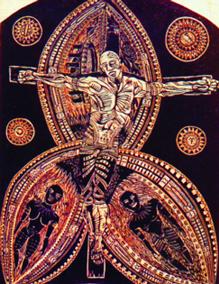
WHEN CHRISTIANS turn their eyes upon Jesus, they do not always see the same face. Sadao Watanabe, the renowned Japanese Christian artist, regularly portrays Christ and his followers as Japanese. Similarly, Ethiopian Christian paintings of the Last Supper depict Christ and his disciples as Africans. Europeans and their North American descendants who might take exception to such artistic license must be reminded that, from the Middle Ages to Warner Sallman's 20th century ‘Head of Christ,' Western artists typically have depicted Jesus with European, rather than Middle Eastern, Semitic features.
Just as Christian artists have rendered the face of Christ to mirror their own diverse cultures so, too, the face of Christ's church has changed its hue and silhouette, its ethnic and racial composition, from epoch to epoch. The first-century Middle Eastern church quickly gave way to the Mediterranean church of the late Roman Empire, which in the Middle Ages became the church of Europe, and in the modern era, that of North America.
But now, at the beginning of the 21st century, the most noteworthy feature of Christendom is that for the first time in history the faces of its adherents are a whole rainbow of colours. In a thought-provoking report on ‘The Changing Face of the Church,' Newsweek correspondent Kenneth Woodward noted that Christianity today is a faith of the South more than the North, of the East more than the West, of the poor more than the privileged, and of the oppressed more than the oppressors.
Sacrificial Christian missionaries deserve much of the credit for this seismic shift from a faith concentrated around the North Atlantic to one dispersed around the world. At the same time, Christianity's multitone hue increasingly will inform its understanding and practice of cross-cultural ministry.
The non-Western Christian mission effort is becoming a force to be reckoned with, not only in terms of numbers, but also in terms of dynamism, initiative and leadership.
"It cannot be denied," write professors
James Engels and William Dyrness, "that the initiative for world
missions today is carried more often by Pentecostal churches in Latin
America or independent churches in Africa than by North American or
European agencies."
Columbia International University missiologist Kenneth
Mulholland agrees: "I see growth and maturity in the Two Thirds World
mission agencies. The leadership of the world Christian movement will shift
to the Two Thirds World; in many respects it already has." Korean
mission educator David TaiWoong Lee notes that the mainline ecumenical
movement accommodated non-Western voices in mission much earlier than did
evangelicals, but from the 1974 Lausanne Congress on World Evangelization
onward, in virtually every international evangelical mission gathering,
"the Two Thirds World has had a lion's share in the formulation
of evangelical missiology."
The day of Western-dominated, Western-directed global
missions is over – or should be. The major burden of Changing the
Mind of Missions, a cogently argued new study by Engel and Dyrness, is to
compel Western Christians – both mission practitioners and donors
– to recognize a new paradigm, a brave, new, non-Western world of
missions. In the 21st-century task of going into all the world and making
disciples, American and European believers should proceed in humility as
partners, rather than as overlords. The need now is "to come
alongside in a spirit of partnership and submission, participating where we
can in an enabling and facilitating manner."
According to Engel and Dyrness, the need now is for
Western missions and their supporters to concede graciously that they no
longer are in the ‘driver's seat' – nor should they
be. "In short, the infant has become an adult and is demanding a
‘Paul-Barnabas' relationship – rather than a
‘Paul-Timothy' relationship, based on one being subordinate to
the other." Engel and Dyrness go so far as to call for a moratorium
– not on missions, but on "prepackaged programs of world
evangelization that are ‘sold' internationally"; a
moratorium on Western "tried and true" stratagems that
commandeer indigenous personnel without a thought to local church
sensibilities or insights; and a moratorium on "'lone
wolves,' especially from independent churches, who often venture out
with little counsel and experience, radiating an unwarranted confidence and
sense of superiority."
The dilemma is, even for Western agencies which recognize that the North Atlantic hegemony in global missions is over, how to respect the autonomy and decision-making authority of non-Western partners and at the same time remain accountable to Western donors. On the one hand, Western financial support with no qualifications can sometimes lead to misuse of funds; on the other hand, Western personnel, as well, have proven fully capable of misuse of funds.
The challenge for Westerners is to overcome the notion that one blessed with uncommon riches necessarily is blessed with uncommon discernment and insight as to how best such bounty should be spent. In any case, as regards personnel, in contrast to funding, the consensus is that Western missionaries increasingly should play consulting and support roles, assisting indigenous churches in the task of gospel proclamation as requested. Western workers with specialized skills will be particularly in demand: those with expertise in communications technology; in publishing; in work with AIDS victims, at-risk women, children, pensioners, prisoners, and the homeless; and above all, those with expertise in training believers in the ‘younger' churches to be trainers themselves.
The new, non-Western chapter in Christian history increasingly will be the story of a multi-hued majority of believers south and east of the old North Atlantic centre of gravity. It will be the story of new contextualized theologies. It increasingly will track the ascendancy of non-Western missionaries serving cross-culturally, not only in the East and the South, but in the heavily secularized West and North as well. Finally, if all goes well, Western support for the vision of non-Western Christians should be part of the church story in the 21st century.
"In Christ there is no East or West," the hymn reads. While this vision of a colour-blind faith is not yet fully realized, it is closer to fulfillment than it ever has been in church history.
Mark Elliott is editor of the East-West Church & Ministry Report.