
An encounter with Islamic Jihad
Mission Fields,
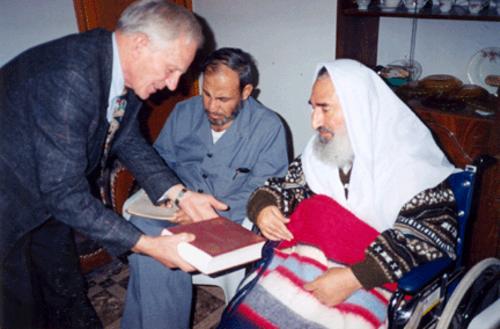
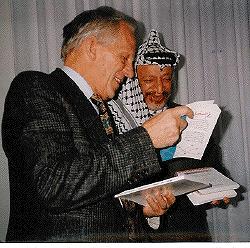
In his new book, Light Force, Open Doors founder Brother Andrew deals with the ongoing strife in the Middle East. The following excerpt recounts a dramatic meeting in June, 2001.
GAZA CITY was a dreary place. In every direction, one could see gray cinder block buildings, most without any architectural embellishments. Half a million people were crammed into apartments, and the only way for most families to expand was to build up, by adding another floor. But extreme poverty, caused by nearly 70 percent unemployment, showed in the skeletons of unfinished floors atop many homes.
The Marna House provided a refreshing retreat from the ubiquitous dust, as well as from the poverty and bitterness of the population. A gentle evening breeze blew off the Mediterranean Sea, just a few blocks to the west, rustling the branches of palm trees inside the walled compound.
There I met with Abdul of Islamic Jihad, one of the most feared terrorist groups in the world. He wore a plain white caftan. His gray hair was thinning on top and much of his bristly beard was white. Deep wrinkles framed his dark eyes. As we shook hands, those eyes stared intently into mine as though trying to peer into my soul.
"Thank you for coming," I said as we sat on the plastic patio chairs. "I want to arrange a meeting with your boss," I said, referring to Sheikh Abdullah Shami, the leader of Islamic Jihad in Gaza. I mentioned a mutual friend who had connections with Hamas. "I have gotten to know several of the leaders of Hamas, and we have talked openly about Islam and Christianity. I was hoping that I might establish a similar dialogue with Islamic Jihad."
"Who do you know in Hamas?"
"I have met with Sheikh Yassin, Dr. Abdulaziz Rantisi, Mahmoud Zahar and many others."
"What do you wish to discuss?" His piercing gaze was unrelenting.
"I represent Christians in Holland and the West. I want to have an exchange of perspectives on faith -- Islam and Christianity. I would also like to know his thoughts about the Palestinian situation and about the future for peace."
Abdul reached into his caftan and pulled out a cell phone. He speed dialed a number and talked for a couple of minutes.
I thought about the risks involved in meeting with Sheikh al-Shami. I realized that Islamic Jihad, like Hamas, was a sworn enemy of Israel and I was well aware of the terrible acts for which they claimed responsibility. More than once I'd been accused of being anti-Israel because I had befriended her terrorist enemies. My defence was simple: "The best way I can help Israel is by leading her enemies to Jesus Christ."
My purpose was to introduce them to the Prince of Peace, the only one who could cure the rage in their hearts. But how could they possibly meet Jesus if someone in whom he dwells didn't go to them?
Abdul flipped his phone shut and announced, "He will see you tomorrow afternoon."
Abdul then leaned back in his chair, lit a cigarette and said, "I have spent 19 years in prison. When you spend that much time in prison, you have a lot of time to think. You talk about the future of peace. The solution is Islam! I read the Bible in prison. I also read the Qur'an and that's when I decided to become a Muslim."
"You were not a Muslim already?"
"Culturally, I was a Muslim. Not intellectually. However, I have questions about the Bible and Christianity, and maybe you can answer them."
I opened my hands on the table, inviting him to ask whatever he wished. Abdul crushed the remainder of his cigarette and lit another. "Why do the Christian Zionists support Israel so strongly? I would like to understand."
"You ask me hard questions!" I laughed -- and for the first time, Abdul smiled for an instant.
"There are two factors at work for many Christians. One is guilt." Here I briefly explained how, for the most part, the church in the West didn't rise up and protest the killing of Jews during the Holocaust. "After the war, many Christians believed that it was necessary to give the Jews a place of their own so that they would no longer be at the mercy of a ruthless tyrant like Hitler.
"The second factor concerns theology. There are many Christians who believe that God is preparing the world for the end times and that the nation of Israel is the fulfillment of many prophecies."
"I have heard that in the book of Zechariah the last two chapters are being fulfilled today. Do you believe that?"
"Now you ask me to explain one of the toughest passages in the Bible. Those chapters are indeed about the last days. We believe that Jesus will rule over all the earth, as it says in Zechariah 14:9. I don't need to remind you that Muslims believe this as well. But whether the present state of Israel is referenced in these verses, well, Christians do not agree on that."
"I do not believe the prophet is talking about this Israel." Abdul stood, preparing to leave. "You know all we want is peace!"
I stood with him and asked, "Do you really believe the ways of Islamic Jihad will produce peace?"
Abdul shrugged. "Inshallah. With help from Allah."
I pulled a book out of my satchel. "I do believe there is hope for real peace, but it is not found in terrorist methods. Real peace is found through the person of Jesus whom you so admire." I handed him a copy of my book God's Smuggler in Arabic, saying, "This will tell you more about me and what I do. It may also help you better understand Christianity."
He accepted the book with a curt nod, saying, "I will read it." Then he quickly walked away.
Brother Andrew saw Abdul 18 months later. Abdul said he had read God's Smuggler, and asked for more Arabic books about Christianity. Andrew gave him three more books, plus a Bible.
Excerpt taken from Light Force, by Brother Andrew and Al Janssen (Revell division, Baker Publishing Group, 2004).