
Dusty sandals along the Ganges
Mission Fields,
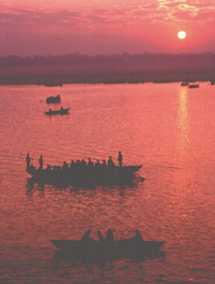 |
For millions of Hindus, the Ganges is the most holy river on earth, revered both as a goddess and as a mother. They are drawn to her banks to bathe for purification, to pray for boons to be granted, to drink its holy water and to immerse the ashes of their dead. An article in National Geographic magazine inspired me to walk the entire length of the Ganges River. Here was a way I could combine adventure with a time of personal reflection a prayer walk for the nation of India and the opportunity to meet and speak with scores of people living in the villages of India. I am completing the walk over a number of years; so far I have walked about 650 of the river’s 2,500 kilometres. This is an account of one portion of an extraordinary pilgrimage.
DAYTIME TEMPERATURES are reaching 42 degree Celsius. I am thankful for the light, loose, cotton kurta (Indian shirt) I am wearing. The sun reflecting off the sand hurts my eyes. Following the Ganges has become increasingly difficult. The plain that holds the Ganges at full flood during the monsoon is at least two kilometres wide. At the moment the Ganges is a narrow band of water snaking back and forth to either side of the flood plain. Sometimes I am right beside the river and other times I am just following a sandy plain.
Fragile yet obstinate flowers occasionally grace the sandy surface. At times there are tributaries to cross; the last one was chest deep. I strip to a loincloth and carry my backpack and clothes above my head to the other side. The red gumcha (thin towel) I wear as a loin clothe dries in three minutes in the hot wind. The gumcha goes back on my head.
Along the flood plain farmers are growing vegetables. None of these farmers have permanent structures here, just simple A-frames made of straw standing about four feet high at the peak under which they rest in the heat of the day and sleep at night. I follow a line as best I can, from one A-frame to another. They are my only hope for drinking water.
Sometimes a hand pump has been sunk into the sand to get water to irrigate the vegetables. A farmer calls me to come for some water. I thankfully fill my half-litre water bottle. He gives me three cucumbers. The water has a strong rusty taste and the iodine I add does little to improve the flavour. The cucumber, however, provides great relief to a parched throat.
A stand of eucalyptus trees rises from the flood plain around noon, and I rest in the shade while the sun reaches its climax. Another cucumber becomes lunch.
The sun begins to dip. I see a village along the bank of the river. Earlier in the day a herder who had brought his cows and buffalo to the Ganges had informed me of this place with its temple dedicated to Vidhur, one of the Hindu deities.
An ashram, or spiritual retreat centre, has been constructed on the banks of the river next to the temple. I enter the ashram grounds and inquire about a place to stay. Two young men assure me of accommodation but first I should meet the swami. He is conducting satsang (singing and prayers), so I am given a seat on his veranda.
A kindly old gentleman wearing a white dhoti (loin cloth), a white sacred thread and a thin white cotton towel draped around his neck greets me with folded hands. He tells me that I will be staying in the room next to his. He arranges for tea to be served in his room. He sits crossed-legged on the bed and I sit on a chair.
We talk. He explains that his whole focus in life is to be conscious that “I am not this, I am that.” A long discourse follows. “My body changes with age. I am not that. I remember things that happened to me in childhood. I am not that little boy, but I am that consciousness.” It is the essential teaching of Advaita (non-dualistic) Hinduism.
The swami asks me what time I normally get up in the morning. I tell him, with a sense of pride and the feeling that I can easily accommodate his schedule, 5:30 am. It is customary in rural India to regulate your retiring and rising by the sun. I see the swami’s face fall a little. He says “We rise at 4 am and have satsang in my room at 5:30.” This early rising time is long before the sun gets up but I hurriedly assure him that I can make it for satsang.
After the meal I go into the town to get my sandals repaired, and return to wander the tree-filled grounds of the ashram and to sit quietly enjoying the cool evening air. We both sleep on the verandah on cots underneath mosquito nets. It is too hot inside the rooms.
Sometime later, I hear him rolling up his mosquito net and straightening out his bedding. I check my clock: it is 3 am. I hear him rousing the other ashramites in their quarters, singing and chanting softly. I check my clock: 4 am. At 4:30, the mosque in the village begins its broadcast of the Muslim call to prayer. I concede defeat and get up. The swami is pleased and asks me to come to his room for tea and further conversation. He is eager to show respect to me, a follower of Christ. He tells me that the focus of my meditation should be “to love and to serve.” He says that I should focus my thoughts on Christ on the cross. I should think about Christ taking the nails in his body. I should think about how many nails he bore. I should think about his words “Father forgive them because they do not know what they are doing.” I should remember that he did not think of his own pain. He did not think of his own life. “This is love, this is to serve.”
I am moved as I think of Christ, in this place, with this old man. He continues “Then you too will know that you are not this, but that.”
To him, the Christ event is just a technique in his search for supreme consciousness. How I long for him to know Christ in a true way.
Rob Sinclair is affiliated with Operation Mobilization. He lives in Richmond, B.C.