
There's no business like God's business
Mission Fields,
"THERE IS NOTHING greater than knowing that you are where God wants you to be, and that he is using your skills to further his kingdom."
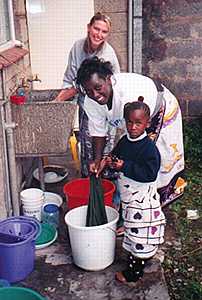
So states Keri-Lynn Veer, a chartered accountant working for Deloitte & Touche in Langley, B.C. For six months over 2001-2002, the Trinity Western University graduate took a break from her job to volunteer her skills as finance office administrator of Africa Inland Mission's Kenya branch.
Her tasks, she says, included "preparing the budget for an office that supports 160 field missionaries, administering funds received for programs and pastors operating in Kenya, and many things in between. As there is a definite lack of trained accounting personnel in the mission field, word quickly spread that I was in Nairobi. I was asked to teach a seminar to a class of graduating nurses -- many of whom would be working in rural clinics and were responsible for the administrative records -- on how to keep financial records."
The most rewarding work, she says, "came in dealing with the national pastors . . . It was incredible to have them come in and share about the work they were doing in the villages across Kenya. Pastor Ondoro, one of the national pastors, would come in with photos of his church building project in progress. What a blessing to see how the funds going through my office were benefiting the people!"
Leave of absence
Yet Veer's experiences in Nairobi are only half of the story. She had discussed her desire to volunteer for a mission with her employer years before taking the step of faith to Africa.
Deloitte & Touche, she says, "were quite willing to work out an arrangement where I could take six months off during our slower time, as long as I promised to return for our busy season. The incredible part was that they not only granted me the leave of absence, but they also helped with my support raising. In fact, they raised about one third of the support that I needed through raffles and personal support."
Veer's story is one of many examples of Canadian Christians employing their professional expertise in the mission field. Another person benefitting from an open-minded employer is Annie Cheung, who is currently in Swaziland, Africa.
A computer security analyst employed at the Workers' Compensation Board of B.C., Cheung has taken a year's leave to help co-ordinate administrative work for the annual Festival of Praise. The event exhorts the nation to follow in the footsteps of Christ.
"My goal is to enable the evangelists, preachers -- to be the support behind them -- so that they can function at their calling," Cheung says. "My mission here is mainly organizing and helping with the office, coordination of activities -- [finding] solutions for the ministry office, setting up mailings, database and automation as much as possible."
She, too, is grateful to her employer for understanding her desire to work in the name of God, and granting her a lengthy leave of absence. "I am blessed that this is part of the union contract, that employees can ask for a leave of absence up to a year -- provided management approves," she says.
"I had talked about wanting to do this with my [superiors] for quite a few years. They were very supportive, and encouraged me to pursue things that are important in life other than work. Last year, I felt it was the right time -- and my boss made special arrangements to enable this to happen."
Humanitarian donations
While the business community tends to reflect a resolutely secular mindset, Christian humanitarian projects are nevertheless getting substantial support from various Canadian businesses.
A prime example is the Winnipeg-based Canadian Foodgrains Bank (CFB), which relies on the goodwill of Canadian companies to serve as a centralized grain distribution system.
Richard Phillips, CFB's director of resources, says: "Our many growing projects receive donations of crop inputs (such as fuel, seed, fertilizer, chemicals and equipment) from individuals, local farm supply outlets, manufacturers and elevator companies." He cites donations by manufacturers such as Monsanto, Dow AgroSciences, Syngenta, Dupont and BASF.
"The Agriculture Financial Services Corporation donated hail insurance for every acre of community growing project land in Alberta," says Phillips. "Freight forwarders like Johnson & Dever source competitive ocean freight rates for us. Stowage firms like Les Entreprises Yvon Bessette prioritise our ocean containers in their yards, while bag manufacturers like Manyan Inc. make our bags resistant to UV rays so they can be used for years."
Tentmaking
Christians combine business and missions by working in various professions overseas, while evangelizing in their free time. This is known as 'tentmaking,' a term inspired by the apostle Paul, who worked as a tentmaker while he evangelized in Corinth.
According to Mike McLoughlin of Marketplace Ministries, based in Kelowna, B.C., "the tentmaking movement has seen a significant increase in participation and interest over the past 20 years." This is partly because "countries that are closed to the professional missionaries are open to tentmakers -- who bring economic blessing to the country, as well as bringing their witness to the gospel."
Tentmakers, he says, are also valued by the church -- "not so much for their . . . calling to serve God in marketplace work, but for the money they can generate to support the professional missionary."
Business development
McLoughlin sees another growing trend in modern missions: "business development as a viable part of a mission strategy." He is speaking from experience.
Five years ago, he says, he and his family travelled to Zambia for a two-year outreach. He taught Zambian entrepreneurs small business skills; he also helped form a venture capital company with local Christian entrepreneurs, providing start-up loans for Christians in business. With the help of several million dollars in grants from Britain, McLoughlin says, the company has become "Zambia's bank for the poor. After two years of operation, they have serviced 25,000 loans and organized 360 community loan associations."
Another example of Christian enterprise development is Winnipeg-based MEDA (Mennonite Economic Development Associates). John Longhurst, head of MEDA's marketing department, declares: "We believe business is our mission -- it's not what we do to accomplish some other goal. Creating jobs, acting in a Christ-like way in all our business dealings, being concerned for the well-being of employees, customers, the community and the environment -- that is our mission."
MEDA, he says, supports "efforts by businesspeople to create businesses in countries that will help the local church by providing employment for local Christians and others. Creating a business, because we believe that God calls us to care for people who are poor, is reason enough to do it."
However, he cautions, "there needs to be a business case for setting up the business -- it's not a charity. It needs to make sense from a business point of view, as well as from a humanitarian point of view."
Short-term missions
Longhurst also takes issue with the concept of short-term missions. "We don't encourage people to 'drop out' for a couple of weeks a year to do missions. Christians are called to represent Christ year-long, not just for a couple of mission trips."
Nonetheless, a growing number of people -- who are unable to engage in long-term ministry -- are using their holiday time to go on missions.
World Vision (WV) has noticed an increase in those who want to help directly in ministry, which led the organization to create Destination Lifechange. The program offers a number of short-term humanitarian opportunities -- from teaching English in Costa Rica, to building homes in Guatemala, to helping orphans in Romania.
Several months ago, Sian Frost donated her skills to one of the WV projects. The Beamsville, Ontario resident once had a business called Creations by Sian. "I used to paint murals in people's homes." Moved by the plight of sick children, she decided to set up a non-profit society called Murals of Hope. The organization provides murals for abuse shelters and hospitals.
Frost has been a WV child sponsor for 20 years. "I wanted to see how the organization worked," she says. Last February, Destination Lifechange sent her to paint a mural for a school in El Salitral, Mexico.
She had expected to do a small painting. However, "the size of the mural was doubled, since they wanted it on the outside of the school for the whole community to see." The project, she says, became the talk of the town. "With each passing day the crowds around us grew. We asked for music and three men showed up playing guitars. I told them I liked horses and I got both donkey and horse rides. They gave me every fruit they could find . . . I ate everything I was given -- including miscellaneous pig parts, chewy hen and cactus salad."
Frost describes the entire experience as "awesome," primarily because of the local people. "They have nothing -- but [they] gave us so much." She was also touched by "how much joy something as simple as a mural can bring to a community."
These are just a few examples of the many ways Christian faith is at work in the business community across Canada. While direct evangelism is not always evident, some observers believe Christ's great commission is being fulfilled on a very pragmatic level.
"God is on the move in the marketplace," concludes McLoughlin. "He is calling for Christians to rise up and take their positions as his ambassadors of love, to a broken and corrupt world."