
A faith for the whole world
Mission Fields,
 |
• Patrick Johnstone & Jason Mandryk: Operation World, Bethany/WEC, 2001.
FOR a quarter of a century Operation World has called the attention of the Christian community to the missionary task. Now in its sixth edition, this valuable 798-page resource provides detailed information on every nation in the world -- peoples, economy, politics, religious make-up -- and then challenges the reader to pray for change. The nations are placed alphabetically, and by date, so that one can cover them all in a year.
Window on the World (Bethany/ WEC, 2001) does a similar thing for young people, using lots of illustrations, photos and colour.
 |
• David B. Barrett & Todd M. Johnson: World Christian Trends: AD 30 - AD 2200, William Carey, 2001.
World Christian Trends is 934 pages of facts, figures, graphs and illustrations crammed into 934-page large format . In a word it is daunting. But for the right people -- students of missions, home staff of missions organizations, serious church missions committees, Perspectives graduates, academics -- it is a treasure trove.
The authors' rationale for their mammoth work is this: "The missionary of the 21st century will likely have a much greater load to bear than his or her 20th century predecessor. Faced with information overload in a networked environment, multiple agencies from multiple countries taking multiple approaches, the impact of globalization and postmodernism on seemingly remote peoples, an increased need for cultural, ethnic and religious sensitivity, the emergence of almost unrecognizable new forms of Christianity, and a host of other new factors, missionaries more than ever will need to be well prepared in the 21st century. Only then will the churches of the world be able to fulfil the basic requirement of the Great Commission -- the effective penetration of all peoples with the gospel presence."
 |
• Adrian Hastings: A World History of Christianity, Eerdmans, 1999.
Adrian Hastings, in his impressive account of the state of world Christianity, points out that "Christianity occupies a unique position in world history, being today the predominant religion in four and a half of the world's six continents." If that claim sounds a trifle triumphalistic, Hastings is simply trying to put things in perspective.
"The writing of Christian history," he says, "needs to escape imprisonment within a Europe-centred story in order not only to serve the needs of the many hundreds of millions of Christians who live elsewhere but also to provide an objectively balanced account of a straightforwardly historical kind."
Another useful book along these lines -- but with more of an emphasis on the social, cultural and popular elements of the faith -- is A Global History of Christians (Baker, 1994/2001), by Paul R. Spickard and Kevin M. Cragg.
And Adrian Hastings, who must have a tremendous amount of energy, also edited The Oxford Companion to Christian Thought (Oxford, 2000), which pulls together an impressive worldwide collection of scholars (including Douglas Farrow of McGill University in Montreal, James McConica, president of the Pontifical Institute of Medieval Studies in Toronto, and Stanley Grenz of Carey/Regent College) to consider the "intellectual, spiritual and moral horizons of Christianity."
 |
• Tim Dowley, editor: The Baker Atlas of Christian History, Baker, 1997.
This work combines the material found in a traditional Bible atlas with maps which chronicle the development of Christianity during the two millennia following the birth of Christ.
Like Christ For All Nations, this will appeal to people who respond better to images than to words. And, in the same way, this atlas will demonstrate how outdated is the notion that Christianity is a Western religion. Maps on the worldwide growth rate of Christianity, African Independent Churches, branches of Christianity in Asia present the case with dramatic simplicity.
And the merest of glances at the map on worldwide religious affiliations will underline the need to shift the efforts of the worldwide missionary force from the already-reached majority of the world to the swath which cuts across Saharan African through the Middle East to Central Asia and China and Japan.
 |
• Scott W. Sunquist, editor: A Dictionary of Asian Christianity, Eerdmans, 2001.
This is not a missions book, but a large number of the entries relate to missions and the development of Christianity in Asia (from Pakistan to Japan, from Mongolia to Indonesia). It is a mine of information and, as in any good reference book, one is drawn from entry to entry to follow various trails. For example:
* An entry on Maitricht Chinese Baptist Church reveals that pioneer evangelization by Karl Gutzlaff led to the establishment of the first Chinese Protestant church in the world, among the Swatow Chinese of Bangkok, Siam (Thailand) in 1837.
• And how did Gutzlaff come to be in Siam? Skipping over to his entry, one encounters an adventure story which should be made into a movie. The son of a tailor in Berlin, Gutzlaff became interested in China after meeting with British missionary Robert Morrison. With the Netherlands Missionary Society he ventured into Siam, Indonesia and Malaya, but broke with the mission when it refused to send him to China. During the 1830s he made several voyages along the coast of China.He translated the gospel into Thai, Fujian and Japanese.He became an interpreter and secretary of the East India Company, magistrate of a couple of Chinese cities in the early 1840s, missionary fund raiser . . . the list goes on. He married three times, his wives not, apparently, being as hardy as he. Shortly before he died at the age of 48 he discovered that many of his Chinese preachers were unconverted opium smokers and criminals, but by that time he had attracted the attention of other European missionaries.
• Who was Robert Morrison? Converted in his teens as an apprentice shoe-maker, he sailed for China in 1807. From 1809 until his death in 1834 he worked as an interpreter for the East India Company in order to secure his presence in China. This benign-sounding fact covers some awkward realities. Upon consulting the entry on 'Opium,' we learn, with some discomfort, that "The opium trade was closely associated with early Protestant missionary efforts, not least through the involvement of Robert Morrison and Charles Gutzlaff." Prior to his death, Morrison and his colleagues had only baptized 10 Chinese, but he persevered, and left a legacy enjoyed by tens of millions of Chinese believers today.
• And if the first Protestant Chinese church began in 1837, what about the Catholic church? Nestorian Christianity waxed and waned between the 7th and 9th centuries. An Italian Franciscan arrived in Beijing in 1294, but the church was unable to establish itself. The arrival of the Portuguese in the 16th century brought new missionaries.
* Which is larger in China then, the Catholic or Protestant church? The China entry seems vague on this point, as on others. Written by experts from China, it sometimes downplays sensitive issues such as the dynamic growth of the church and persecution under Communist rule. The editor notes in the Introduction that "The sensitive nature of much of the material from China meant that the writers should work as a team with their articles signed only as 'China Group.' . . . it will quickly become clear that the Chinese entries reflect a self-understanding slightly different from that in other countries." Ah well, at least they can't be accused of perpetuating Western views.
• Nestorian Christianity? That's the problem with this book -- there's just too much fascinating material, every entry leads to another one equally interesting. As Canada's connections to Asia increase, this would be a useful addition to church libraries.
 |
• Bengt Sundkler & Christopher Steed: A History of the Church in Africa, Cambridge, 2000.
This is less easy to dip into than A History of Asian Christianity, both because of its daunting size (1,232 pages compared to 947) and because it is not presented in bite-sized pieces.
But it is also a fount of information; and it is broken down both historically and then by region and nation, so that a reader wanting insight into just one event or area will not be overwhelmed.
Sundkler, a Lutheran, describes the book as "unabashedly ecumenical," and that is one is its chief virtues. He notes that "For centuries the two competing confessions, Catholic and Protestant, treated one another with damning silence -- plodding along on different sides of the same hill or river, relying on the same vernacular related to the same traditional African religion, dealing with similar daily experiences in the district in hot season and rainy season -- yet never meeting. The other party did not or should not exist."
A History of the Church in Africa also devotes considerable attention to the Orthodox Church and particularly to the development of the African Independent Churches.
The book does justice to its name and as such, is a good corrective to a steady diet of materials from evangelical, missionary sources, valuable though those may be.
In the end, the authors remind us that despite all the false starts, unholy alliances with colonial powers, racism and lack of unity, "The Christian Church, through its local congregations with fellowship and song, through its schools and colleges, its hospitals and development work have made sub-Saharan Africa . . . the Christian part of the continent. . . . No political argument and no ostentation can . . . take away Christ's religion from the surface of Africa or from the hearts of African men, women and children."
 |
• Vinson Synan: The Century of the Holy Spirit, Thomas Nelson, 2001.
While the Roman Catholic Church is the largest body of Christians worldwide, the fastest growing is certainly the Pentecostal/charismatic movement. The Century of the Holy Spirit charts its incredible growth, from a tiny band of students meeting in Topeka, Kansas on New Year's Day, 1901, to the Azusa Street Revival in Los Angeles in 1906, and from there, explosively, around the world. By the end of the century, more than 500 million people were involved in this revival.
This amazing story dwarfs the people involved, making it clear that it is in fact a work of the Holy Spirit. Author Vinson Synan (who wrote about half combines academic credibility, personal experience and enjoyable writing to do justice to the story.
For a more in depth look at the phenomenon, consult The New International Dictionary of Pentecostal Charismatic Movements (Zondervan, 2002).
 |
• Tom Phillips & Bob Norsworthy: The World at Your Door, Bethany, 1997.
Most of us will not spend our lives overseas, so this book could be the most useful one in the whole bunch. The authors, both of whom work with International Students, Incorporated, point out that hundreds of thousands of students from all over the world come to North America to study. These are future world leaders. But the majority of these students, according to Billy Graham in the Foreword, will never enter a private home or a place of worship while they are here.
The authors' simple argument is that the North American church will never have a better opportunity to reach people from other cultures, many of which are very resistant to public expression of the gospel. They show that "God has brought the mission field to our doorstep," and endeavours to make ministry to international students understandable and attainable for regular church-goers.
This book is full of practical suggestions -- from recipes for simple meals to topics for conversation and dealing with cultural blind spots. It's a winner.
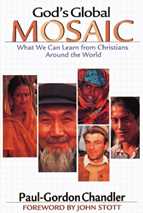 |
• Paul-Gordon Chandler: God's Global Mosaic, IVP, 1997/2000.
Paul-Gordon Chandler is one of those who has gotten overseas, and he devotes this book, as the subtitle declares, to 'what we can learn from Christians around the world.' And, in his view, that is quite a lot.
Devoting a chapter each to Europe, the Middle East, Latin America, the Indian subcontinent, Africa and East Asia, he reminds us that "No matter where we live, at home or in other countries, we are expatriates, spiritually speaking."
The book comes recommended by everyone from Billy Graham and Brother Andrew to George Carey and Bill Bright. It's an easy read, ideal for church libraries.