
From China with Christ
Mission Fields,

MANY of Canada's Chinese citizens are evangelical Christians. Some dedicate themselves to overseas missions; others focus on outreach to Canada's aboriginals. But for many, their own community is the most significant mission field.
"Many Chinese churches do a lot of evangelism," says Simon Wong. He knows whereof he speaks. As one of a dozen pastors at Richmond Hill Chinese Community Church, Wong facilitates many activities. This vital and growing church just north of Toronto ministers to its members in Mandarin, Cantonese and English. It operates ministries to restaurant workers and prisoners, and sponsors short term missions to Central America; it also conducts outreach through wellness seminars and line dancing.
Indirect evangelism
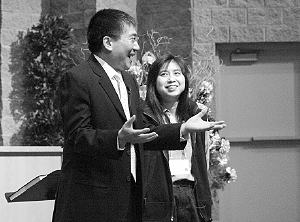
The latter programs, says Wong, reflect a new approach. "In the past, the programs generally [used] direct evangelism. Nowadays there are many forms of indirect evangelism." He cites ESL programs, seniors' activities, citizenship classes, counselling, sports and concerts - efforts which he believes will increase "as more and more Chinese churches see these indirect means are becoming a more successful way to attract people to the church."
"Some churches have services to meet immigrants' needs," says Esther Lau, director of the Chinese Christian Mission (CCM) Calgary Service Centre. "To overcome the language barrier, churches make phone calls for them, and help them find jobs and places to live. They also do outreach through Tai Chi class and parenting classes."
Smaller churches, she adds, "also help each other. Many of them are very aware of missions today. Big churches do the organizing for them. Their missions are both local and overseas." She adds that many Chinese Christians conduct personal evangelism, "usually through evangelistic meetings at churches, once or twice a year. They try to outreach to non-Christian friends and new immigrants."
Chinese believers are also active at universities, says Victor Yang, editor-in-chief of the Vancouver-based Truth Monthly.
"On the UBC campus, a group of believers have been organizing fellowship meetings for Chinese scholars and students for the past 10-plus years. I came to the conviction to become a believer in 1994 through this very ministry when I was a visiting scholar at the Faculty of Education in UBC. Hundreds have come to know Jesus through this ministry."
Ministry to fellow Chinese has its logistical problems, says Simon Wong. "Since many Chinese churches are not situated in areas highly populated with Chinese, evangelism is difficult - as Chinese live in scattered areas. We have to rely on personal relationships and workplace networking."
He adds: "We are seeing a lot of people coming to Canada from Mainland China. They will repeat our previous immigrant movement, from first arriving in Chinatown or other transportation-convenient areas, and later moving to suburban area when they're more established."
In addition to evangelizing their own people, many Chinese see the need to reach out to other cultures. "We have adopted an unreached people group called the Uighur people in the Middle East," says Carlin Wong.
 |
His church, Vancouver's Pacific Grace Mennonite Brethren, "specifically chose this people group because the majority of my church is composed of Han Chinese. The Han Chinese oppressed this people group in past history, and there are very tense and negative feelings between us. One of the goals of this mission is to bring reconciliation between the Han Chinese and the Uighur."
His church, he adds, also conducts outreach to its immediate surroundings. "This area is very concentrated in the Sikh population. We've set up carnivals for the neighbourhood children - and it also gives us a chance to get to know the parents as well.
"We've also taken some Punjabi lessons and even visited a Sikh temple. Some stereotypes we had of Sikhs were broken because we entered into their world."
Challenges
Evangelism of Chinese people, says Simon Wong, has its own unique intellectual challenges.
"Chinese people do not see the necessity to have a belief or faith if they do not have any problem. Many traditional Chinese do not see the need of following a Western religion. Many claim that they have religion already, when we make visitation. Self-righteousness and cultural superiority are two of the important factors that obstruct interest in knowing more about Christianity."
"China's official ideology, dialectical materialism, has influenced many who have received a systematic education under the Communist Party's rule," says Victor Yang. "They have difficulty believing anything supernatural."
"As most Chinese people are Buddhist, many superstitious beliefs continue even after becoming Christians," says Carlin Wong. Another major obstacle, he adds, is ancestor worship. "Chinese people highly respect their ancestors, even after death. When an ancestor passes away, they are regarded as a god afterwards - and are subsequently prayed to and worshipped."
Esther Lau sees the same trend, especially in the older generation. "Some of them idolize their ancestors. For festivals, they bring food in front of them, and they bow to them.
"They think they're still alive in another world. Also, they think, 'If I believe in this Christ, what will happen to my ancestors? I won't be able to pay respect to them.'" Many of the elderly, she adds, "worship idols." As for the younger generation, "many are educated that there is no God; they believe more in science than in God."
Wealth
Edwin Kong, head of CCM Canada in Burnaby, B.C., sees wealth as a chief obstacle, citing "the affluent lifestyle of some of the recent Chinese [arrivals]. Economic growth brings prosperity - but also diminishes the need for the gospel. Multiple Chinese dialects also pose a difficulty."
"For Hong Kong Chinese, making money is the number one [obstacle]," says Matthew Wong, who works with Alpha's outreach to Chinese Canadians. "Most of them are doing pretty well financially here in Canada. They have time for sports, leisure and travel - but little time for Christianity. They are also easily influenced by Buddhism.
"For Mainland Chinese, making money is also number one. But most of them are not doing well here in Canada. They need to work very hard to survive. Again, they have very little time for Christian [faith]. Most of them are atheists; at least they claim to be. Very few of them have been to church or heard about Christianity before they came to Canada."
Chinese people born in this country, he says, "have a totally different cultural background. They subscribe to Canadian culture, no matter if they can speak Chinese or not. Many of them have identity challenges. This group are mostly highly educated and doing well financially. They do not feel too comfortable in traditional Chinese churches, nor do they feel at home in traditional Canadian churches."
"For the Mainland Chinese," says Edwin Kong, "post-Communism syndrome does hinder them. Many come from an atheistic education background; so religion is considered superstitious. At the other extreme, many are also very superstitious by nature, and they will embrace any religion thrown their way after Communism failed.
"The traditional Chinese culture nurtured for the past 5,000 years will continue to dominate our Chinese around the world."
Taking the baton
"In the past," says Esther Lau, "Western missionaries went to China. Now it is our responsibility to take up the baton. Some of us do cross-cultural evangelism in South America, Romania, Czechoslovakia, England, France and Holland - places where there is a significant Chinese population. The ultimate aim is to plant churches.
"We also aim to instill a sense of mission in the young. We have conventions, where missionaries speak, and challenge them to go overseas. Some go to seminary; they become pastors or overseas missionaries. My daughter joined Campus Crusade; she attends Sherbrooke University in Quebec. She speaks French, so she's evangelizing French-Canadians - and also students from overseas."
Her church also exhorts people over 50 to take early retirement. "Many lay Christians," she adds, "are still working, and taking courses at seminaries. One man, an engineer, spent 11 years taking courses; he finished his training, then quit his job. He's now a pastor at Chinese Evangelical Free Church in Calgary."
Many Chinese Christians, says Edwin Kong, tenaciously pursue personal evangelism. "They are very creative in working around obstacles. Some read books, and take seminars and training. I know pockets of Christians are very creative to create opportunities in outreach. For example, there is a ladies' group that meet regularly in a restaurant monthly. They build friendship with neighbours and friends, and invite them to this function where practical talks are featured. Slowly, people are exposed to the Christian faith."
"Our English congregation uses the Alpha program, but not our Chinese congregations," says Simon Wong. Chinese people, he emphasizes, "normally value relationships. Therefore, whatever obstacles we face, we will try to steer away from the obstacles and instead build on relationship - so that the trust level will increase to such a state that people can listen to the gospel message rather than criticize it."
"We have found from our experience that long-term friendship is the key," agrees Victor Yang. "I always encourage those who want to evangelize to make friends with them first. Love them. Understand them. Befriend them." Love, he concludes, "is the most powerful evangelistic tool."