
'Life is too short, I must do Christian art'
Mission Fields,
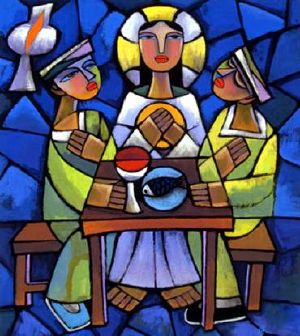
IT IS a common lament of mine that seminaries in Canada pay little or no attention to the arts. Oh, there are some exceptions; but by and large, art makes no appearance in the hallowed halls and classrooms of theological study.
So I must note that the two Anglican colleges at the Toronto School of Theology - Wycliffe and Trinity - partnered in hosting Chinese Christian artist He Qi this spring.
A quiet man with a broad smile and a gentle demeanour, He Qi teaches at Nanjing Union Seminary in China and also serves as an adjunct professor in the philosophy department of the university.
His doctoral dissertation compared the presence of Buddhist and Christian art in China; he was one of the first scholars to take up the subject of religion and art after the Cultural Revolution in China.
For He Qi, it is very important that Christian art and the Christian story be a presence in Chinese culture.
In conversation with the artist, I noted that all the work on display in Toronto, and on his website, had Christian subject matter. I asked if he did other sorts of work, such as landscapes or abstract paintings.
His answer was telling; he paused and said: "Life is too short, I must do Christian art."
During a Toronto lecture, he noted how traditional Chinese art is without colour; it is black and white. Clearly influenced by a Christian doctrine of creation, He Qi has a very colourful palette. Among other things, his paintings are celebration of colour.
The style of his work is iconic, and seems to fit with what we call folk art. The images are strong but gentle. One can discern the influence of those who have gone before in art history; and at the same time, we see qualities that draw on indigenous Chinese culture.
He Qi is very clear about his desire to give his work a Chinese identity. He resists any facile adoption of styles from the past and is a keen advocate of being contemporary. But as an art historian he knows that one cannot - nor should one - ignore the past.
It is interesting to know that, in far-off Nanjing, there is an artist teaching in a Christian seminary. I learned that students go to seminary right after 'middle school.' The first four years provide the foundation for their next three years of theological training.
There seems to be a certain wisdom in including art history as a foundation for the study of Christian theology. Art, after all, is a rich reservoir of cultural and religious history - as well as a resource for theological and biblical awareness.
He Qi's commitment to doing only Christian subject matter is a practice that would find resistance among Christians in some artistic quarters in North America. Cultural differences clearly bear on this matter and it is a subject worth discussing for those in the Christian arts community in the west.
Whatever the case, He Qi is a man with a deep sense of Christian calling - and a very special artistic gift.
John Franklin is executive director of the Toronto-based Imago arts ministry (www.imago-arts.on.ca).