
Gospel according to puppets
Mission Fields,
"DO YOU like puppets?" asked Min Min, my six year old neighbour, after seeing my small puppets.
"My dad does too, but his puppets are much bigger than yours," he continued. His dad, Mr. Su then showed me his Pili puppets. When I shared my vision for using puppets to tell Bible stories, Mr. Su offered to listen to the stories and help me turn them into puppet scripts.
I believe that God brought me to live next door to the Su family to begin the process of making my vision into reality.
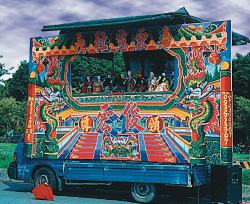
Ever since seeing street performances of puppets, I wondered if this cultural drama could be used to communicate the gospel.
At first, I considered traditional puppets like the ones still used in front of the temples to entertain the gods. But then I came to see how these puppets mainly depict the gods and their stories. There are many rules and regulations for the use of these puppets.
As well, the traditional puppets no longer mesmerize a crowd or attract the attention of the youth.
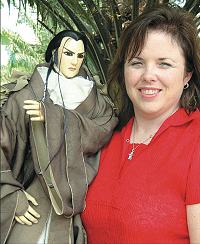
Then, when my neighbour, a 45 year old machinist, introduced me to the world of Pili puppets and their dedicated followers, I saw my vision taking a new direction.
Historically in Asia, puppets have been used to educate, communicate and entertain.
In Taiwan, traditional puppetry has been adapted to suit a TV audience, blending historical/cultural aspects of traditional hand puppets as well as modern special effects. Pili puppets have revived the art of puppetry, as well as adding a distinct Taiwanese flavour.
The modern style of Pili puppets is popular with the Taiwanese working class—young and middle aged men, in particular. Thus, it is my desire to use this style of puppets to tell Bible stories on the street, in the parks or even in homes.
Despite the fact that the Taiwanese working class makes up the majority of the population, most are unreached with the gospel. Pastors admit their church style is simply not adaptable to working class lifestyle.
Through friendship evangelism, which includes drinking tea, singing karaoke, telling chronological Bible stories and just spending time, our OMF team hopes to reach many Taiwanese working people for Christ.
Bible stories told by Taiwanese puppets would be culturally relevant, popular with the working class, particular to Taiwan and flexible in time and location, while using a familiar storytelling style.
It is our vision to see Taiwanese working class men, women and children laughing, clapping or crying as they watch and understand Bible stories being performed by Taiwanese puppets manned by Taiwanese believers.
My teammates, Tim and Jennifer McCracken, are helping to make this vision come alive. The script, written in Taiwanese, is the first of several chronological Bible stories adapted to suit a Pili puppet performance.
Beginning with the creation of the angels and ending with the fall of man, this story is full of action and drama. Lighting and smoke effects will accompany God's creation of the world. Angels and demons fighting will capture the attention of those who revel in the Chinese kung fu.
Michelle Collins, a native of Edmonton, works with OMF International in Taiwan.