
A passage through India
Mission Fields,
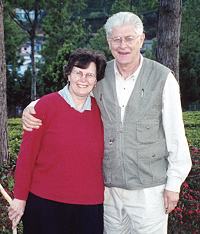
IN DELHI, my husband Garry and I stayed at a hotel in the older part of the city. A survey of the staff revealed that the manager was a Syrian Orthodox Christian, the owner a Sikh, the chamberman from Nepal most likely a Buddhist, and the doorman a Hindu Rajput. How's that for multiculturalism?
Our hotel was near a huge, congested market area. People ply their businesses on roadsides, sidewalks and anywhere else they can find a niche. We took a long walk down there on a Saturday.
In front of one of the shops a mime in tux, hat and whiteface was performing to attract customers into the store. You can't have a conversation with a mime, but my husband Garry shook hands and took his picture. He was delighted to interact because people stopped to stare at our white faces.
Baptist tea
We spotted a Baptist church on another jaunt. We pushed open a big iron gate; a lady came out and introduced herself as headmistress of the Baptist school, and offered us tea.
She is a warm, enthusiastic Christian who has taught at the school for 41 years, been headmistress for 10, and is about to retire. She showed us around, and introduced each staff member in such a way that you could tell she is loved there.
In the small classrooms, kids sat cross-legged on mats or small tables, all bright-eyed and polite, wearing bright red sweaters. The school was started by a British missionary, Miss Fry, in 1949. Now it is entirely run by the local people.
The headmistress, Mrs. George, raved on about her two sons-in-law, who are both pastors.
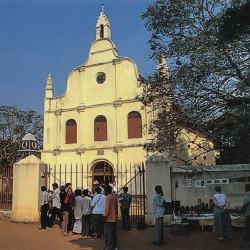 Church of St. Francis, built in 1515, in Cochin. |
She said she feels God is leading her to write tracts when she retires. She has done a couple in Hindi; she wants to do English ones too, so I offered to help with editing.
This school is government-subsidized, so they can't proselytize the children, who come from non-Christian families. However, they sing Christian songs and teach morals with Bible stories - and the walls carry Bible verses in prominent places.
It must work, because as Garry was leaving, the chowkidar (gate guard) excitedly wanted to tell him that 12 years ago he came to Jesus from a background as a high Brahmin.
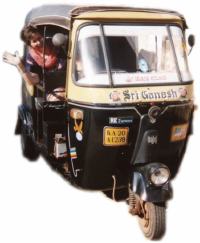
One day, we rode an auto rickshaw to the International Church. There, we found great fellowship with believers from all over the world - even from our hometown of Victoria, B.C.
Gridlock
Going to church was a breeze of a ride with no traffic, cool morning air. On the way home, well - think of a combination of gridlock, car horns, close encounters of the vehicular and pedestrian kind. Let's just say we paid the driver extra for his heroic efforts, then got out and walked. It was faster.
For several days, we stayed in Udupi, Karnataka State, with Mrs. Manorama Acharya and her son Raja. Their house was adorned with local art, antiques and Raja's hunting trophies.
The cape buffalo skull on the wall had two neat holes in the forehead, shot pointblank as the beast was charging Raja. He is a good hunter, registered with the government to kill rogue elephants and tigers, as required.
Raja is a part of the Brahmin community. His mother has exchanged Christmas cards with us for 40 years, and Raja said this had been such a significant friendship for her that he wanted to do all he could for us - including sending us home with a thousand-year-old manuscript written in Old Tulu, which almost no one can read anymore.
Raja took us exploring the countryside, which he knows like his backyard from hunting wild boar and tigers.
These days the forest also has Maoist guerrillas, who rob banks or extort money from the villagers to maintain their lifestyle.
The police were afraid to go into the forest to deal with them, so they dressed Raja up in full police uniform and took him along as their guide for a raid; it probably didn't hurt that he is a crack shot.
Idols
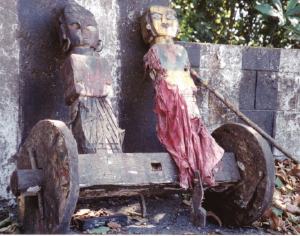
Raja drove us to a wildlife sanctuary, with lots of butterflies and kingfishers; then he suggested we visit Sunset Point. This turned out to be at the top of a 5,000-foot mountain. At the bottom there was a sign: 'Dangerous road ahead! No idol talking to driver' (sic).
Actually, halfway up the mountain there were indeed some idols. These were painted wood figures - one male and the other female - called marie, which means 'evil' in one of the local languages.
Raja explained that when a village experiences an epidemic or some other catastrophe, these dolls are carved - and, with great ceremony, taken to the boundary of the place to remove the evil.
The dolls stay there until the adjoining village has its own catastrophe; then they are moved to the next boundary, and so on; and ultimately, they end in the last village - where they are thrown into the sea. There is an annual Hindu pooja in this area, which centres around an image of one of the gods being thrown into the ocean.
Raja told us a joke about the custom. A Muslim, a Catholic, and a Hindu were in a boat. A severe typhoon arose, and they were all thrown into the water.
The Muslim prayed: "Allah, I have been a good Muslim. I give alms and pray five times a day. Please save me!" Immediately, Allah came down and deposited the Muslim onto the beach.
The Catholic also prayed: "Lord, I have been a good Catholic. I say my Hail Marys and go to mass regularly. Please save me!" Immediately, God scooped up the Catholic and threw him onto the beach.
Finally, the Hindu prayed: "I have been a good Hindu. I have done my poojas and given gifts to the idols. Please save me!" The Hindu deity replied: "You have thrown me into the sea many times. Now you must learn what it feels like - so you are on your own!"
Legacy of Thomas
One highlight of the trip was our visit to the country's oldest European church, in Fort Cochin, Kerala State. It was built by the Portuguese in 1515, and once housed the bones of explorer Vasco da Gama. Having been 'liberated' successively by the Dutch and the British, it is now in the Church of South India denomination, a union of Anglican, Methodist and several other groups.
We attended the English service, with a variety of local and tourist-type people Rev. Jacob's native language - and that of most of his congregation - is Malayalam, the fastest tongue-twisting speech in the world. If there were a contest for speed-reading the liturgy, this group would win!
This part of India has had a Christian presence ever since the Apostle Thomas brought the gospel. Cochin also has a synagogue dating to 1565, but Jewish spice traders have apparently been here ever since the dispersion of the Jews following the destruction of the Jerusalem temple in 70 AD.
Kerala State has the highest proportion of Christians in the land, as well as the highest literacy rate (virtually 100 percent). Every morning, troupes of beautifully uniformed children head off to school. Kerala also consistently elects communists to government. Go figure.
In Panaji (formerly Panjim), an old city in the state of Goa, our hotel was a 300 year old Portuguese mansion. We ate on a second-floor verandah hung with vines, surrounded by palm trees, bougainvillea bushes, and a tree resembling a poinsettia. The inn was located in a warren of narrow, twisting roads and lanes, with European-looking cottages in bright colours everywhere.
Catholic heritage
Almost half the people in Goa are Hindu. There are some Protestants; but the other half of the population are Catholic. We visited a world heritage site composed of a cathedral, several large churches, a convent and a museum - all built by the Portuguese about 500 years ago. They are nice, huge places to cool down.
The high ceilings and stone floors feel very much like European cathedrals, with carvings, frescoes, gilding, candles, genuflecting pilgrims - it's all there. Microphones, and cords draped around the altar for lights, are signs of progress, I suppose.
In one church, we found a pile of hymn books, which turned out to contain many newish evangelical/charismatic songs. We sat in on the end of one mass, which concluded with the singing of several of these pieces, accompanied by an electronic organ.
At our hotel, we met a Naga tribesman from Assam, and asked him if he was a Christian. He said indignantly: "All Nagas are Christians!" After some conversation, we asked him where to find a church. A man next to him started describing how to find a Catholic church, but he said, "Believers church?" We said yes, and he told us where to go. We tried, but our tuk-tuk driver couldn't find the place.
Durga
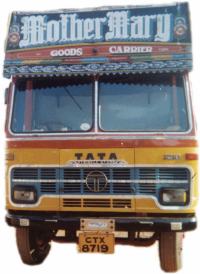
Religion is very blatant here. All the big lorries are painted with elaborate signs; most have a name over the windshield. I did an informal poll, accurate within several points at least three times out of 10, in front of our hotel one morning.
Within 15 minutes, I was able to note the names of 37 trucks as they went by on National Highway 17. While a few had company logos, the most popular name was Durga Prasad (four) with two Durgambas and one Durga Parameshwar. These are obviously Hindu trucks, using variations of Durga - the ferocious tiger-riding devi, or goddess. There were also two Shri Laxmi, two Shri Vijayalaxmi, two Ganesh and several other Hindu names.
There was one Muslim (M. Ismail). Infant Jesus, St. Anthony, King of Kings and Mother Mary made an appearance for the Catholics. Harder to place were Supreme, Elizabeth and Decent; but I really felt Prince of Peace had the message needed for the Indian road.
In Mangalore, we attended an evening meeting of the New India Church of God. This church has three congregations: Malayalam, Kannada, and English. We were both asked to speak, and our messages were translated into Malayalam.
The pastor of the English church gave his testimony. He had been a heroin addict for 14 years. Then he was delivered by Jesus, suffering no withdrawal symptoms.
After the meeting, we met a young Brethren pastor, who had to move to Mangalore from about 20 kilometres away - because he had been beaten by Hindu extremists when his preaching resulted in conversions. One time, he was left unconscious on the road.
Christianity is on the rise here, with many new congregations forming and meeting in hotel facilities. This has the Hindu authorities worried, and they are pressuring the hotels not to rent to Christians. A couple who hosted us have built a room the size of a double garage onto their house so they can have weekly prayer meetings.
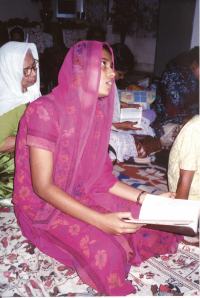
One night, we attended one of their home services. Some 30 Malayalam-speaking people came - mostly young professional families. We were both asked to speak briefly, and then a Campus Crusade worker gave a message in English and Malayalam. Their songs were choruses that we mostly knew, e.g. 'Shine Jesus Shine.'
These Christians are serious about prayer. Each morning and evening they sing, read scripture and pray in their homes. They truly rely totally on the Lord for everything - which is perhaps the most important thing Garry and I learned from this trip.